Fool’s World Map

‘If you can see this map comfortably, you’re definitely a fool,’ say its makers.

vakaworld_snip.gif

This is just part of a map of the world incorporating miscomprehensions about geography (map). It reminds me of Desbladet’s report of an American couple who wanted their money back after a tour to see the midnight sun in Norway because they hadn’t realized they would just ‘see our own sun’.

(Via Boing Boing)

Anti-Vodaphone posters/Plakate gegen Vodaphone

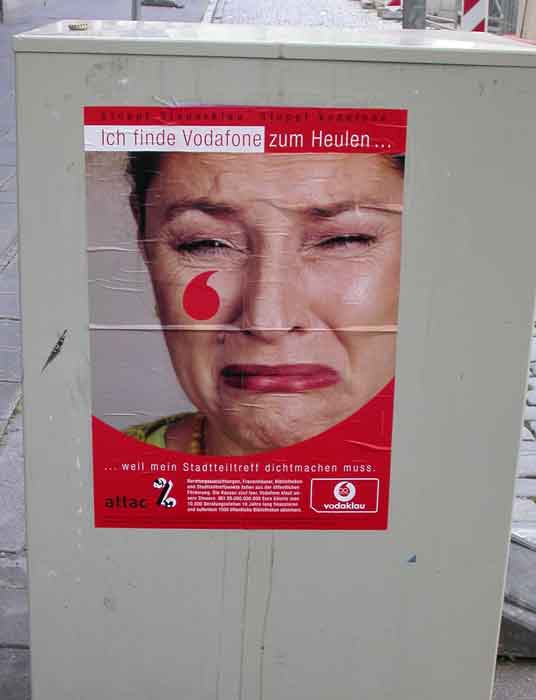
This appeared outside my building a couple of days ago (click to enlarge):

vod1w.jpg

This woman is crying because her local community meeting place (whatever that is) has closed down, and all because Vodaphone is trying to reduce its tax bill.

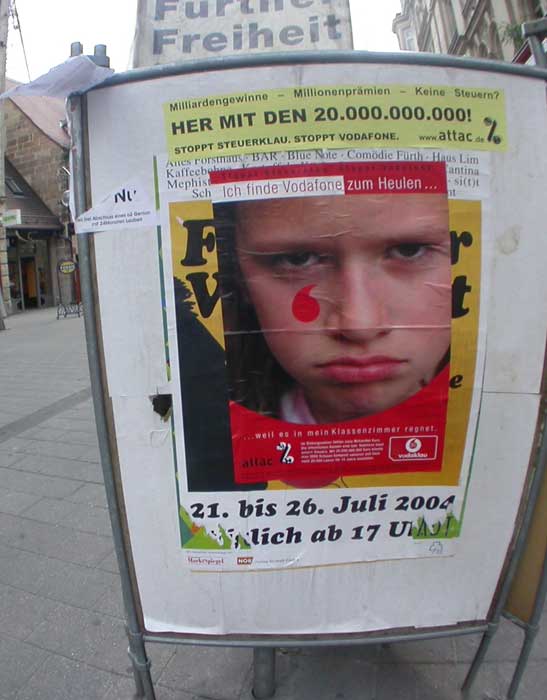
And this appeared round the corner:

vod3w.jpg

It’s raining into this poor child’s classroom. No wonder the Germans are worried about school results.

Here’s the source of the campaign (in German), with other materials for the campaign. Of course, 20 billion is a lot of euros, but I thought companies had a duty to try to reduce their outgoings. I’m also not clear about the direct effect on schools and local community projects funded by the city. I suppose if Vodaphone collapsed and jobs were lost they would complain too. And I wish it was raining here so I could concentrate on my work!

LISA Translation Memory survey

LISA, the Localization Industry Standards Association, is conducting a translation memory survey.

bq. The goals of this survey are to:
. understand the status of deployment of translation memory
. the business value of translation memories and translation memory tools (in-house and off-the-shelf)
. to understand the profile and extent of the usage of the OSCAR/TMX standard within the translation memory market
. and to determine the trends in these areas

(bullet points and syntax by LISA).

bq. This survey will run through till the end of September 2004 and the results will be available for free to the public just like the previous report (http://www.lisa.org/products/survey/2003/tmsurvey.html ).

The survey can be done here.

Statue of Justice as a prostitute/Justiz als Prostituierte in London

BBC News (via Cronaca) reports that the guerrilla artist Banksy has unveiled a 6-metre-high statue of the figure of Justice in London (this ties in with the recent miscarriage of justice story) (see pictures on BBC site):

bq. Banksy, best-known for sneaking his work into the Tate, has depicted the figure of justice as a prostitute with leather boots and a thong.
Several hundred fans gathered at Clerkenwell Green on Wednesday to see the bronze statue being unveiled.
It was put in place at 0200 BST (0100 GMT) on Wednesday without permission.
… It shows the figure of justice – whose statue overlooks the Old Bailey in London – with US dollar bills stuffed into her garter and a plaque on the plinth saying: “Trust no-one.”

Earlier projects of Banksy’s are also described:

bq. In April, Banksy exhibited a dead rat wearing sunglasses in the Natural History Museum for several hours before museum staff noticed.

Personal chattels, chattels personal and the Irish Senate

I may be flogging a dead fish here, but I did want to add a final note of explanation on this topic.

As the diagram in my earlier entry indicates, the term chattels personal is fairly clearly defined in English law and means all property (at least as defined in English property law) except land and leasehold interests. However, personal chattels is a term I only know from the Administration of Estates Act, and it means the personal items someone has at death – it apparently doesn’t include money.

The next question is which of these terms the Irish Senate was dealing with and what it was doing in an Act referring to auctions. I remember that the Times used to quote parliamentary debates and put in brackets ‘Tory cheers’ or ‘Labour laughter’. These hints are missing from the dead fish debate.

Unfortunately the Act in question must have been passed in 1973 so I hold out little hope of finding it online. However, this English – Irish terminology list suggests that in Ireland, chattels personal are called personal chattels (see after chattel real). (I see that a cestui que trust in Irish is cestui que trust).

Looking at the Irish Senate discussion again, I therefore wonder if it was not indeed a red herring (their term) to quote the Administration of Estates Act, which used ‘personal chattels’ to narrow down the meaning of ‘chattels personal’.

I think at this point I have confused myself enough to drop the issue. But Mark Liberman quotes an earlier Language Log post :

bq. Professor Moglen’s article contains this memorable passage:

bq. No one can tell, simply by looking at a number that is 100 million digits long, whether that number is subject to patent, copyright, or trade secret protection, or indeed whether it is “owned” by anyone at all. So the legal system we have … is compelled to treat indistinguishable things in unlike ways.

bq. Now, in my role as a legal historian concerned with the secular (that is, very long term) development of legal thought, I claim that legal regimes based on sharp but unpredictable distinctions among similar objects are radically unstable. They fall apart over time because every instance of the rules’ application is an invitation to at least one side to claim that instead of fitting in ideal category A the particular object in dispute should be deemed to fit instead in category B, where the rules will be more favorable to the party making the claim. This game – about whether a typewriter should be deemed a musical instrument for purposes of railway rate regulation, or whether a steam shovel is a motor vehicle – is the frequent stuff of legal ingenuity. But when the conventionally-approved legal categories require judges to distinguish among the identical, the game is infinitely lengthy, infinitely costly, and almost infinitely offensive to the unbiased bystander.

This seems appropriate and it may be necessary to come back to it in another context.

Fortunately, in the Irish Senate, Mr. Cooney did say that fresh fish and personal chattels will be ‘on all fours’ (perhaps taking poetic licence with this legal phrase).