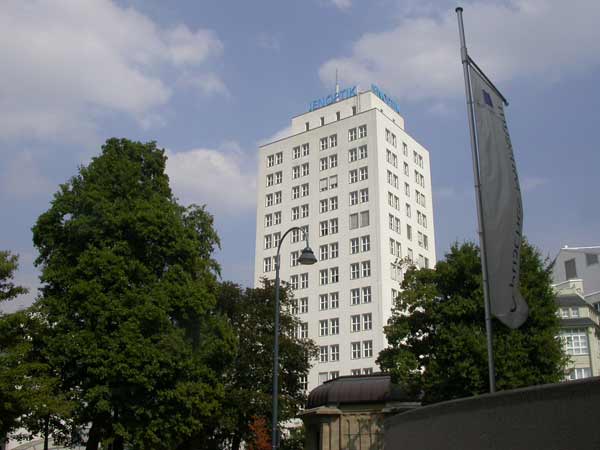
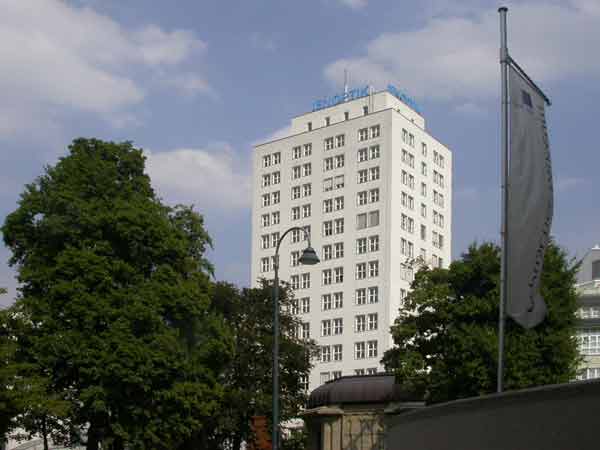
I’ve sometimes translated descriptions of high-rise buildings and I like this one. It was built in 1935 and looks to me as if it still has its original windows. The white is nice, but I have seen a photo on the Internet where it is bare concrete. It is 42 m high. The first photograph is original, the second one corrected on my Nikon Coolpix 4500. I don’t suppose I would buy a Linhof if I could afford one. But I suppose there must be software that does this too. Have I gone too far?
Author Archives: MMarks
Display problems on multilingual websites
The latest issue of Free Pint (August 21), mentioned here before, has an article on the problems of running a multilingual website. The site is in Britain and attempts to offer up-to-date information on benefit law in languages of the local community. The main emphasis is on the advantages of Unicode over PDF. Here is the Multikulti site the article reports on. It includes versions in Arabic, Bengali, Chinese, Farsi, and Gujerati.
Parentheticals in legal writing
Howard Bashman, in How Appealing, has an entry headed You know they’re criminals because they have aliases. He quotes an opinion beginning:
bq. Chittakone Chanthasouxat (Chanthasouxat) and Keopaseuth Xayasane
(Xayasane) (collectively, Defendants) appeal their convictions for drugrelated offenses.
Bashman’s mild query as to whether it was necessary to write “Chanthasouxat” is taken up by Eugene Volokh:
bq. Why do lawyers think it’s helpful to have obvious parentheticals like this? If there is only one Chanthasouxat in the case, people will realize that Chanthasouxat refers to that Chanthasouxat. If there is more than one, then you shouldn’t call either Chanthasouxat. Likewise, there were exactly two defendants in the cases being considered in the opinion; who else would “Defendants” refer to?
Bashman also links to a Findlaw review of Volokh’s new book on academic legal writing.
These parentheticals make me think of the technique in translation of quoting a statute both in German and English to introduce the German abbreviation. This shouldn’t be done slavishly, only as far as is necessary to help the reader.
The use of aliases for criminals reminds me of a report about two shoplifters in Fürth whose names were replaced by aliases – Oleg and Olga. Their nationality was not mentioned.
Juristendeutsch /German legalese strengthening timewords
Udo on law blog quotes a wonderful sentence of German officialese or legalese from der.millo.de’s tax office:
»Ich weise in diesem Zusammenhang auf die Möglichkeit einer ggf. verbösernden Entscheidung hin.«
A websearch reveals quite a number of occurrences of verbösern, especially in tax contexts.
This kind of language is a problem for translators. This one is easy to guess, but not all are. I usually get help from the big 8-volume Duden Das große Wörterbuch der deutschen Sprache (superseded by a ten-volume one) – I see now on CD-ROM. I can’t imagine the officialese in it has changed. It says for verbösern:
bq. (scherzh.): [in der Absicht zu verbessern noch] schlechter machen: durch das Einfügen dieses Absatzes hat er den Artikel nur verbösert…
but for the noun Verböserung it has a second, legal meaning:
bq. (Rechtsspr.) Änderung einer gerichtlichen Entscheidung zuungunsten eines Betroffenen, der gegen die Entscheidung ein Rechtsmittel eingelegt hat.
Corinna Schlüter-Ellner, a German lawyer and Spanish-German translator, has prepared materials on Juristendeutsch – verständlich gemacht. Wendungen und Wörter der Rechtssprache mit Definition oder Übersetzung in die Gemeinsprache und Kontextbeispielen.
There is no website, nor are these materials in a book. They consist of a pack of 32 pages of A4 paper, each with about 15 examples, sold from November 200 for DM 15.00. Contact details and examples: read on. Continue reading
German unfair commercial practices law
Again from IPKAT (on August 19th, but I have only just seen it), an interesting entry with links, headed Unfair Practices, German Style, on the basis of an article in The Lawyer.
ECJ slow translation complaint
IPKAT complains about the delays in receiving translations of ECJ decisions into certain languages.
bq. To give just one example, the Opinion of the Advocate General in Campina Melkunie (the BIOMILD case) has been unavailable in Danish, English and Greek since it was delivered on 31 January 2002. …
bq. The ECJ will say, correctly, that legal translation is a time-consuming, labour-intensive and expensive activity and that someone has to pay for it.
Not only that, but the ECJ needs to train its translators. I did at one time, as a freelance, translate opinions of the German and Austrian Advocates General into English, but afaik the policy is now not to send them out. But German-English is probably not the main bottleneck.