Legal repercussions of anglicisms: Mopsgate

Last week the suffix -gate was chosen as the German Anglicism of the Year 2013. Unusually, this award recognizes the positive contribution of anglicisms to the German language. -gate has been around a long time, even in German, but was particularly common last year.

I seem to have missed Mopsgate (puggate). And this despite the fact that I recently saw two women and six pugs on the corner. This was explained when I traced a pug breeder to a nearby road. Trevor kindly found a collection of German pug quotations for me.

The story is the disappearance of a 6-kilo gold-painted stone figure of a pug from a monument to Loriot, the stage name of Vicco von Bülow, who famously said that life without a pug is possible, but meaningless. The pug figure was placed on a stele by unknown persons, so it was not physically attached nor part of the original monument. It may have been blown off and shattered.

Stuttgart sucht also weiter einen Mops aus Stein, 27 Zentimeter groß und sechs Kilo schwer. Die Polizei kennt den Fall, hat aber nur so lange ermittelt, bis feststand, dass die Figur nicht zum Denkmal gehört. „Das wäre ja dann ein besonders schwerer Fall von Diebstahl“, sagte ein Sprecher. Es liege keine Anzeige vor. „Keine Beschädigten, keine Beschuldigten, keine Straftat – so ist das bei der Polizei.“

There is a lot of literature about pugs in German, not just by Jandl. I remember from Boris Godunov ein Mops kam in die Küche und stahl dem Koch ein Ei, but I am indebted to Trevor for the other link. And apparently Queen Victoria had multiple pugs (why did the Queen descend to corgis?)

Fürther ist Feuer und Flamme für den Kilt

I have to admit I have sometimes thought Franconians were like Scots because they are equally dour. (I’m allowed to say this for reasons of ancestry).

It feels a bit odd, though, to read of a gentleman from Fürth who is fixated on a kilt. And not a sensible kilt with tool pockets but a thing out of tartan. Martha (his surname) seems to equate the English with the Bavarians and regard them as enemies.

Martha ist überzeugt, „dass wir Franken die Schotten Bayerns sind“. Schotten und Engländer würden sich hassen, Bayern und Franken sich auch nicht unbedingt liebhaben, argumentiert er.

He bought his kilt from Andreas Hertl, another Fürth scotophile.

It’s not surprising, then, that there’s at least one Franconian tartan.

August 1997. Designed by (or for?) the Highland Circle – a group of Malt Whisky drinkers in Franconia, Germany. Sample in Scottish Tartans Authority’s Johnston Collection and Lochcarron swatch. Scottish Tartans Society notes say designed by members of the Highland Circle and produced by Hugh MacPherson of Edinburgh. Blue & green lightened to show sett.

There are even Catalan tartans.

The Ballad of Legal Aid

On 6 January there was actually a lawyers’ strike protesting against cuts in criminal legal aid.

For some reason I had missed this wonderful song by a practising barrister: The Ballad of Legal Aid. Watch and listen!

But the topic is a popular one in music, as shown by this clip promoting legal aid in Bangla Desh (the Bengali term is ‘legal aid’, and ‘hotline number’ can also be heard).

Thanks to Trevor

Transblawg hits the big time

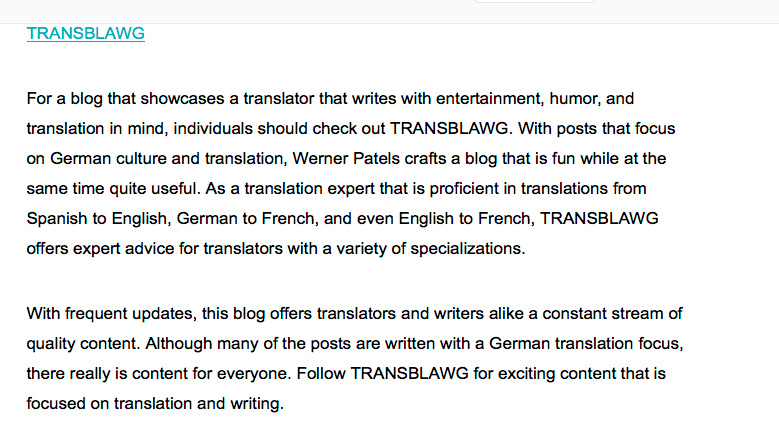
Fame at last! One hour translations have devoted at least an hour to describing Transblawg. Here’s a screenshot – spot the deliberate errors:

Werner has become a political commentator now and I fear he would not be impressed to be described as Transblawg’s author.

It’s unusual for me to get this kind of accolade, since I never get an award as Best Translation Blog or the like (possibly because I don’t advertise the chance of voting for me on the site advertising the competition).

Thanks to Kevin Lossner of Translation Tribulations for this. Sadly his blog didn’t make the list.

Why are litigation letters often so dreadful?

Why are litigation letters often so dreadful?

I picked this old article up from a tweet by Jack of Kent (David Allen Green), the author.

It’s reminiscent of the kind of tone I sometimes hit when translating similar correspondence by German lawyers.

The authors of this dreadful correspondence will invariably profess themselves “surprised” or “astonished” (or even “surprised and astonished”). They are “bewildered” and “confused” and sometimes “shocked”. If any of these assertions were literally true then the dispute resolution departments of many law firms must be in a constant state of noisy hyper-ventilation. It would be close to a national medical emergency.

The comments are good too. Anonymous writes:

David,

I am dismayed and surprised to read this post. The allegations are bewildering when they are not misconceived and illiberal.

I await your response within fourteen days.

I wonder if Rupert Haigh’s Oxford Handbook of Legal Correspondence advises this kind of thing.