Der Fall Collini – translation into English

I am not finished with Der Fall Collini – there will be one more post with miscellaneous notes. But first, the translation into English by Anthea Bell, which I managed to borrow from the London Library. One of the reviews of The Collini Case I found was at the complete review, which seems all to be the work of one Austrian living in the US. lt comments “The terminology does give Bell some trouble”, and says this is not her finest work. It does also comment on how British her translation is, which is not surprising.

I don’t want to run down Bell’s translation, which is very good and does the job, and even if it were not so good, it would certainly be adequate for a reader – OK, translations always lose something, of course. But I wanted to see how the legal terminology would be a problem for her. And in contrast to Schirach’s short stories, this novel has much more to do with lawyers and courts. It follows the training and experience of a young lawyer in the Berlin criminal courts.

I have looked through the translation and found some peculiarities in the legal terms used, which I will try to set out in a table. (The font changes, but at the moment I can’t see how to harmonize it).

It does seem to me that there are some basic legal terms where Bell flounders, for example the meaning of Rechtsprechung or chambers.

  Schirach Bell Comment
  Liste für den Notdienst der Strafverteidigervereinigung legal-aid rota The reference to legal aid here seems odd. The English equivalent would be “duty solicitor”, which might not work here.
  Notdienst der Strafverteidiger, Rechtsanwalt Caspar Leinen. Caspar Leinen here, on standby duty for legal aid  
  Sie wissen, dass Sie nach der Rechtsprechung nur entpflichtet werden können… You know that legally you can be relieved of the duty to give legal aid only if… I have the feeling that Bell thinks “legal aid” means acting as someone’s lawyer – in fact it means financial support given to parties.(This is a difficult term to translate)
  die Kanzlei Leinens Leinen’s chambers Leinen’s office
  junge Anwälte young defence counsels “counsel” is the plural for me, no S
  Rechtsanwalt Caspar Leinen Caspar Leinen, legal adviser Caspar Leinen, Rechtsanwalt, or Caspar Leinen, lawyer
  Ihr erster Schwurgerichtsfall Your first big murder case Good!
  schrieben Anträge wrote their pleas wrote/drafted petitions
  wenn er in dem Mandat bliebe if he stayed in his brief if he remained instructed? not easy
  Post, die kein Richter kontrollieren durfte post uncensored by a magistrate why not judge?
  Strafprozessrecht criminal proceedings criminal procedure
  Die 12. Große Strafkammer – eines der acht Schwurgerichte am Landgericht Berlin – ließ die Anklage wegen Mordes gegen Collini zu The 12th Criminal Court – one of the eight courts of first instance in the Berlin regional judiciary where serious felonies were tried – authorized the arraignment of Collini for murder. Schwurgericht is a court that deals with the most serious criminal offences. 12th Criminal Chamber..eight courts of first instance for serious criminal offences at the Berlin higher Regional Court…indictment (arraignment is OK) Not sure what “judiciary” is doing here.
  ich habe noch eine Besprechung in der Wirtschaftsstrafabteilung I have to see someone in the commercial law department business/commercial crime department
  …dass nach der Rechtsprechung nur die höchste Führung der Nazis Mörder waren …that in juridical terminology only the top Nazi leaders were murderers according to German case law
  nach der Rechtsprechung …die sogenannten Schreibtischtäter waren…alle nur Gehilfen. Keiner von ihnen galt vor Gericht als Mörder p. 181 According to the juridical definition, the people who organized such things from their desks were all just accessories according to German case law …
  Der Empfang für die Besucher war im sogenannten Berliner Zimmer untergebracht, einem großen Raum mit nur einem Fenster, der Vorderhaus mit Seitenflügeln und Rückgebäude verband. Reception for visitors was in the Berlin Room, as it was called, a large room with only one window. It linked the facade to the lateral wings and the back of the building. I find sogenannt superfluous in the German and “as it was called” even worse in the English. I don’t know why Schirach even needed to define a Berliner Zimmer (I keep reading about them – here is a diagram https://www.tip-berlin.de/stadtleben/architektur/berliner-zimmer/ ) This is probably just part of Schirach’s technique of adding lots of trivial details as if these were evidence of authenticity.
  Anwalt der Nebenkläger counsel in the accessory prosecution Romain gives this for Nebenklage, but it might confuse a reader of the English. Hans Meyer was an accessory to murder; this refers to co-prosecution by victims – not easy to translate though.


Ferdinand von Schirach, Der Fall Collini

(This post is a recreation of one that was originally dated 14.11.25 and was lost)

This novel was recently discussed online by the ITI GerNet book group run by Kate Sotejeff-Wilson. I did write a review of it for the ITI Netzblatt, but if anyone likes reading crime fiction, go ahead and try it. It is well paced and easy to read. From the start we know who the murderer was – the novel is about why Collini killed.
Spoilers may follow.

Schirach was a 45-year-old lawyer when he first published fiction. He wrote short real-crime stories, and he also created theatre productions with audience involvement. All were widely translated and globally successful. But this was his first novel.

The novel was well received in the UK and USA. Reviewers liked the plain style. (This huge success outside Germany as opposed to more complex treatment inside reminds me of the praise heaped on Jenny Erpenbeck’s Kairos).
But rather than repeating my own review and giving away most of the story, I am interested in two points which need not hold the reader up.

<!--nextpage-->

Change in German law
Firstly, the main focus of this novel was probably the 1968 German law that changed the time limits for prosecution of accessories to Third-Reich crimes. Suddenly, some time limits were reduced to 20 years, meaning that no prosecutions of these offences could be started later than 1965-ish. Thus, for example, if Italian partisans were killed by Germans as revenge, the only person guilty of murder was the person who ordered the killing; the actual killers were seen as accessories to murder and after twenty years had passed, they were now exempt from prosecution.
Unfortunately, it is not easy to embed this law in a crime novel.
And it would be good for readers first to have an overview of the approach of criminal law to Third-Reich atrocities from the very beginning. In both West Germany and East Germany.
The change in time limits is known as the Dreher-Gesetz, after Eduard Dreher, a former Nazi judge who was an official in the Justice Ministry. It was smuggled into a multi-purpose statute called Einführungsgesetz zum Gesetz über Ordnungswidrigkeiten (Introductory Act to the Act on Administrative Offences), which dealt with criminal offences too. It was mainly intended to decriminalize trivial offences, but in fact it also decriminalized some more serious ones.
This is the subparagraph (Absatz) inserted in 1968, as quoted at the end of the novel:

(2) Fehlen besondere persönliche Eigenschaften, Verhältnisse oder Umstände (besondere persönliche Merkmale), welche die Strafbarkeit des Täters begründen, beim Teilnehmer, so ist dessen Strafe nach den Vorschriften über die Bestrafung des Versuchs zu mildern.

In Andrea Bell’s translation:

2. If none of the special personal qualities, circumstances or conditions (special distinguishing features) forming grounds for the penal liability of the perpetrator of a crime are present in an accessory to it, then the accessory’s penalty is to be mitigated in line with the regulations on the penalty for an attempted crime.

The situation was more complex than stated here, in that the West German parliament was in the process of changing the law on limitation: this subparagraph undermined this process, though it was voted through by the Bundestag in 1968, its effect being downplayed or overlooked.

An excellent and full source of information is Bundeszentrale für politische Bildung – here is an article on this subject, Amnestie von NS-Tätern – Das “Dreher-Gesetz” von 1968.
An article by Richard A. Fuchs, Germany’s Justice Ministry and its Nazi past.
This refers to the Rosenburg files, the 2016 result of an investigation into the change of law initiated by Sabine Leutheusser-Schnarrenberger in 2012, the year after Der Fall Collini was published.

Translation difficulties

Comments on the English translation of the novel follow in the next post.



Basil Markesinis obituaries

Sir Basil Markesinis died on 23 April 2023. There was an obituary in The Times today and in the Daily Telegraph two weeks ago. Telegraph:

The multilingual, cosmopolitan son of a former prime minister of Greece, Markesinis held, successively, the chairs of European Law and then Comparative Law at the University of Oxford, where he founded the Oxford Institute of European and Comparative Law.

Moving to London as Professor of Common and Civil Law at University College (UCL), he established the Institute of Global Law (“exceeded only by galactic”, observed one wag), holding the position simultaneously with a part-time chair at the University of Texas at Austin, where a legal colleague was quoted as describing him as “one active b—-r and as wise as a tree full of owls”.

It was quite an exciting read. If you have access to the Times or the Telegraph, you can see a photo of him wearing red trousers.  I only knew his comparative-law books on The German Law of Contract and The German Law of Torts, both several times revised and updated. I used them a lot but I regret I have never found time to read them at length. But I have long been looking forward to doing so.

Just last week the ITI German Reading Group was reading the novel “Corpus Delicti” by Juli Zeh, who under her real name is an honorary judge (proposed by the SPD) in the constitutional court of Brandenburg. I didn’t think the legal vocabulary in this science fiction novel would be a big problem for translators, but I noticed the term überholende Kausalität and wondered how I would translate it, if it were essential to the plot or to a legal text. And so I looked at Markesinis on the German law of torts. He refers to overtaking causes. An example is a medical practitioner who blinds a patient who would have subsequently become blind in any case. He queries whether overtaking is the less appropriate adjective than overtaken, which is something I was trying to get my own head around.

At all events, those two books are a really full and useful read, with plenty of references to German sources.

Twenty years of Transblawg

I remembered that this blog started on 15 April 2003 so it is now over twenty years old.

First post, 15.04.2003

But looking older. There were other translation blogs and legal blogs (blawgs) at that time, although I think even then blogging was a bit old hat. When I was teaching legal translation at the IFA in Erlangen (which is 75 years old this year), I made my own material and I used to answer other translators’ questions on legal translation in a number of forums. In those days, people were not shy to show their ignorance online, as I think advertising one’s expertise on the internet was a newish thing. I certainly built my business on internet contacts, some of which even preceded the WWW and were made in Unix. I remember the noise of my first modem connection in the mid-90s with excitement.Today I follow a lot of blogs through Feedly, but really there is so much else to read online that I don’t usually feel like researching the background to new items. This blog is almost dead. But I do think it was a good idea to take a narrow focus, on legal translation rather than all kinds of translation.

What is on my radar today?

1. The German Federal Ministry of Justice has published a draft bill to introduce English-language commercial courts in Germany.

I’ve blogged on this issue on and off since 2010.

A number of Länder have introduced English-language courts, but this is the first federal initiative I can remember.

One problem with the bill is that appeal to the Federal Court of Justice (Bundesgerichtshof) is always to be possible, and that court may decide either in English or in German. This is unlikely to be attractive to international parties. Decisions at all levels are to be translated into and published in German.

I’d just like to say something about the ability of German judges to speak English. I recall hearing that some judges think their English is very good or are married to native speakers of English, and being very keen to be involved in an English-language case, possibly for reasons of prestige. In the only case I have heard a detailed report of (by a translator colleague who sat in on it), none of the lawyers or parties were native speakers of English, and they weren’t all Germans either.

At the end of a post in February 2014, I mentioned a case where the court was talking about the term Grundurteil in English. They decided to use the German word, a good idea. It does seem very strange for non-native speakers who have a good understanding of German law to talk in a foreign language about something intrinsically German.

It was a good idea to keep the German term, and I don’t think every judge in that position would have decided to do that. It’s part of the kind of technique that experienced translators and interpreters develop. Another part of that is deciding whether Dietl’s English version is good. (I always prefer Romain, but that doesn’t solve every problem). I got the impression that the judges did not have a critical approach to bilingual dictionaries. You don’t have to be a professional or particularly qualified translator to know these things, but it might help if someone in court does not just “speak good English”, whatever that means.

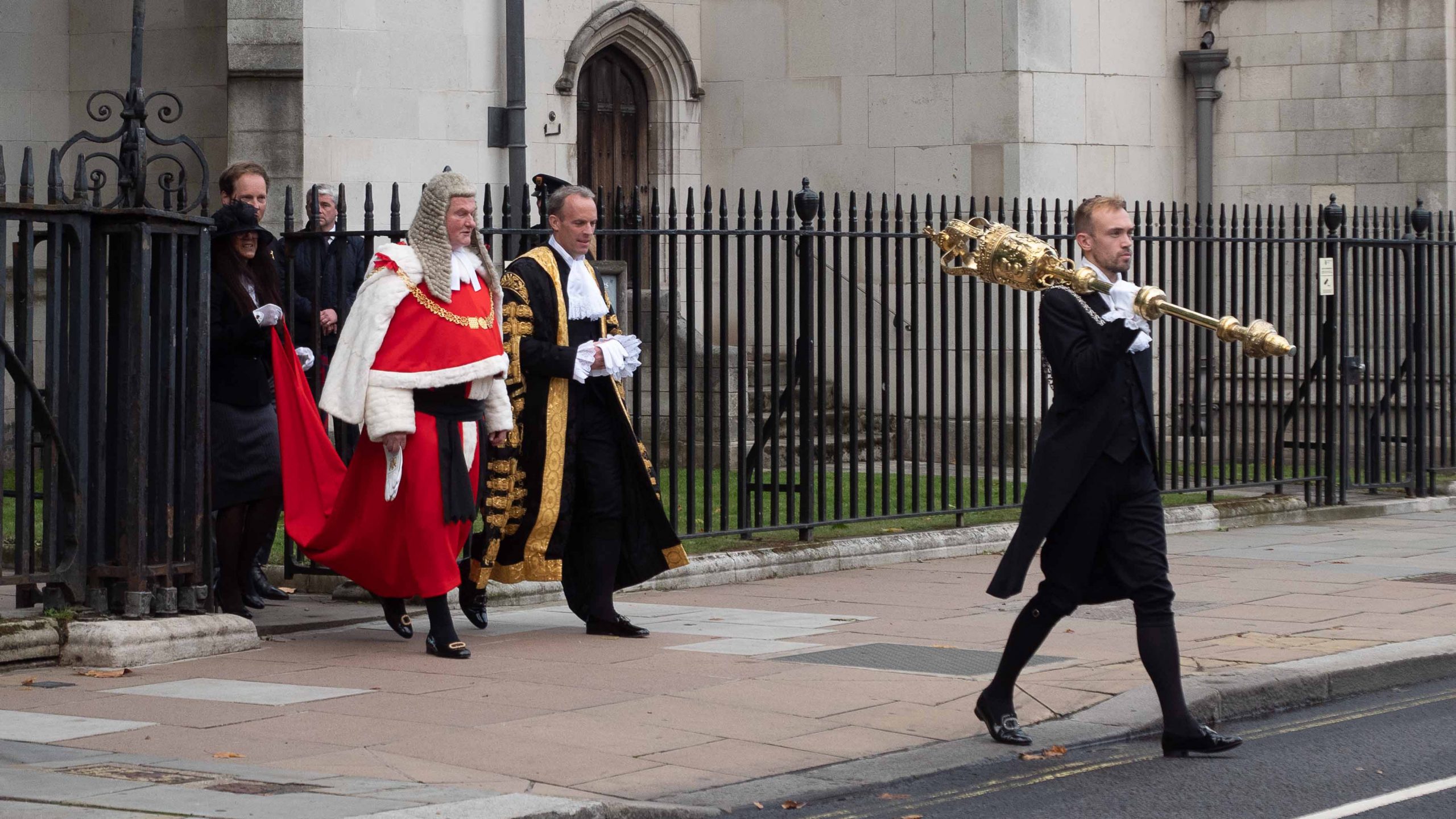
2. Here (again) is one of my photos of Dominic Raab, the second time and hopefully last that he was Lord Chancellor. October 2021.

Machine translation and legal translation

Every time I think I might write about this it seems a drop in the ocean, but then the topic comes up again. Machine translation has become very much better since it was first based on neural networks. In fact, I thought we had departed from rule-based MT and arrived at statistical MT, but we are now on neural MT, excuse my ignorance.

In my experience of using DeepL and DeepL Pro and Google Translate a few times, these systems are very good but not 100% reliable. Which means that sometimes a negative sentence may be rendered as a positive. I have no experience of revising MT output or preparing texts for MT.

But what strikes me specifically about legal texts is that when I put a German text through DeepL, the standard or ‘official’ translations of court names and statute titles are missing, although in Linguee they are present. In the old days, a law firm wanting to use rule-based MT was able to adapt its MT system by filling it with the standard translations into English. Now it is not so, and I would spend a lot of time revising the versions.

This was remarked on in a short article in MDÜ 6/2019 by hans Christian von Steuber. He refers to a talk by Patrick Mustu “Was DeepL & Co. im Zeitalter von 4.0 (noch) nicht können”:

Ein Beispiel aus eminer Erfahrung: Die beliebte “Datenschutzgrundverordnung” wird als “basis data protection regulation” übersetzt, “DSGVO” überhaupt nicht”.

This is the GDPR. It’s always surprising when this is not recognized. And when the translation of a statute title varies within one text.

Another reference was mentioned by colleagues this week. The Swiss Federal Chancellery (Bundeskanzlei) was going to buy licences for 2000 DeepL users in 2019 (UEPO December 2018) and had a review of the effectiveness done (PDF Bericht DeepL-Test). Here an example:

Original text: loi fédérale sur les prestations
de sécurité privées fournies à
l’étranger (LPSP)

DeepL translation: Federal Law on Private Security
Services Abroad (LPSP)

Post-edited text: Federal Act on Private Security
Services Provided Abroad
(PSSA)

I always wonder when I see English versions of abbreviations of statute names recommended. Leaving it in German is odd and so is creating an English version such as PSSA (obviously the work of a human post-editor).

That’s all I have to say about MT and legal translation, but the Swiss test contains a classification of MT problems.

Goodbye to Palandt

Bye-bye, Palandt! – post at the Dispute Resolution Germany blog, on July 27th:

C.H. Beck, Germany’s leading legal publisher, today announced that several of its publications will finally be renamed in light of the Nazi past of the jurists whose names they currently bear. All of these publications are household names for law students and practitioners alike.

The campaign for these names to be changed was pretty much a niche thing for many years and gained traction and public visibility only fairly recently.

I didn’t realize that Palandt was a member of the Nazi party. According to German Wikipedia, Beck Verlag chose him as the editor (of the BGB commentary) at short notice in 1938. Palandt (1877-1951) wrote the foreword and introduction until the tenth edition in 1952. In 1945 he removed the pro-Nazi bits. He was allegedly not responsible for the overall editing.

I haven’t got a Palandt at the moment, but I have sometimes bought reduced-price older editions in Germany and found them very useful, but not predictably frequently. Probably there are ways of consulting it online – it was never very easy as a full-time freelance translator to go to a library to consult it, as time was scarce.

After much criticism, Beck Verlag has eventually decided to change the name from Palandt to Grüneberg. The same fate befalls Maunz, Schönfelder (killed in Italy in 1944) and Blümich (I don’t think I’ve encountered Blümich).