Language weblogs/Sprachblogs

Lexiophiles has expanded its list of blogs to vote for (Top 100 Language Blogs).

The best place to look is the list of nominated blogs for language professionals, where there is a very brief description of each blog in the Language Professionals category.

Transblawg has come up on their radar (my thanks to the unknown promoter). They have Peter Harvey, but not Kalebeul or fucked translations, nor Patenttranslator – and no fidus interpres. So it’s all a bit touch and go, and in any case they are not looking specifically for translation blogs. There are four categories: Language Technology, Language Learning, Language Professionals and Language Teaching.

To find similar lists for the other three categories, start here.

Translation problems in murder trial/Übersetzungsprobleme in Mordverhandlung

Steve at languagehat takes up an article by Janet Malcolm in the New Yorker (abstract available here, full article only on subscription). The subject is a murder trial requiring written translation of an audiotape in Russian and Bukhori (a dialect of Persian spoken by the Bukharian Jews in Central Asia). It seems that the audiotape was difficult to hear and the translator made a number of errors, although there isn’t enough evidence as to why. The biggest misunderstanding was very favourable to the prosecution – one person to another, travelling in a car, saying ‘Are you getting off?’ but translated as ‘Are you going to make me happy?’ – the verb used is described as odd by commenters to the languagehat entry, and was apparently hard to hear anyway.

I haven’t got the full article, but I find some curious features:

One can imagine the translator’s own happiness when he heard those lines—and Leventhal’s when he read them in the transcript.

Leventhal was the main prosecutor. I don’t know why the translator would be happy.

We go through life mishearing and misseeing and misunderstanding so that the stories we tell ourselves will add up. Trial lawyers push this human tendency to a higher level. They are playing for higher stakes than we are playing for when we tinker with actuality in order to transform the tale told by an idiot into an orderly, self-serving narrative.

This raises a number of questions. The prosecution should certainly not be playing for high stakes if this means getting a conviction on the basis of one translated sentence – they would have to have a lot more to convince them. Prosecution should not be about convicting people at all costs. And if two people are in a car, then ‘Are you getting off?’ is not exactly a tale told by an idiot that needs to be reconstrued to make sense.

(I’ve read at least three books by Janet Malcolm, all of which were excellent – most recently ‘Two Lives – Gertrude and Alice’, but here I have not enough to go on).

LATER NOTE (and spoiler): I did actually get the whole article. It’s extremely interesting and is mainly a psychological study of what we know of people in court cases. It’s clear there will be an appeal. The problem with the audiotape transcription strongly suggests this was unreliable evidence, but in the context of the whole, it appears just one piece in the mosaic. One has the impression that the trial was unfair to the defendants and to the defence counsel, but nevertheless that the defendant Borukhova may have been correctly convicted.

DE>EN>DE law dictionary/Karin Linhart, Wörterbuch Recht

I summarized a number of small German-English law dictionaries some time ago. Here’s another one, by Karin Linhart: Wörterbuch Recht, Beck Verlag.

Now a review of this dictionary, in German, by Christine Haselwarter, has appeared in the ADÜ Nord Infoblatt, 2/2010, available online as a PDF at www.adue-nord.de.

As I’ve said before, I don’t think these small dictionaries are so useful for translators, because there are bigger ones available and there is a limit to the number one wants to consult. But they are an ideal size to be carried in a bag, for instance by law students.

This seems to me – on a cursory inspection – a good and reliable dictionary from US legal English into German. It has a number of Infokästchen – boxes on a grey background with extra information – very popular with students and with the review too. For instance, on contingency fees (only US), punitive damages, zealous lawyer (seems to be a US term), jurisdiction (US only) and many more. There are frequent references to US terms that are not translated into German, but cited and explained. In the DE>EN direction, there are fewer boxes.

There is extra material at the end, for example ten rules on how German lawyers should behave ‘im englisch-sprachigen Ausland’. Here I note that Karin Linhart is familiar with US law and South African law, but I don’t know how far her rules apply to all common-law countries. For example, there is no need to use euphemisms when looking for the loo in the UK – in fact, it might be counter-productive. I have my doubts about South Africa too, but I’ve never been there (‘Fragen Sie niemals nach der “Toilet”!).

So without doing a proper full review, I would just like to say I think this dictionary should be seen in an American context, and I think that’s what very many German law students want in any case.

There is another book by Karin Linhart, Englische Rechtssprache – Ein Studien- und Arbeitsbuch. I really must say I have no idea why the book is so huge – A4 with thick paper. The paper may be because one’s supposed to write the answers on it. The nice thing about this book is that it really is full of exercises, with fairly short introductions. It has suggested solutions in the back. Many books on English for lawyers, at least those written for lawyers, have pages and pages of reading and only short exercises, if any. For those who want the terminology first and learn vocabulary in this way, this is an attractive volume. There are many English-German lists and comments on vocabulary too. The book is based on Karin Linhart’s work with students at Würzburg University. (Incidentally, there is a small section on Office Language, quite useful I think, with terms like paperclip, stapler, ring binder, hole punch – this EN>DE list possibly explains the presence of some of the terms the ADÜ dictionary reviewer found superfluous).

LATER NOTE: Richard Schreiber has an entry on this dictionary at the Übersetzerportal.

Football hooligans/Ein Hool

One of Werner Siebers’ clients is a football fan:

Der Mandant ist Fußballfan; nicht Hardcore, nicht Ultra, kein Hool, aber mit Überzeugung.

On Google, there are about 1480 ghits for “ein hool site:de”. It seems to be an abbreviation of hooligan.

I don’t know how long this has been around. There is a 2009 song ‘Meine Mutti ist ein Hool‘, but whether that invented the term, I don’t know.

Easter customs in the UK/Osterbräuche in England

From Süddeutsche Zeitung:

Kätzchen-Tätschler in Großbritannien

In Großbritannien berühren sich die Menschen gegenseitig mit gesammelten Weidenkätzchen, das soll Glück für das nächste Jahr bringen.

‘(At Easter) In Great Britain, people touch each other with pussy willow branches to bring luck for the coming year.’ (Kätzchen: catkins)

Highly mysterious.

It also says, apparently correctly, that in Australia, chocolate bunnies are sometimes replaced by chocolate bilbies – the bilby is a rabbit-sized marsupial which was a victim of the plague of rabbits. See the At the Elephant blog. Mind you, the chocolate rabbit is more of a German thing. I have heard of people in Upminster buying chocolate rabbits at Aldi, though.

Here’s another curiosity from a site in global English:

As a part of Easter tradition, there is a trend among British people to eat yummy hams, in order to commemorate the Easter Sunday.

Surely it takes more than three days to make a ham?

The same site refers to unisex Easter bonnets:

For offering prayers in the church, men and women dress up in their special outfits and as a part of their wardrobe, colorful Easter bonnets embellished with flowers is like a must.

Easter/Ostern

Happy Easter to everyone. Here’s what it looks like in Fürth:

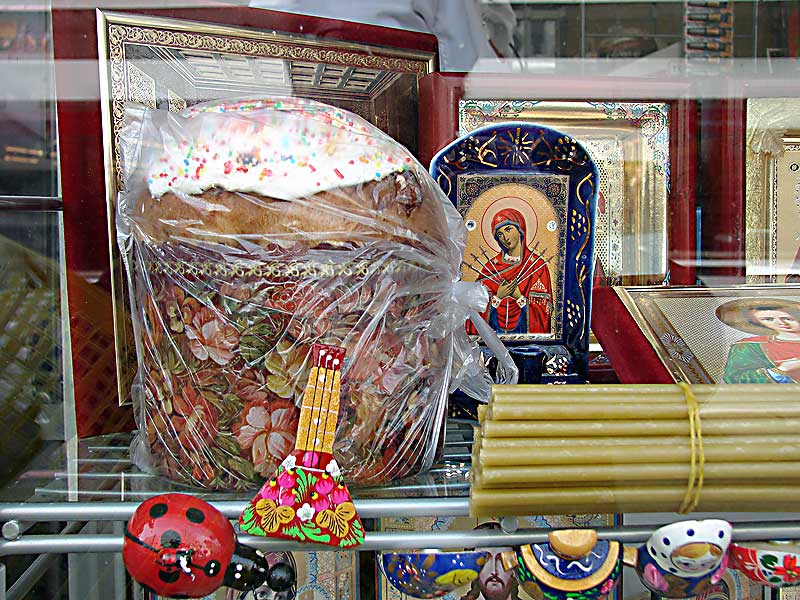
Russian Easter cake (from Russia):

Easter bunny of quark-oil dough:

I was looking for one of these but only found it at Greller’s Backhaus (Fürther Freiheit). The quark and oil yeast dough is very soft and moist. You can find recipes via Google, but most of them are for the baking-powder variety, which I have never tried. Here is a fairly similar recipe (top one with butter and yeast, not bottom one with oil and baking powder) and here is a recipe in German.