Hydrophobic in Hackney

It’s ‘peeback’ time in Shoreditch and Dalston reports the use of paint that urinates back at you. Who first had the idea that Ultra-Ever Dry paint would work like this? Apparently Hamburg beat San Francisco to it.

San Francisco is not the first city to implement urine-repelling paint. The city of Hamburg, Germany has also used the paint and saw a decrease in people who use the streets as a bathroom.

“Based on Hamburg, we know this pilot program is going to work,” Nuru said. “It will reduce the number of people using the walls. I really think it will deter them.”

Lidl: Taste of the Alps

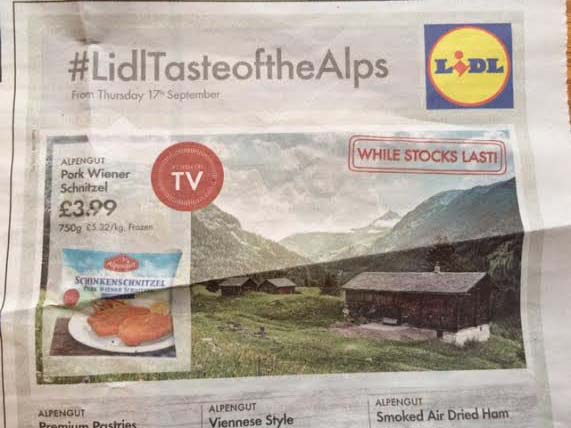
Since yesterday Lidl has had this range available: Lidl: Taste of the Alps.

alpenglut

Upminster is Aldi country rather than Lidl country, although Lidl has been going through a process of gentrification (it’s in the news for paying all its workers in the UK above the minimum wage) and I am urged to get some of their wine offers, but have not yet made it to South Ockendon.

I don’t suppose the web page will be available for ever. It is fuller than what you read in the Evening Standard or see in the video. But it is amazing how far the Alps extend. Who would have thought of the alpine pig in pork schnitzel, to say nothing of Bismarck herrings? Some are labelled Alpengut, which I keep reading as Alpenglut. Kabanos must be from the Polish Alps. Bavarian Brie is less surprising. But what of Meadow Fresh potato salad?

Ford Fiesta

It’s probably an illusion that Hornchurch was named after these horns, but it seems there was a bull’s head and horns on an earlier church.

horns1w

But the Resurrection Window appears to be post-medieval:

resurrection2w

Note computer, Spitfire and car:

resurrectionextw

Details of how to ring and ringers’ jugs at The Bells of Hornchurch.

I was impressed that they were ringing this lunchtime, but was told that it is all about Waterloo, and too jingoistic for my informant.

Getting through to HMRC on the phone

HMRC: Welcome to HM Revenue and Customs. To direct your call to the right place, I’d like to know why you’re calling today. So tell me, in a few words, what’s the reason for your call?
ME: A general VAT enquiry
HMRC: A VAT enquiry – is that right? Yes or no.
Me: Yes.
HMRC: And what is about VAT you’re calling about? You can say things like ‘I want to import a car’, or ‘Why have I received a VAT surcharge notice?’, or even ‘I’ve lost my password for online VAT.’ So go ahead – in a few words, what’s the reason for your call?
Me: I want to know how to charge VAT to the City of XYZ [it has no VAT number].
HMRC: About your payment options, is that right? Yes or no.
Me: No.
HMRC: Sorry, you can say things like ‘I want to import a car’, or ‘Why have I received a VAT surcharge notice?’, or even ‘I’ve lost my password for online VAT.’ So go ahead, tell me, what’s the reason for your call?
Me: How to charge VAT to a customer in Germany.
HMRC: A question about charging VAT outside of the UK – is that right? Yes or no.
Me: Yes.
HMRC: OK. And are you calling as the VAT-registered customer, an agent, an employee of a VAT-registered business, or something else?
Me: The VAT-registered customer. [their computer never understands this although they just offered it as an option]
HMRC: Sorry, which of the following are you calling as? Say: customer, agent, employee, or something else.
Me: Customer.
HMRC: Thank you. You can find lots of useful information about the VAT implications on both the importing and exporting of goods and services within the EU and beyond, as well as information on reclaiming VAT from other EU countries on our website, hmrc.gov.uk/vatinternational. Now, if you would still like to speak to one of our advisers, please hold on a moment and I’ll transfer you. By the way, for quality and security this call might be recorded. [music]

The computer woman’s voice is exaggeratedly helpful and friendly.

The real person I eventually get through to is very helpful, but I have been known to swear during the above dialogue and to be bad-tempered afterwards.

William Townley 1866-1950 – footballer

Another Englishman in Fürth (see William Wilson, earlier entry).

William Townley’s career in the glorious days of Fürth football are well documented:

The following year he was hired by the northern Bavarian club SpVgg Fürth. This club owned the most advanced facilities in Germany and was quickly becoming the largest club in the country with a membership approaching 3,000. Two months after his arrival Fürth lost against English side Newcastle United only 1–2. He guided the club to its first two Bavarian championships (Ostkreismeisterschaft) which heralded the onset of a golden era that would last into the 1930s which saw the club become one of the most dominant football sides in the country.

except for a gap in the First World War:

In December 1913 Townley got the call from Bayern Munich, but on a loan arrangement he re-joined to Fürth in April of the following year to guide the that club through the national championship rounds. In the final Fürth captured its first national title, defeating defending champions VfB Leipzig, holders of a then record three German titles. It is not clear, but he may then have returned to Munich, before the horrors of World War I overtook the continent, obscuring knowledge of Townley’s activities during this period.