Ferdinand von Schirach, Der Fall Collini

(This post is a recreation of one that was originally dated 14.11.25 and was lost)

This novel was recently discussed online by the ITI GerNet book group run by Kate Sotejeff-Wilson. I did write a review of it for the ITI Netzblatt, but if anyone likes reading crime fiction, go ahead and try it. It is well paced and easy to read. From the start we know who the murderer was – the novel is about why Collini killed.
Spoilers may follow.

Schirach was a 45-year-old lawyer when he first published fiction. He wrote short real-crime stories, and he also created theatre productions with audience involvement. All were widely translated and globally successful. But this was his first novel.

The novel was well received in the UK and USA. Reviewers liked the plain style. (This huge success outside Germany as opposed to more complex treatment inside reminds me of the praise heaped on Jenny Erpenbeck’s Kairos).
But rather than repeating my own review and giving away most of the story, I am interested in two points which need not hold the reader up.

<!--nextpage-->

Change in German law
Firstly, the main focus of this novel was probably the 1968 German law that changed the time limits for prosecution of accessories to Third-Reich crimes. Suddenly, some time limits were reduced to 20 years, meaning that no prosecutions of these offences could be started later than 1965-ish. Thus, for example, if Italian partisans were killed by Germans as revenge, the only person guilty of murder was the person who ordered the killing; the actual killers were seen as accessories to murder and after twenty years had passed, they were now exempt from prosecution.
Unfortunately, it is not easy to embed this law in a crime novel.
And it would be good for readers first to have an overview of the approach of criminal law to Third-Reich atrocities from the very beginning. In both West Germany and East Germany.
The change in time limits is known as the Dreher-Gesetz, after Eduard Dreher, a former Nazi judge who was an official in the Justice Ministry. It was smuggled into a multi-purpose statute called Einführungsgesetz zum Gesetz über Ordnungswidrigkeiten (Introductory Act to the Act on Administrative Offences), which dealt with criminal offences too. It was mainly intended to decriminalize trivial offences, but in fact it also decriminalized some more serious ones.
This is the subparagraph (Absatz) inserted in 1968, as quoted at the end of the novel:

(2) Fehlen besondere persönliche Eigenschaften, Verhältnisse oder Umstände (besondere persönliche Merkmale), welche die Strafbarkeit des Täters begründen, beim Teilnehmer, so ist dessen Strafe nach den Vorschriften über die Bestrafung des Versuchs zu mildern.

In Andrea Bell’s translation:

2. If none of the special personal qualities, circumstances or conditions (special distinguishing features) forming grounds for the penal liability of the perpetrator of a crime are present in an accessory to it, then the accessory’s penalty is to be mitigated in line with the regulations on the penalty for an attempted crime.

The situation was more complex than stated here, in that the West German parliament was in the process of changing the law on limitation: this subparagraph undermined this process, though it was voted through by the Bundestag in 1968, its effect being downplayed or overlooked.

An excellent and full source of information is Bundeszentrale für politische Bildung – here is an article on this subject, Amnestie von NS-Tätern – Das “Dreher-Gesetz” von 1968.
An article by Richard A. Fuchs, Germany’s Justice Ministry and its Nazi past.
This refers to the Rosenburg files, the 2016 result of an investigation into the change of law initiated by Sabine Leutheusser-Schnarrenberger in 2012, the year after Der Fall Collini was published.

Translation difficulties

Comments on the English translation of the novel follow in the next post.


Lawyers using dictionaries: a guide

Terrence R. Carney, of the University of South Africa, has published Linguistics for Legal Translation (thanks to Juliette Scott in her From Words to Deeds blog). The book can be downloaded free of charge as a PDF.

The book is intended not for scholars of linguistics but for legal practitioners.

The focus is statutory interpretation, though constitutional interpreters and interpreters of contracts might also gain from this text. Furthermore, I wrote the book specifically for those who must clarify lexical semantic and pragmatic meaning contested in case law, but who have no official training in linguistics or language studies. More precisely, the book aims at providing a resource for those who attempt forensic lexicological investigations in order to resolve legal disputes.

The book has a particular interest in the use of dicionaries and legal corpora. It is rather strange to read case reports where judges alight on a particular dictionary – whether monolingual or bilingual – and treat it as gospel. So one may hope that some of them come across this book and have time to read it.


Englisch als Vertragssprache/Zieltexter.de

I have mentioned the book Englisch als Vertragssprache by Triebel and Vogenauer before. I have now found a detailed description by Annika Kunstmann in German in Zieltexter.de:

Das Buch „Englisch als Vertragssprache“ von Dr. Volker Triebel und Prof. Stefan Vogenauer, erschienen 2018 im Verlag C. H. Beck, München, beschäftigt sich mit englischsprachigen Verträgen und der Erkenntnis, dass solche gerade bei Geltung deutschen Rechts zu mehr Missverständnissen, Fehlerquellen und Fallstricken führen können, als dies bei deutschen Vertragstexten der Fall ist.

There is more.

Zieltexter.de is an online publication by ADÜ Nord, following the closure of the print Infoblatt. I missed Richard Schneider’s announcement at uepo.de.

Von Amts wegen

I was always pleased with myself when I recognized whether von Amts wegen was to be translated as ex officio or as of (the court’s) own motion.

But I never asked myself why. Recently, someone has asked why!

It seems that the term ex officio is used in more situations in German than in English. Here is the von Beseler/Jacobs-Wüstefeld dictionary of 1991 on von Amts wegen:


ex officio, by virtue of (one’s) office; because of one’s position; officially; proprio motu (Lat.); upon (of its) own motion; upon/of the court’s (own) motion; in ordinary

I think if someone does something by virtue of their office, ex officio works. But if a court comes to a decision, perhaps because it usually deliberates about it, then of its own motion is appropriate.

I looked up both expressions in the big Oxford English Dictionary, but they don’t add anything much to this.

I have one other excellent law dictionary but I don’t speak much Italian so I have never read the introduction, which I am sure is wonderful. I must scan it and run it through DeepL. It is by, Francesco de Franchis, Dizionario Giuridico English-Italian, 1984

He even says where ex officio would not be used in English. It is the bilingual law dictionary every translator wants, but it is in the wrong language.

Di ufficio; si dice, ad es., che il Lord Chancellor (v.) è un giudice della Court of Appeal ex officio, come pure il President della Chancery Division e il Lord Chief Justice. Ma si noti che quando si vuole alludere ad una iniziative di ufficio e ad una istanza di parte si parla, rispettivamente, di suo officio e di its own motion e di at the instance of the parties.


Basil Markesinis obituaries

Sir Basil Markesinis died on 23 April 2023. There was an obituary in The Times today and in the Daily Telegraph two weeks ago. Telegraph:

The multilingual, cosmopolitan son of a former prime minister of Greece, Markesinis held, successively, the chairs of European Law and then Comparative Law at the University of Oxford, where he founded the Oxford Institute of European and Comparative Law.

Moving to London as Professor of Common and Civil Law at University College (UCL), he established the Institute of Global Law (“exceeded only by galactic”, observed one wag), holding the position simultaneously with a part-time chair at the University of Texas at Austin, where a legal colleague was quoted as describing him as “one active b—-r and as wise as a tree full of owls”.

It was quite an exciting read. If you have access to the Times or the Telegraph, you can see a photo of him wearing red trousers.  I only knew his comparative-law books on The German Law of Contract and The German Law of Torts, both several times revised and updated. I used them a lot but I regret I have never found time to read them at length. But I have long been looking forward to doing so.

Just last week the ITI German Reading Group was reading the novel “Corpus Delicti” by Juli Zeh, who under her real name is an honorary judge (proposed by the SPD) in the constitutional court of Brandenburg. I didn’t think the legal vocabulary in this science fiction novel would be a big problem for translators, but I noticed the term überholende Kausalität and wondered how I would translate it, if it were essential to the plot or to a legal text. And so I looked at Markesinis on the German law of torts. He refers to overtaking causes. An example is a medical practitioner who blinds a patient who would have subsequently become blind in any case. He queries whether overtaking is the less appropriate adjective than overtaken, which is something I was trying to get my own head around.

At all events, those two books are a really full and useful read, with plenty of references to German sources.

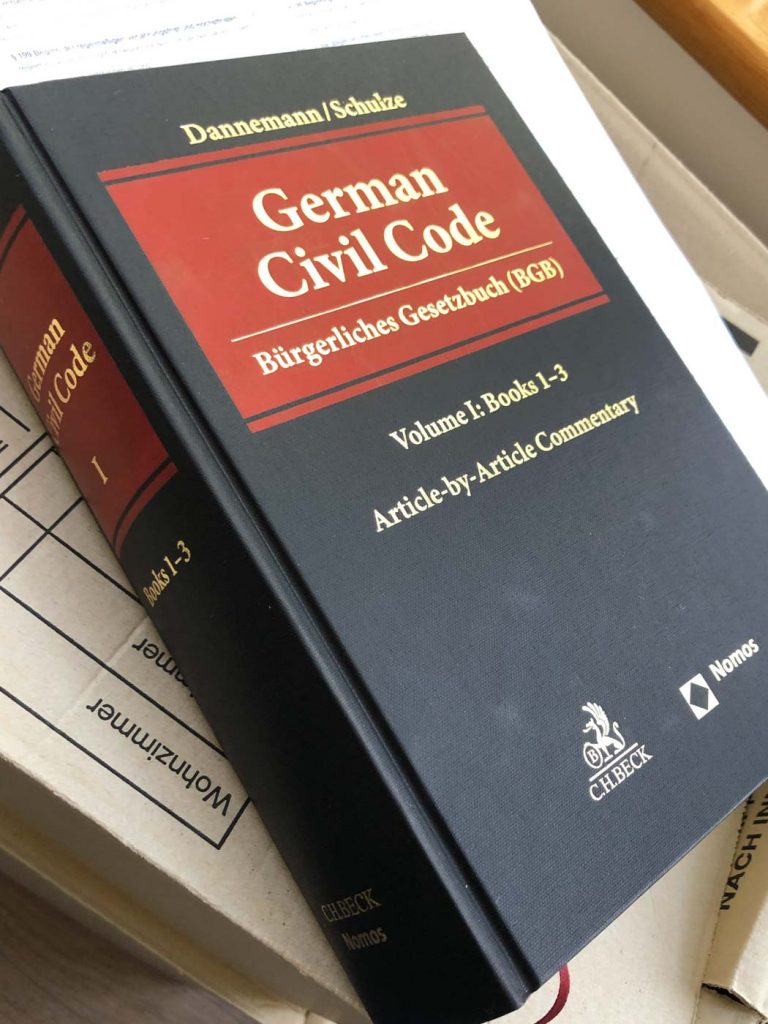
German Civil Code – Books 1 – 2 Commentary

Dannemann/Schulze: German Civil Code Volume I: Books 1 – 3 Article-by-Article (sic) Commentary

This is a huge thick tome which has just appeared. You might like to have a copy, although you might not like to pay the justified price of over £200 for it.

About 40 authors and over 2300 pages. Here’s the blurb at Beck Verlag.

  1. There are many so-called official English translations of German statutes online. Some are here: https://www.gesetze-im-internet.de/Teilliste_translations.htm

But you can often find translations elsewhere. Austrian and Swiss statutes are similarly available.

There used to be an official site linking translations elsewhere (only as long as the German statutes were current, although translators and lawyers do sometimes need earlier versions). Sadly that cgerli site, cited at the bottom of the opening page of this blog, now only links to hotels in Salzburg. Before that, Robin Stocks used to keep a collection, but I think it would be too much for him and me to resurrect/update it.

There is a side-by-side translation of the new post-2002 bits by Gerhard Dannemann online at the German Law Archive.

The online translation of the BGB is thus described:

Übersetzung durch ein Übersetzer-Team des Langenscheidt Übersetzungsservice. Laufende Aktualisierung der Übersetzung durch Neil Mussett.
Translation provided by the Langenscheidt Translation Service. Translation regularly updated by Neil Mussett.

It only goes as far as the 2013 update of the German original.

2. The Dannemann/Schulze commentary quotes this online translation, plus its own versions of the post-2013 sections. It does not like the translation but I assume foreign lawyers would be confused if the online version, which they sometimes pass on to clients, were different. And it has the great advantage that the authors can point out which bits of the translation they don’t like. I have not yet many examples, as I have not had time to look very closely, but for example, the general part now includes Unternehmer and Verbraucher, which the online translation calls entrepreneur and consumer. The notes show how complex the situation is: the EU directives use the term trader. Dannemann has an online translation of the new parts of the BGB post-2002 and uses businessperson, which I like. The Commentary notes:

The definition of entrepreneur (Unternehmer) is of central relevance…Even though the German word is identical, it must be distinguished from Unternehmer as used in §§ 631 et seq.

By the way, I don’t understand why section 14, in theory identical to the online translation, capitalizes the word partnership:

An entrepreneur means a natural or legal person or a Partnership with legal personality who or which, when entering into a legal transaction, acts in exercise of his or its trade, business or profession.

The online BGB translation is often criticized by translators, but they can’t usually give examples of what they mean. Nor do I feel able to criticize them off the cuff – it’s only on the rare occasions when a specific section is problematic that it strikes me. I am giving the Unternehmer example to show how useful a commentary is.

3. Why does it say on the cover and title page “Article-by-Article Commentary”? Surely these are sections in English?

4. I love German commentaries. They are huge tomes with all sorts of details on the law, section by section. If you really need details on this Code, are not near a German law library and find this volume too expensive, I would recommend buying a used copy of Palandt’s commentary in German. Not dated before 2002, when the Code was greatly changed, but it need not be new. Here’s a screenshot from abebooks today, showing you could get the 2007 version most cheaply. There are later ones available too. I used to pick one up at a students’ bookshop in Germany.

It would answer most questions of the meaning of the Code.

5. This commentary is intended for English-speaking lawyers who know little German or little German law. It has a full introduction putting the Code in historical context. Each section has the original German (dated 2018 I think), the online translation and a number of notes under subheadings. There may be notes on the translation and on EU law.

6. I should repeat what I’ve written before, that the terminology of the BGB is consistent in what now seems an unnatural way. Many criticisms of the translations are based on a misunderstanding – they find a term unnatural and don’t realize it has to be consistent throughout, just like the original. This is why, as I’ve written before too, there must be footnotes. And this volume more than generously provides them.