I have mentioned the book Englisch als Vertragssprache by Triebel and Vogenauer before. I have now found a detailed description by Annika Kunstmann in German in Zieltexter.de:
Das Buch „Englisch als Vertragssprache“ von Dr. Volker Triebel und Prof. Stefan Vogenauer, erschienen 2018 im Verlag C. H. Beck, München, beschäftigt sich mit englischsprachigen Verträgen und der Erkenntnis, dass solche gerade bei Geltung deutschen Rechts zu mehr Missverständnissen, Fehlerquellen und Fallstricken führen können, als dies bei deutschen Vertragstexten der Fall ist.
There is more.
Zieltexter.de is an online publication by ADÜ Nord, following the closure of the print Infoblatt. I missed Richard Schneider’s announcement at uepo.de.
I was always pleased with myself when I recognized whether von Amts wegen was to be translated as ex officio or as of (the court’s) own motion.
But I never asked myself why. Recently, someone has asked why!
It seems that the term ex officio is used in more situations in German than in English. Here is the von Beseler/Jacobs-Wüstefeld dictionary of 1991 on von Amts wegen:
ex officio, by virtue of (one’s) office; because of one’s position; officially; proprio motu (Lat.); upon (of its) own motion; upon/of the court’s (own) motion; in ordinary
I think if someone does something by virtue of their office, ex officio works. But if a court comes to a decision, perhaps because it usually deliberates about it, then of its own motion is appropriate.
I looked up both expressions in the big Oxford English Dictionary, but they don’t add anything much to this.
I have one other excellent law dictionary but I don’t speak much Italian so I have never read the introduction, which I am sure is wonderful. I must scan it and run it through DeepL. It is by, Francesco de Franchis, Dizionario Giuridico English-Italian, 1984
He even says where ex officio would not be used in English. It is the bilingual law dictionary every translator wants, but it is in the wrong language.
Di ufficio; si dice, ad es., che il Lord Chancellor (v.) è un giudice della Court of Appeal ex officio, come pure il President della Chancery Division e il Lord Chief Justice. Ma si noti che quando si vuole alludere ad una iniziative di ufficio e ad una istanza di parte si parla, rispettivamente, di suo officio e di its own motion e di at the instance of the parties.
Sir Basil Markesinis died on 23 April 2023. There was an obituary in The Times today and in the Daily Telegraph two weeks ago. Telegraph:
The multilingual, cosmopolitan son of a former prime minister of Greece, Markesinis held, successively, the chairs of European Law and then Comparative Law at the University of Oxford, where he founded the Oxford Institute of European and Comparative Law.
Moving to London as Professor of Common and Civil Law at University College (UCL), he established the Institute of Global Law (“exceeded only by galactic”, observed one wag), holding the position simultaneously with a part-time chair at the University of Texas at Austin, where a legal colleague was quoted as describing him as “one active b—-r and as wise as a tree full of owls”.
It was quite an exciting read. If you have access to the Times or the Telegraph, you can see a photo of him wearing red trousers. I only knew his comparative-law books on The German Law of Contract and The German Law of Torts, both several times revised and updated. I used them a lot but I regret I have never found time to read them at length. But I have long been looking forward to doing so.
Just last week the ITI German Reading Group was reading the novel “Corpus Delicti” by Juli Zeh, who under her real name is an honorary judge (proposed by the SPD) in the constitutional court of Brandenburg. I didn’t think the legal vocabulary in this science fiction novel would be a big problem for translators, but I noticed the term überholende Kausalität and wondered how I would translate it, if it were essential to the plot or to a legal text. And so I looked at Markesinis on the German law of torts. He refers to overtaking causes. An example is a medical practitioner who blinds a patient who would have subsequently become blind in any case. He queries whether overtaking is the less appropriate adjective than overtaken, which is something I was trying to get my own head around.
At all events, those two books are a really full and useful read, with plenty of references to German sources.
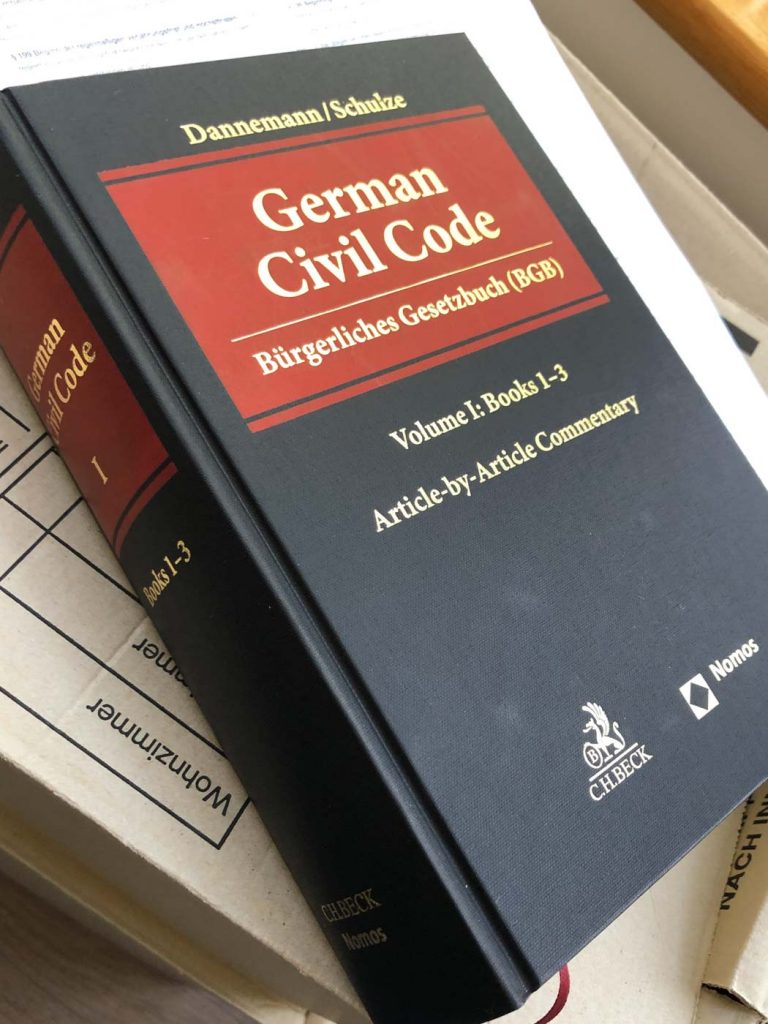
This is a huge thick tome which has just appeared. You might like to have a copy, although you might not like to pay the justified price of over £200 for it.
About 40 authors and over 2300 pages. Here’s the blurb at Beck Verlag.
But you can often find translations elsewhere. Austrian and Swiss statutes are similarly available.
There used to be an official site linking translations elsewhere (only as long as the German statutes were current, although translators and lawyers do sometimes need earlier versions). Sadly that cgerli site, cited at the bottom of the opening page of this blog, now only links to hotels in Salzburg. Before that, Robin Stocks used to keep a collection, but I think it would be too much for him and me to resurrect/update it.
There is a side-by-side translation of the new post-2002 bits by Gerhard Dannemann online at the German Law Archive.
Übersetzung durch ein Übersetzer-Team des Langenscheidt Übersetzungsservice. Laufende Aktualisierung der Übersetzung durch Neil Mussett. Translation provided by the Langenscheidt Translation Service. Translation regularly updated by Neil Mussett.
It only goes as far as the 2013 update of the German original.
2. The Dannemann/Schulze commentary quotes this online translation, plus its own versions of the post-2013 sections. It does not like the translation but I assume foreign lawyers would be confused if the online version, which they sometimes pass on to clients, were different. And it has the great advantage that the authors can point out which bits of the translation they don’t like. I have not yet many examples, as I have not had time to look very closely, but for example, the general part now includes Unternehmer and Verbraucher, which the online translation calls entrepreneur and consumer. The notes show how complex the situation is: the EU directives use the term trader. Dannemann has an online translation of the new parts of the BGB post-2002 and uses businessperson, which I like. The Commentary notes:
The definition of entrepreneur (Unternehmer) is of central relevance…Even though the German word is identical, it must be distinguished from Unternehmer as used in §§ 631 et seq.
By the way, I don’t understand why section 14, in theory identical to the online translation, capitalizes the word partnership:
An entrepreneur means a natural or legal person or a Partnership with legal personality who or which, when entering into a legal transaction, acts in exercise of his or its trade, business or profession.
The online BGB translation is often criticized by translators, but they can’t usually give examples of what they mean. Nor do I feel able to criticize them off the cuff – it’s only on the rare occasions when a specific section is problematic that it strikes me. I am giving the Unternehmer example to show how useful a commentary is.
3. Why does it say on the cover and title page “Article-by-Article Commentary”? Surely these are sections in English?
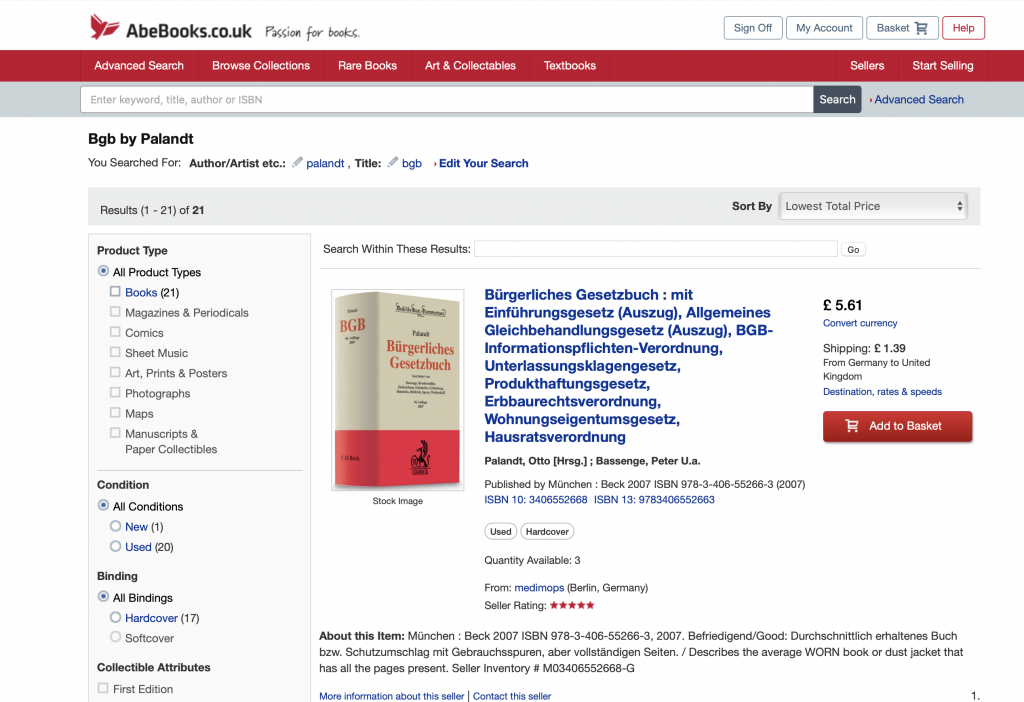
4. I love German commentaries. They are huge tomes with all sorts of details on the law, section by section. If you really need details on this Code, are not near a German law library and find this volume too expensive, I would recommend buying a used copy of Palandt’s commentary in German. Not dated before 2002, when the Code was greatly changed, but it need not be new. Here’s a screenshot from abebooks today, showing you could get the 2007 version most cheaply. There are later ones available too. I used to pick one up at a students’ bookshop in Germany.
It would answer most questions of the meaning of the Code.
5. This commentary is intended for English-speaking lawyers who know little German or little German law. It has a full introduction putting the Code in historical context. Each section has the original German (dated 2018 I think), the online translation and a number of notes under subheadings. There may be notes on the translation and on EU law.
6. I should repeat what I’ve written before, that the terminology of the BGB is consistent in what now seems an unnatural way. Many criticisms of the translations are based on a misunderstanding – they find a term unnatural and don’t realize it has to be consistent throughout, just like the original. This is why, as I’ve written before too, there must be footnotes. And this volume more than generously provides them.
Katrin Fitzherbert’s autobiography won a prize for autobiography in 1997. I only heard of it recently and picked it up second-hand. It’s subtitled A Family Memoir of Germany and England in two World Wars.
TRUE TO BOTH MY SELVES is an extraordinary account of a childhood disjointed by country and by war. Curiously mirroring her English grandmother, who married a German hairdresser in London and was then expelled to Germany following the First World War, Katrin Fitzherbert was born in Germany in 1936 and lived under Hitler’s regime until, at the age of eleven, she was suddenly ‘repatriated’ to an England she had never known. There she had to forget her German father and the German language. This is the story of three generations of remarkable women, and their struggle for survival and integrity as individuals in times divided by war.
This is a readable and honest account of some parts of English and German history I know only skeleton facts about – what it was like living through WWII as a child who supported the system and then being told to pretend she had been born in London (for fear of the 1918-type repercussions), that after WWII the English tended to see all Germans as either villains or victims, the psychological pressure when no one in her family had any understanding of what it was like having to hide half of one’s own history.
The blurb on the book says:
Katrin FitzHerbert was born in Germany in 1936. She was educated at fourteen schools in Germany and England and read PPE at St. Anne’s College, Oxford. She has been a journalist, an anthropologist, and trained and worked as a psychiatric social worker. She is the founder and director of the National Pyramid Trust, a charity promoting self-esteem and resilience in primary-school children. She is married, has two daughter, and lives in London and Totnes.
At the moment I use only the Dietl/Lorenz law dictionary on the Acolada platform. I more often use Romain on paper (despite the time it takes to look things up). I actually wore out the latest Romain so I bought a copy of the earlier (1994) edition. The later one had feminine and masculine versions of all German nouns where this was relevant, but I didn’t need to look up Anwalt and Anwältin myself.
When there is a new paper version of Dietl/Lorenz (with CD for both directions – currently promised for 2020), I don’t expect it will contain versions of all the latest legal terminology, but that can be found on the Web nowadays – there are quite a few law firms’ sites with a variety of options. Gradually paper dictionaries are whittled down to a few useful ones.
I always used to have an up-to-date version of Creifelds German law dictionary, and now I see that it could be put on the computer and consulted along with Dietl/Lorenz. I read this in the Acolada newsletter. Creifelds Rechtswörterbuch.
I noticed while researching this that Beck Verlag promises another book in the form of a German-English legal dictionary for 2020: This has the perhaps misleading title Rechtsenglisch and is by Rinscheid and Miller. It is as so often for anyone, including judges in (German) English-language courtrooms. It contains sentence examples and is organized both alphabetically and also thematically, so that a lawyer can learn the relevant vocabulary, for example before a client conference. I’d love to be a fly on the wall.
Zum Werk Die fachgerechte Formulierung deutscher Rechtsberatung in englischer Sprache erfordert mehr als lediglich die Übersetzung einzelner Rechtsbegriffe. Die schnell zugänglichen Online- Wörterbücher scheinen nur auf den ersten Blick eine verlässliche Abhilfe bei der kontextgerechten Verwendung eines Rechtsbegriffs zu bieten. Mit der Vokabel allein ist schließlich noch keine Korrespondenz mit dem Mandanten geführt, kein Schriftsatz geschrieben und auch keine vernünftige Hilfestellung für eine Telefonkonferenz gegeben. Konsequenz ist eine häufig unreflektierte Verwendung von Übersetzungsvorschlägen mit in der Folge fehlerhafter Darstellung. Die Autoren des vorliegenden Werkes schließen eine wichtige Lücke, in dem sie dem international arbeitenden Juristen eine umfassende Arbeitsgrundlage zur Verwendung der englischen Rechtssprache liefern. Hierzu ist das Werk auf drei Säulen aufgebaut. Erstens enthält das Werk ein alphabetisch sortiertes Glossar mitsamt Beispielssätzen, Erläuterungen und Hinweisen zur kontextgerechten Verwendung (Deutsch-Englisch). Zweitens sind die Begriffe zusätzlich thematisch sortiert – so kann sich der Rechtsanwender mit den in einem speziellen Sach- oder Rechtsgebiet geläufigen Vokabeln vertraut machen, beispielsweise vor einer Mandantenbesprechung. Die dritte Säule bilden Formulierungshilfen und Textbausteine für die Praxis (Emails, Schriftsätze, Telefonkonferenzen etc.). Vorteile auf einen Blick Das vorliegende Buch bietet – ein klassisches zweisprachiges Nachschlagewerk/Wörterbuch mit Beispielsätzen, Erläuterungen und Hinweisen – zusätzlich die Möglichkeit einer nach Sach- und Rechtsgebieten geordneten Suche – Englische Formulierungshilfen aus der Praxis Zielgruppe Für international tätige Anwälte und Unternehmensjuristen, Richter in englischsprachigen Kammern, Juristische Fachübersetzer, Studierende der Fachspezifischen Fremdsprachenausbildung, Universitäten und Forschungseinrichtungen.