Books on legal writing in English

There are many useful books for lawyers on how to write better legal English. How useful they are for translators is another matter. By all means, if you have time, work through some of the suggestions on legal writing (an internet search for ‘drafting’ is also a good idea). Consider whether you mind whether the book is for British or U.S. or another form of legal English.

But as I suggested in the post on virtual synonyms, when translating into English you can’t simplify at will. Consequently we tend to spend more time researching specific law and language problems than taking the wider view.

As a member of the BDÜ it probably doesn’t behoove me to look at the publications of the BDÜ Fachverlag with as much suspicion as I do, but I’ve never recovered from how a colleague salivated over a book on how to translated GmbH articles into English. The book was a student’s work written for a non-lawyer lecturer and was full of problems. But then, caveat emptor.

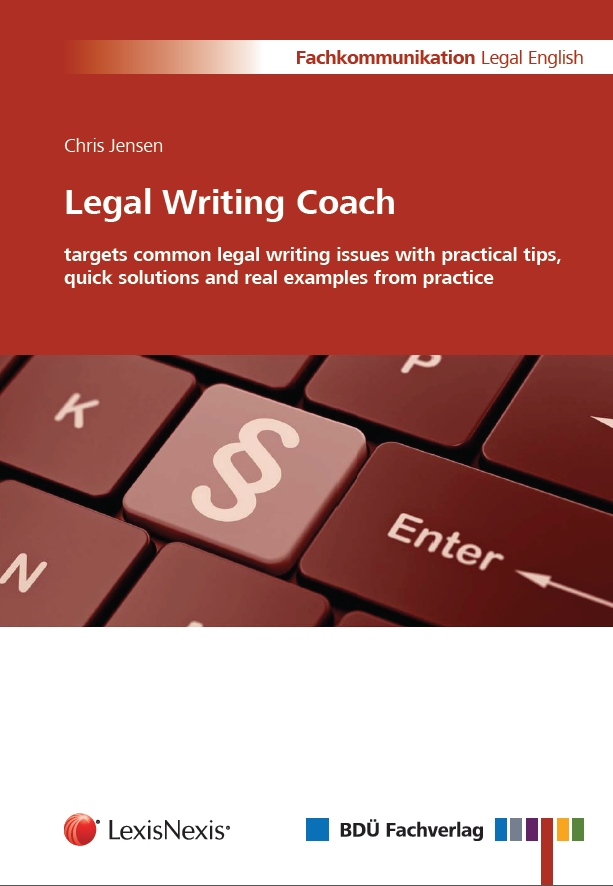
The latest book advertised to me is probably not at all bad, in fact it may be good, but is it a book for lawyers on how to write legal English or does it address translators into English too?

LegalWritingcoach_Titelbild

I couldn’t trace the LexisNexis edition, but what is that keyboard on the cover telling us? I suppose it is implying that there is a German element.

I am told (my emphasis):

Wenn Sie juristische Texte ins Englische übersetzen, dann kann ich Ihnen die jüngste Neuerscheinung aus dem BDÜ Fachverlag ans Herz legen, den „Legal Writing Coach“ – eine Sammlung von leicht verwendbaren Materialien, die an das begrenzte Zeitbudget von vielbeschäftigten Anwälten und Übersetzern angepasst ist. Der „Legal Writing Coach“ basiert auf der langjährigen internationalen Erfahrung des Autors und bietet eine Fülle von echten Praxisbeispielen und zielt auf die häufigsten Probleme beim Schreiben juristischer Texte ab. Die angebotenen Lösungen lassen sich schnell und einfach umsetzen. Mit diesem Buch können Sie Ihre Fähigkeiten verbessern, gute juristische Texte in englischer Sprache zu verfassen.

You can see the table of contents in a PDF linked to here. I can’t tell what about it is for translators. It does appear that the author is based in Vienna.

It does have an Annex on British and American legal usage and one on slutations, titles, and closings which might be interesting for translators.

Ian McEwan: The Children Act

Charles Dickens: Bleak House

CHAPTER I
In Chancery

London. Michaelmas term lately over, and the Lord Chancellor sitting in Lincoln’s Inn Hall. Implacable November weather. As much mud in the streets as if the waters had but newly retired from the face of the earth, and it would not be wonderful to meet a Megalosaurus, forty feet long or so, waddling like an elephantine lizard up Holborn Hill. Smoke lowering down from chimney-pots, making a soft black drizzle, with flakes of soot in it as big as full-grown snowflakes—gone into mourning, one might imagine, for the death of the sun. Dogs, undistinguishable in mire. Horses, scarcely better; splashed to their very blinkers. Foot passengers, jostling one another’s umbrellas in a general infection of ill temper, and losing their foot-hold at street-corners, where tens of thousands of other foot passengers have been slipping and sliding since the day broke (if this day ever broke), adding new deposits to the crust upon crust of mud, sticking at those points tenaciously to the pavement, and accumulating at compound interest.

Ian McEwan: The Children Act

ONE
London. Trinity term one week old. Implacable June weather. Fiona Maye, a High Court judge, at home on Sunday evening, supine on a chaise longue, staring past her stockinged feet towards the end of the room, towards a partial view of recessed bookshelves by the fireplace and, to one side, by a tall window, a tiny Renoir lithograph of a bather, bought by her thirty years ago for fifty pounds. Probably a fake.

The parallels between Bleak House and The Children Act, Ian McEwan’s new novel, are limited, although the weather theme is pursued, fog in Bleak House being replaced by a long damp spell in the summer of 2012 in The Children Act.

It’s a short novel less about the law than about balancing the judge’s involvement in her work with her personal life. To write it, McEwan had to do a lot of research into law and lawyers. Indeed, one of his advisers was James Wood of Doughty Street Chambers, the second mention of those chambers here in a couple of weeks.

There is an introductory quote from the Children Act of 1989:

When a court determines any question with respect to … the upbringing of a child … the child’s welfare shall be the court’s paramount consideration.

There’s a good summary and review by Carl Gardner at Head of Legal. As he writes, one can criticize it from the legal point of view, but that, as he says, is from a lawyer’s point of view – on the other hand, it’s only because this is a legal blog that I’m mentioning it. For instance, there is a lot of discussion as to whether a boy three months short of his 18th birthday can decide his own medical treatment, and that (referred to as Gillick competence) is scarcely a controversial matter – maybe if he were 15, the opposing sides would exploit the age factor. There’s also the point that a child over 16 and under 18 who refuses medical treatment may be overruled by the courts, but only subject to the child’s paramount interest.

(Gillick competence refers to Mrs Victoria Gillick, who had five sons and five daughters, and in 1983 failed to get a court declaration that the daughters would not get contraceptive advice until they were over 16.)

Another lawyer’s review, by Sarah E Green, in Family Law Week, links to some of the decisions used by McEwan in the novel. The bits I found most interesting in showing how a family law judge has to think were based on Re G, a case concerning the schooling of Jewish children after a divorce:

Application for permission to appeal the making of (1) a specific issue order in relation to the education of five children from the Chareidi community of ultra orthodox Jews; (2) a residence order in favour of the mother. Permission refused in relation to the residence order. Permission granted in relation to the education specific issue order but the appeal dismissed.

Green concludes:

This book has been received by the legal community with much aplomb, although with somewhat less enthusiasm from a handful of critics outside of the legal sphere. It is a must-read for any family lawyer with a passion for literature.

Paragraph 84 of Lord Justice Munby’s judgment is the source of McEwan’s character’s remark that all three barristers, the two solicitors and the CAFCASS officer in the case were women – and yet the father’s religious community would have prevented his daughters from educational opportunities:

8

4. The first focused on educational opportunity. Here the evidence was clear and the choice stark. Whatever may be the practice in relation to education down to the point when children takes GCSEs, it is clear that, even for boys, the educational options narrow drastically thereafter in the Chareidi system and that tertiary education as generally understood hardly features at all. Career opportunities for boys in professions such as medicine and the law are very limited indeed, for girls virtually non-existent. The contrast with the wider community could hardly be greater. It is hard to imagine how either law or medicine could operate today without the women who at every level and in such large numbers enjoy careers which they find fulfilling and from which society as a whole derives so much benefit. Take the law: when I was called to the Bar in 1971 there were 2,714 barristers in practice at the independent bar of whom only 167 (some 6%) were women; by 2011 there were 12,673 of whom 4,106 (some 32%) were women. That is a measure of just how far society has moved in the last 40 years. And that, in my judgment, is the kind of societal reality to which a family judge must have regard in a case such as this. It is, after all, the reality which is daily on display in our family courts. The present case, as it happens, is typical of many: all three counsel who appeared before us were women, so too were the two solicitors, and so too was the CAFCASS officer. Judge Copley, in my judgment, was plainly entitled to conclude, as he did, that:

“the schools to which she wishes to send them will provide infinitely superior opportunities for these children to gain a much fuller and wider education, not only at secondary level but also at tertiary level should they choose that – the father’s own evidence and that of his witnesses bears this out – and thereafter they will have much greater job opportunities”,

just as he was entitled to accept Mrs Adams’ view that it was:

“more likely that the children will achieve greater economic success if they are given aspirations in relation to careers that exist outside the Jewish community.”

The musical recital at the end of the novel reminded me of Alan Rusbridger’s Play It Again, where you also get the contrast between playing the piano and dealing with a hectic work life.

New Journal: Language and Law / Linguagem e Direito

I’m posting this introduction by Malcolm Coulthard and Rui Sousa-Silva to a new journal. I haven’t read much of the first online edition myself yet.

We are delighted to announce the first issue of a new international bilingual bi-annual journal – Language and Law – Linguagem e Direito. The journal is electronic and available for everyone to download at http://ler.letras.up.pt/site/default.aspx?qry=id05id1444id2666&sum=sim .

Because Language and Law has no printing costs it can be extremely flexible to individual author’s requirements: not only can it publish quickly all the high quality articles it receives, but also it can cope with long appendices, reproduce illustrations, photographs and tables in colour, and embed
sound files and hyperlink as necessary.

We chose the title Language and Law – Linguagem e Direito to indicate that we welcome articles across the whole spectrum of the discipline and from both practitioners and academic researchers. Thus, for example, this first issue includes contributions from a chief of police, a public prosecutor, a professional translator, a professional interpreter and two expert witnesses, as well as from academic lawyers and linguists.

There is an article by Maria Lúcia Gomes and Denise Carneiro about Forensic Phonetics in Brazil, and one by Alison Johnson and David Wright about authorship analysis. Rui Sousa-Silva writes about plagiarism by translation. Liz Carter about deceptive responses in police interviews, Marcos Ribeiro and Cristiane Fuzer about honour crimes, Edilson Vitorelli about the language rights of indigenous Brazilians. Gail Stygall analyses incomprehensible Jury Instructions while Débora Figueiredo examines representations of the crime of rape in Brazilian legal texts.

We hope you will want to become a regular reader of the journal – to do so you simply need to send an email to llldjournal@gmail.com with the word ‘SUBSCRIBE’ in the Subject line. Then you will receive automatically a link to each new issue of the journal as soon as it is published.

We hope that you will also want to share your own research with the wider academic community through the pages of our journal. If you wish to do so, please read the notes on submitting an article available at: http://www.linguisticaforense.pt/llldjournal-en.html.

Linguistica Antverpiensia: Themes in translation studies

Trevor pointed this series out to me. I can completely missed it.

Linguistica Antverpiensia new series: Themes in translation studies

In particular, an issue in 2013 on legal translation:

No 12 (2013)
Research models and methods in legal translation

I will be coming back to this. This looks promising:

Exploring near-synonymous terms in legal language. A corpus-based, phraseological perspective
Stanislaw Gozdz-Roszkowski

Abstract

This paper aims to determine the extent to which a corpus-based, phraseological approach can be effectively applied to discriminate among near-synonymous, semantically-related terms which often prove troublesome when translating legal texts. Based on a substantial multi-genre corpus of American legal texts, this study examines the collocational patterns of four legal terms ‘breach’, ‘contravention’, ‘infringement’ and ‘violation’, first in the genre of contracts and then in the multi-genre context of the entire corpus. The findings highlight the area of overlap as well as specificity in the usage of these terms. While collocational constraints can be argued to play an important disambiguating role in the semantic and functional analysis of both source and target text items carried out by translators prior to the interlingual translation, this study emphasizes the applicability of the phraseological approach to English source texts.

You can get the whole document as a PDF. I will return to it in a separate entry.

These struck me too:

Die notarielle Urkunde im italienisch-deutschen Vergleich: Überlegungen zur Übersetzung von Immobilienkaufverträgen
Eva Wiesmann

Abstract

Notarial documents have some translation-relevant particularities which are strongly associated with the legal culture of the respective country. They are subject to competing influential factors – among others laws and administrative provisions, the facts of the case, form books, notary offices, and the recipient of the document – which determine the content, the specific structure and the language of notarial documents. In addition to the basic parameters of translation, translators should know and tackle the common features and the differences between the notarial documents of the countries concerned in order to produce a professional translation. This paper examines the most important common features and differences between Italian and German real estate sales contracts and presents the implications for translations from Italian into German against the background of the basic parameters of translation.

and

Investigating legal information in commercial websites: the Terms and conditions of use in different varieties of English
Federica Scarpa

Abstract

The Terms and conditions of use which are embedded in commercial websites provide a standardised legal model based in common law which exemplifies the increasingly influential role that English plays in international and intercultural commercial and legal settings, but also how deeply rooted legal knowledge is in socio-cultural values and national cultures. Using a small monolingual corpus of Terms and conditions of use drafted in English and embedded in the commercial websites from different countries of origin and legislations based both on common law and civil law, the paper investigates the extent to which different layout/content and language features are displayed by: (1) ELF Terms and conditions translated from different languages/legislations, and (2) ENL non-translated Terms and conditions drafted in different ‘core’ varieties of English. The aim is to show that the English intralingual variation of this highly structured and conventionalised legal format reflects in fact the existing disparities in legal practice among various national legislations, even among systems belonging to the common law family. International legal models such as the one investigated should consequently be considered as “globally-relevant STs” (Adab, 1998, p. 224), i.e. flexible text formats that have been adopted by most countries but at the same time allow for local socio-cultural aspects to influence the construction of legal discourse.

Book on German corporate law

Schulz/Wasmeier: The Law of Business Organizations. A Concise Overview of German Corporate Law. Springer Verlag 2012

Look Inside at amazon.

I haven’t read much of this book, but mainly the first chapter, which covers the background on conducting business in Germany, German business law, and German insolvency law. The other chapters deal with AG, GmbH, corporate acquisitions and cross-border corporate activities. At the back are ‘convenience translations’ of extracts from statutes, articles of association of a GmbH and so on.

The introduction of a large amount of terminology, with the original German in brackets, looks very sound. The text occasionally has a slight German feel to it (discussing the advantages and disadvantages of ‘the Ltd.’ rather than ‘the limited company’, for example, or promising in the preface ‘to make German law comprehensive for a foreign reader’; heavy use of ‘so-called’), but the terminology introduced strikes me as excellent.

It looks as if Professor Schulz was the main mover and shaker and Oliver Wasmeier, now Dr. Oliver Wasmeier, was a trainee doing a stage of his training as ‘a legal clerk at the lower district court of Freiburg im Breisgau’, whatever that means (Amtsgericht?). The main body of the book looks sounder to me.

I could have done without the familiar German textbook tactic of introducing each chapter with a ‘Case Study’, which is virtually universal in university books. For instance:

Case Study
A-Corporation (A) is incorporated in the state of Delaware, USA, with its headquarters in Wilmington …John B. (B), the CEO of A, is interested in Germany in particular …B calls Peter C. (C), head of A’s legal department, to ask him to prepare a memorandum …

I suppose these case studies are intended to help the student see the law in practical terms, but students should be able to do that on their own! So I don’t know who the audience is – the preface refers to ‘business practitioners and international students’, but whether those would expect case studies I don’t know.

But this isn’t meant to be a negative review. A few years ago there was a rash of books in English on German law, but that seems to have died down, and I thought this was a good candidate for those considering how to translate terminology in context.

Estate agents’ photos

Here’s a book that hasn’t yet been published, but the examples look promising:

Terrible Estate Agent Photos by Andy Donaldson.

Some nice captions too:

‘After days of waiting this agent’s patience is finally rewarded. Weak with thirst, a pair of wild mattresses appear at the watering hole.’

I wouldn’t have seen they were mattresses on a quick look.

There is also a blog called Terrible real estate agent photographs
. It is apparently the predecessor of the book.