German courts holding commercial cases in English

The subject of German judges holding cases in English has raised its ugly head again and is not likely to go away. I’ve mentioned it several times, from 2010 on.

Courts in Paris and Amsterdam as well as Frankfurt would like to take over the international commercial cases so often held in London. Apparently after Brexit UK decisions won’t be automatically effective in the EU and this will slow things down.

Frankfurt am Main Landgericht (Regional Court) has announced this week that from January it will have an English-speaking commercial chamber. From Legal Tribune Online (in German!):

Gerichtsstandort Frankfurt Eng­lisch­spra­chige Kammer für Han­dels­sa­chen ab 2018

Das Landgericht (LG) Frankfurt am Main will ab Januar 2018 eine englischsprachige Kammer für Handelssachen einrichten. Wie das LG am Donnerstag mitteilte, soll Frankfurt damit als Gerichtsstandort gestärkt werden. “Unternehmen sollen die Möglichkeit erhalten, nach ihrer Wahl die Verhandlung auf Englisch durchzuführen”, sagte der Gerichtspräsident Wilhelm Wolf.

I’m not going to analyse this at length, but it is fun reading some of the comments on articles quoted here.

Here is something in English from Bloomberg:

Paris, Frankfurt Try to Grab Lucrative Legal Action From London

“London is stepping into the shadows,” says Roman Poseck, president of the appeals court in Frankfurt, where officials plan to have an English-language panel in place by January. “Frankfurt wants a piece of the pie.”

(Is this what’s known as a mixed metaphor?)

This is all early November 2017 stuff. It was being discussed in March though.

Here is my earlier report on a colleague’s description of the first court hearing in English:

First German court hearing in English

I remember coming to the conclusion that the judges understood each other despite using English, not because of it.

The problem for me, of course, is the language, and above all the gulf between what some judges think is fluent English and what some translators and interpreters think. Especially when it comes to talking about one’s own or a different legal system in a foreign language.
Donoghue v. Stevenson (almost) rides again

Legal Cheek reports that a case called Donoghue v. Stevens was heard in Manchester today:

EXCLUSIVE: There was stifled laughter all round at Manchester County Court this morning when the case of Donoghue v Stevens appeared on the hearing list.

Unfortunately, the case — which is of course very similar in name to the 1932 tort law classic, Donoghue v Stevenson — has nothing to do with a snail or ginger beer, and actually involves a road traffic accident.

Manchester County Court’s hearing list shows that Donoghue v Stevens was heard at 10am this morning before District Judge Davies.

I notice that Otago University anticipated the change of name.

Is there an alternative to the gavel image?

As I have frequently posted – e.g. here -, the image of a gavel is often used in British and German newspapers to illustrate a court judgment. But UK and German judges don’t use gavels. Judges in the USA use them. In the UK, the gavel or hammer is what an auctioneer uses.

I don’t suppose everyone would understand how irritating it is to keep seeing this totally inappropriate image. But one site that does is Inappropriate Gavels. They tweet at @igavels too, and there’s no lack of examples in the press.

It strikes me that the gavel is a good image to use – stock image companies are full of them. alamy reports 28.294 images of gavels. So we need an alternative image.

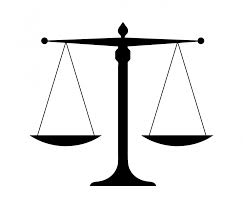
The only commonly used image for a court decision apart from gavels is the scales of justice, sometimes held by a woman. alamy seems to have 6,937 of those. Maybe we should be encouraging good images of the scales of justice if we are to eradicate the gavel.

Here’s a Guardian article on Inappropriate Gavels, with comments, from the year 2015: Gavel bashing: why banging in court on TV is a serious factual offence.

The Trial – real lawyers and jury on BBC

People in the UK can see this 5-part serial on iPlayer – spoilers ahead.

Last week the BBC put on a program showing a fictitious murder trial but with real barristers, judge, court clerk and expert witnesses and with a jury who were randomly chosen members of the public. It reminded me of Marcel Berlin’s The Law Machine, which I watched ad nauseam with my students years ago.

The first episode I watched I thought not only the defendant and witnesses, but also the jury were actors. Not so! But those jurors were fixated on calling each others’ remarks sexist – the case involved a man charged with murdering his estranged but not quite estranged wife. For example, the relatively coherent older woman juror with experience of social services began to describe the way ‘an abusive man’ may appear amenable at first but gradually becomes domineering and controlling. She was immediately shouted down by two or three male jurors as ‘sexist’. Now this was boring if it was actors, but if it was ‘real’ people it made me worry about how one could speak about abuse and still be heard. However, I have now come to the conclusion that the jury’s remarks were tightly edited and we cannot decide from hearing a short exchange what they were like over several hours. Just like the Big Brother house and other reality TV products, you can’t trust it.

If one wanted to see the law in action, I would strongly recommend the way the barristers appeared. I particularly enjoyed the bit of bickering between them: it seemed authentic and matched my own memories.

It was odd that the judge’s closing speech was not given.

And then, in the last programme, at great length, the ‘true story’ was shown and we saw that the defendant really did kill his wife. I think it was a massive mistake to show what really happened. And above all, the way the jury’s individual votes were shown, showing that it was the women who voted guilty, and the details on how much domestic violence is not reported. An important issue, but we were to be manipulated.

This case should have ended in a not guilty verdict, not guilty for lack of evidence, but it resulted in a hung jury. Of course the jurors knew they were on TV, and that might have influenced their demeanour.

The whole thing has been well taken apart by The Secret Barrister: In forgetting our fundamental principles of justice, The Trial’s fascinating run fell down at the last:

Taking the above together, the only possible interpretation of the editorial line is: “This jury should have convicted. They didn’t, ergo they failed. What does this tell us about juries? (Clue: Maybe it’s sexism.)”

Which would be fine, had that been the premise of the programme. But it wasn’t. At least, not as far as we’d been led to believe. It was billed – accurately – as a groundbreaking docu-drama in which we would be given a unique insight into the way that juries operate. The opacity of the jury room means that, notwithstanding academic studies attempting to recreate its conditions, we know little about how juries approach their task. We have a fervent cultural faith in the inherent supremacy of trial by jury; let’s, Channel 4 suggested, cut open this sacred cow and have a rummage around inside.

As the Secret Barrister says, the jury trial is not about discovering the truth – but the programme behaved as though it was.

Obiter J also has a useful post on the programme, more about legal details and less about criticizing.

Legal research colouring book and EW judicial system

What Color is your C.F.R.? – PDF version free online – is a nice idea, alas very much a USA thing and not very full (yet) (via Open Law Lab, tweeted by Stéphane Cottin). C.F.R. is apparently the Code of Federal Regulations.

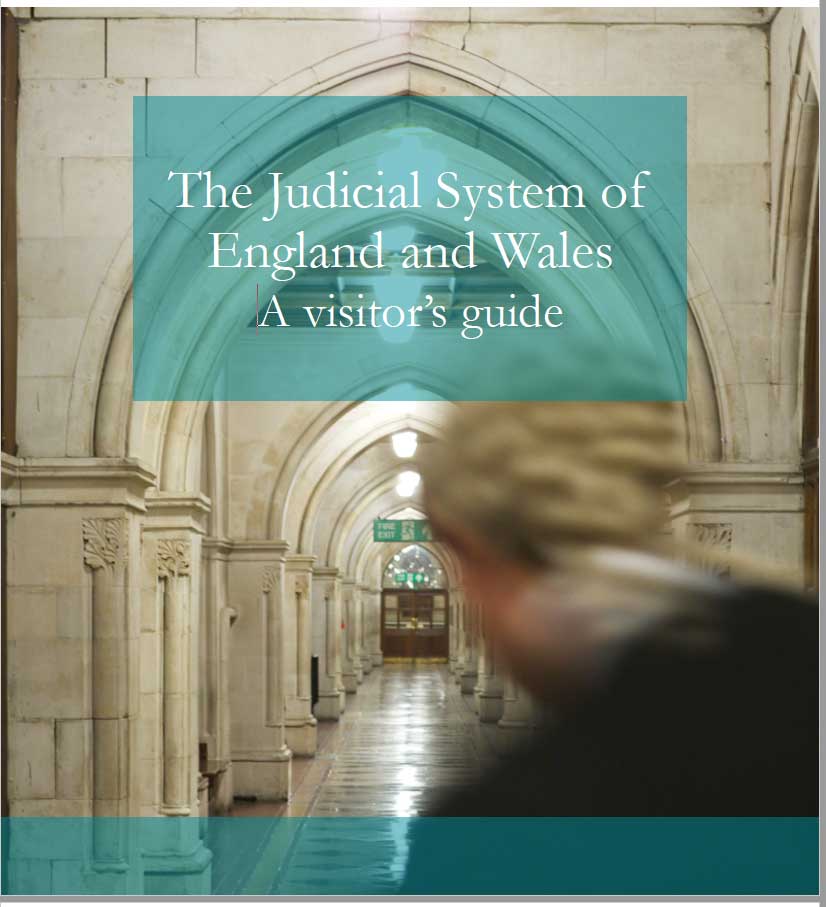
For something more British, The Judicial System of England and Wales: a visitor’s guide is another free downloadable PDF, published by the judiciary, probably of use not only to visitors. In particular, it has a great courts diagram. I especially like the photo on the title page:

jud-sys-cover

Randnummer/pinpointing

A colleague recently asked how to translate Randnummer/Randzeichen/Randziffer into English, in three different contexts.

1. The usual query of inexperienced legal translators is ‘What does Rz./Rn. mean?’ The usual translation of Randnummer, Randzeichen or Randziffer is marginal number or margin number. Here’s a discussion on ProZ.

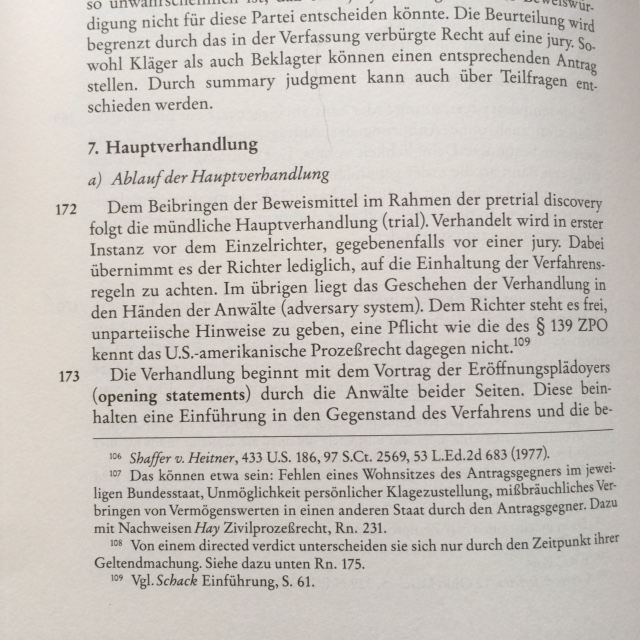
Germans just love marginal numbers, especially in legal contexts and above all in textbooks. This example is from an old copy of Peter Hay, US-Amerikanisches Recht, page 74:

hay IMG_6398

The marginal numbers here are the 172 and 173. Every single paragraph is numbered consecutively through the whole book. So you don’t need to refer to ‘7. a)’ but just to one number.

I think these are a peculiarly German thing, and there are instructions online on how to create them in Microsoft Word, for example, which is not too easy. (Randziffern in Microsoft Word). They are sometimes related to the subject matter and sometimes to the physical location, see the administrative court judgment below and the English case report practice mentioned further below.

Here’s another example of marginal numbers used in a German court case, which I don’t think is very common. The NRW Oberverwaltungsgericht uses these numbers in the right-hand margin to make it easier to refer.

2. Case reports of the CJEU use paragraphs, called para. or paras., a term which needless to say is hard to pin down when you’re looking for it (rather like indent in EU cases). So when a German version of an EU case refers to Randnummer, it is translated into English as para. The number is not in the margin, either.

3. Finally, we really do have marginal numbers/letters or marginal references in English. Some case reports have used not numbers, but letters to make it easier to quote. Google Books has Studying Law, by Simon Askey and Ian McLeod, from which I quote:

Marginal markings and neutral citations
Some series of law reports use marginal markings, in order to make it easier to provide pinpoint citations, while others do not. The original report of Henthorn v Fraser contains no such markings, while the most common system in the 20th century was to provide marginal letters, evenly spaced down each page. The system of marginal letters worked reasonably well, but it was rather cumbersome for true pinpoint citations, which had to take a form such as ‘page 234, letter D, line 3.’ More importantly, this citation would vary from one set of law reports to another, according to the page numbering of the report in question.

I remember barristers lugging cartloads of law reports to the Law Courts, where the court staff would lay out matching volumes from the court library and these would later be cited in argument. Nowadays I suppose at least for newer cases computers replace this.

More on citation in OSCOLA, whence the nice word pinpoint:

A pinpoint is a reference to a particular paragraph of a judgment or page of a report.

and also Latin ‘gadgets‘:

Avoid the use of ‘Latin gadgets’ such as supra, infra, ante, id, op cit, loc cit and contra, which are not widely understood.