
Marital acquest/Zugewinn

In the recent entry on the Mills-McCartney divorce arrangements, I quoted this:

This is not a case where the principle of sharing of the “marital acquest” is engaged at all.

This term was new to me. It seems a good solution for Zugewinn in German law: the property acquired by both spouses from the date of marriage on, which may be divided fifty-fifty in Germany if so agreed or in default of a contract. The situation in England is different, but still it can be necessary to talk about this amount as one of the factors.

I find acquest in the OED:

3. Law. Property gained by purchase, or gift, or otherwise than by inheritance.

Used in this sense in French and in jurisprudence, it says in the etymology.

Google reveals 112 uses, and I think it must recently have been taken up. Probably it was one of the recent big cases where the concept needed to be discussed that used it and was widely reported.
Here‘s an example:

Increasingly on divorce (and the same principles are likely to apply on the dissolution of civil partnerships) the court is interested in ascertaining what has been described as the ‘marital acquest’, that is, the assets accumulated by the parties during their marriage.

I see it was quoted in Miller v. Miller.

This does not mean that, when exercising his discretion, a judge in this country must treat all property in the same way. The statute requires the court to have regard to all the circumstances of the case. One of the circumstances is that there is a real difference, a difference of source, between (1) property acquired during the marriage otherwise than by inheritance or gift, sometimes called the marital acquest but more usually the matrimonial property, and (2) other property.

Zugewinn is usually translated as accrued gains or surplus.
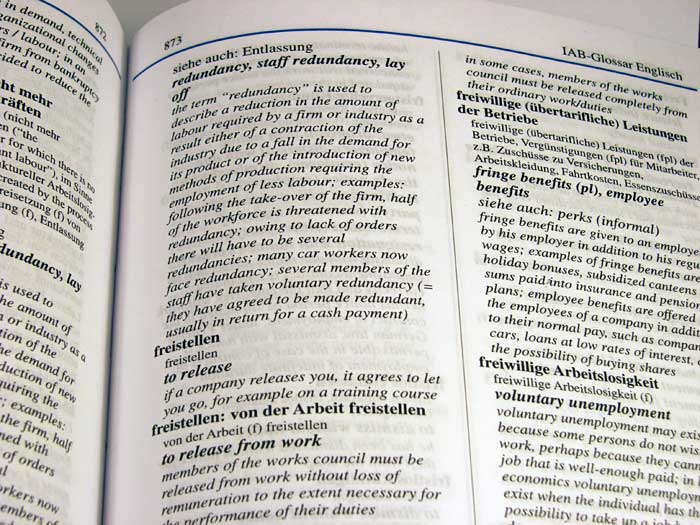
IAB Glossar

There was a discussion of the IAB Glossar on a translators’ mailing list recently. I was interested to know if anyone else found it useful. There came praise in the highest tones from an in-house ministry translator. I suspected the book was of most use to German civil servants who knew the topic and were working into English.

Here’s an entry on Freisetzung von Personal (click to enlarge):

It looks to me as if that definition is a definition of the German term, which happens to appear in English. The identical definition appears in the EN to DE half.

This sort of thing makes me uncomfortable. Where did they find their English definition? I’d have to research it. Dietl is completely different: in the DE to EN part, it will have a definition of Amtsgericht, for example, in both languages. And I know as the reader that that is Dietl’s definition summarizing the German situation. But the IAB approach is not good for people translating between two systems of law. If I don’t know which system is being referred to, how can I assess the quality of the suggestion?

Another thing I found odd was that the word Freistellung was not given in the garden leave sense, which is quite common nowadays, of preventing people from working out their notice.

I did post a query, but unfortunately it was misunderstood as a request for more information about gross misconduct:

Könntest Du mir ein Problem erklären, das ich mit diesen Glossaren habe: im EN>DE Teil (2004 Ausgabe) unter “gross misconduct” steht eine lange Definition auf Englisch: “gross misconduct represents a serious transgression of disciplinary rules, which is normally punished through dismissal without notice …”, ohne Quellangabe. Im DE>EN Teil steht unter grobes Fehlverhalten keine deutsche Definition, sondern genau die gleich englische Definition, wieder ohne Quellangabe. Unter “Verfehlung” steht zum dritten Mal genau die gleiche englische Definition, wieder ohne Quellangabe.

EN>DE steht “schwere, / grobe Verfehlung, grobes Fehlverhalten” als
Übersetzungen.

Ich habe den Eindruck, dass hier eine Definition aus dem deutschen Arbeitsrecht steht, aber da wäre es leicht, einen Paragrafen zu nennen. Und die deutsche Fassung der Definition müsste auch zu finden sein. Das ist mit ein Grund, warum ich das Buch selten öffne, gerade weil auch ich mich mit feinen Unterschieden beschäftigen und auskennen muss. Ich habe den Eindruck, hier ist ein internes Werk, das für Deutsche Beamten gedacht ist, die deutsches ins Englische übersetzen und denen die deutschen Definitionen bekannt sind, aber die gerne Hilfe bei der englischen Formulierung hätten.

(For details of this book, see earlier entry – it’s apparently available as a CD too now)

Version 3 German GAAP taxonomy released / Deutsche GAAP-Taxonomie zweisprachig veröffentlicht

Robin Bonthrone reports:

Version 3 of the XBRL taxonomy of German GAAP dated 1 December 2007
has now been released. The taxonomy is available in German and
English. You can either download the native XBRL format files from
XBRL Deutschland’s website at:

http://www.xbrl.de/downloads/taxonomies/de-gaap-ci-and-gcd-2007-12-
01.zip

or view the complete taxonomy in an online viewer at:

http://www.abra-search.com/ABRASearch.html

Select “German GAAP Version 3, GAAP module” in the list box and then
use the drop-down box to choose between German and English. You might
find it easier to have both language versions open in separate windows.

A premium quality resource brought to you by the team at XBRL
Deutschland’s Taxonomy Working Group, including F&B.

Franglish: le poolish

I am not getting round to blogging a whole list of topics because I have too much else to do. Here is a sop: I was looking at a baking glossary (DE, EN, IT, FR, NL, ES) that Christiane recommended to see if it looked reliable – it does – and I was struck by the French word for sponge (Vorteig), le poolish. I was even more surprised to discover its origin, from the English word Polish. Yet it refers to the sort of sponge made with baker’s yeast (sourdough is levain). Perhaps this ‘via Vienna’ is the answer:

Ce mode de fabrication a son origine en Pologne, et ce sont les boulangers viennois qui l’introduisirent en France pour Marie Antoinette.

(Before she told them to eat cake). I still don’t see where the ‘English’ came from.

Swiss criminal law terminology / Terminologie des Schweizer Strafrechts

This vocabulary doesn’t seem familiar to me. Go to the Obergericht, click on Dolmetscherwesen and then on Strafrechtsterminologie der Bundeskanzlei (D, F, I, E). It can’t be copied, but here’s one entry, scanned, to give an impression (scanned, OCR’d but not spellchecked for the various languages):

20
Täter (1); Täterin (2); Straftäter (3); Straftäterin (4); Delinquent (5); Delinquentin (6); Straffälliger (7); Straffällige (8)Person, die rechtswidrig und schuldhaft einen gesetzlichen Tatbestand erfüllt hat.
PS: CH; USG: (7)(8) zu vermeiden
(1) Schweiz. Strafgesetzbuch, Art. 7 (SR 311.0): (2) BSG 321.1 G 150395, Art. 46 Abs. 1 Ziff. 1; (3) BFS/BJ,
Anstaltenkatalog, 1998, S. 11: (4) POMBE, Baechtold, 1995; (5) BFS, Rückfallraten, 1997, S. 21; (6)(DF)(USG)
T. Freytag, Universität Freiburg, Seminar für Strafrecht, 2001; (7)(8) BFS, Bewährungshiffe in der Schweiz, 2001,
S.4
auteur (1); auteure (2); auteur de l’lnfraction (3); auteure de l’lnfraction (4); auteur de l’acte (5); auteure de l’acte (6); auteur de l’acte punissabie (7); auteure de l’acte punissabie (8); deltnquant (9); delinquante (10); auteur dlrect (11); auteure directe (12); auteur materiel (13); auteure materielle (14); auteur immediat (15); auteure immediate (16)Personne qui accomplit personneilement, avec la consclence ou ia volonte extgees par la loi, les actes
materlels constitutlfs d’une infraction.
PS:CH
Code penal suisse, (1) art. 7, (3) art. 27 a\. 3, (5) art. 18 ai 3, (9) art. 42 eh. 1 (RS 311.0); (2)(6)(8) CHA BE,
SCTerm, 1997; (4)(12)(14)(16)(GRM) ACH; (7) RSB 321.1 L 150395, art. 235; (10) Cornu, Voc. juridique, 1990,
p. 248; (11)(13)(15) Graven, Infraction penaie punissabie, 1995, p. 282; (DF) d’apres source (10), p. 83 sous
“auteur”
autore (1); autrice (2); autore di un reato (3); autrice di un reato (4); autore di reato (5); autrice di reato (6); autore diretto (7); autrice diretta (8); agente (9); delinquente (10)
Persona che realizza I presupposti oggettivl e soggettivi 6\ un reato. PS: CH: GRM: (9M10)f./m.
(1)(2)(3)(4)(5)(6)(7)(8)(DF) aw. M. Hohl Tattarietti, 2001; Codice penaie svizzero, (9) art. 7 cpv. 3, (10) art. 42 n. 1 (RS 311.0)
offender (1); perpetrator (2)Person who commits a crimlnal act with the mens rea required by the law.
PS:CH
(1) Home Office, Digest 2, Criminal Justice System, 1993, p. 7; (2) Romain, Dict. Legat Terms, part 1, EN-DE, 1989;
(DF) adaptation ofFrench definition

On the subject of Swiss German, Jens Wiese at Blogwiese has just announced that he has reached the end of his topic. At the moment he is rehashing old topics. He says that he often gets queries and they are all words he has already discussed. He still writes a weekly column in a couple of Swiss newspapers.

(Thanks to the ubiquitous Urs Wolffers)

Shareholders/Gesellschafter

The translation of forms of business association is quite complex and takes so long to discuss that the steam goes out of the boiler before the discussion has got off the ground.

I met some U.S. translators briefly last Friday, but not too briefly for one of them to tell me that all the U.S. lawyers she works for reject the translation of Gesellschafter of a GmbH as shareholder.

This is a good concrete example – without such examples it’s really impossible to discuss why some lawyers don’t like some translations (see earlier entry without examples).

It would be great if people asked their English-speaking lawyers why they don’t like the translation.

So, let’s look at this. Gesellschaft itself is a problem, but at least my favourite translation of GmbH, which is GmbH, is straightforward (until the client complains).

But the word Gesellschafter has to be translated. The nearest equivalents (not translations) of Gesellschafter in English are:

AG: shareholder
GmbH: member
KG: partner
OHG: partner

But look at this:
Aktie in AG: share
Anteil in GmbH: share

So it has become standard to translate every Gesellschafter of a limited company as a shareholder. Of course, it may seem like translatorese in a GmbH, but it seems a good solution to me. For some reason, hardly any Germans seem to have heard of the word members.

The U.S. lawyers who didn’t like shareholder apparently wanted members or partners. Members, OK, but never never never partners in a GmbH: it creates the wrong idea.

It’s been suggested to me that the lawyer familiar with two languages may simply be getting confused, and transferring the existence of two terms for shares (Aktie and Anteil) in German to a wrongly assumed existence of two terms in English.