Dietl/Lorenz DE>EN new edition

You can buy this dictionary, or will soon be able to, in the paper version or as an Acolada digital version (already available) – I see it’s possible to rent it online for an annual fee. The Acolada version can be combined with other reference works, including Kettler’s dictionary of Intellectual Property and Creifelds.

https://www.beck-shop.de/dietl-lorenz-woerterbuch-recht-wirtschaft-politik-dictionary-of-legal-commercial-political-terms-band-2-deutsch-englisch-volume-/product/813610

https://acolada.de/woerterbuecher/woerterbuch-fuer-recht-wirtschaft-und-politik/

Lexikon/Wörterbuch
Buch. Hardcover (In Leinen)
6. Auflage. 2020
Rund 1102 S
C.H.BECK. ISBN 978-3-406-60914-5
(In Gemeinschaft mit Matthew Bender/New York und Helbing & Lichtenhahn/Basel)
Format (B x L): 16,0 x 24,0 cm

This is the 6th edition. The 5th is out of print.

If you are using a paper dictionary, I remember this and Romain both being quite time-consuming to use. The digital version will at least find your word promptly.

I have a problem with dictionaries nowadays. The updates are not always very comprehensive, or at least they don’t contain new information that is very useful for me. For example, the latest DE>EN Romain contained a large number of updates to include feminine terms. Maybe it used to say Rechtsanwalt and now it says Rechtsanwalt/Rechtsanwältin. I am afraid this had little effect on my use of the dictionary. My copy eventually fell apart and I then bought a second-hand copy of the earlier edition (3rd ed., 1994). This does the job for me. I think there may be a successor to Romain in the pipeline but have no information on this.

Local photos

The very rare posts here have been rather heavy, so before that continues, here are some local photos.

First of all, here is an NHS “Better Health” poster. When Boris Johnson decided to campaign against obesity, we began to see this slogan ‘Let’s Do This’ and this advice here ‘Simple Swaps’. This is a fat man stuffing lettuce into his mouth. There is a 12-week NHS course online to encourage healthy eating, and all sorts of slimming clubs (as they no longer call themselves) are probably available free for some weeks through your GP. So I imagine a fair amount of money has been pumped into this by the government. I think the problem is more complex, but then I would say that, wouldn’t it?

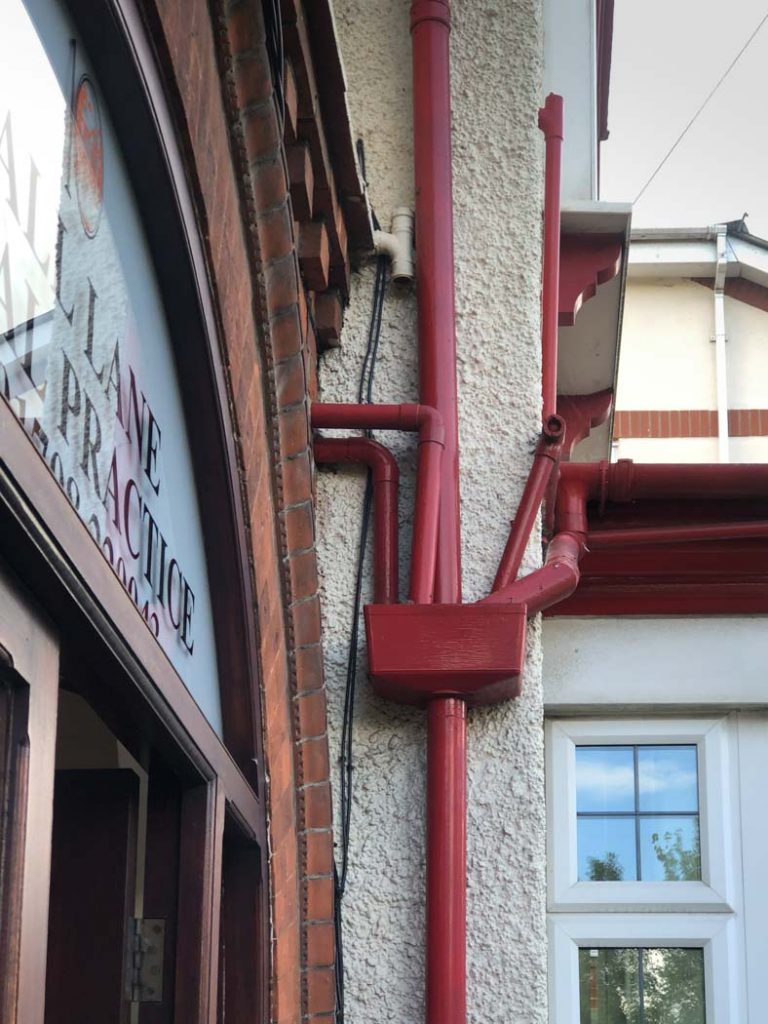
The next is the side view of the door to my dentist’s practice. It’s the view you get if you wait to the left of the door wearing a mask. I like the way all the details are picked out in red. Fortunately I only had a checkup.

The final one shows the kind of reason I haven’t had to give the cat any breakfast today – she is fast asleep. The mouse in this photo did escape though, perhaps to be caught another time. Mice are under people’s sheds and decking, usually.

I was proceeding in a northerly direction

I’ve just received a comment on a post I wrote in 2004: I was proceeding in a northerly direction/Polizeisprech.

The comment is actually a link to an article on another blog written by a police officer who picks up factual errors in TV police shows. He writes that no policeman has ever ‘proceeded in a northerly direction’, by which he means not that they never go north, but they never use the expression. But that’s exactly the point: it’s when a police officer is in a magistrate’s court refreshing his memory from his police notebook, which is standard practice and permissible, and reads out what he has written – it doesn’t come over naturally.

On this subject I can’t help remembering the German TV series Ein Fall für Zwei, where the German lawyers would strut up and down in court as if there had been a jury in the German court – US TV was the inspiration for that.

Here’s another article on the same topic

Leo Whitlock, one of the editors at the Kent Messenger group of newspapers, has penned an interesting blog looking at the how individuals use overly complicated words when speaking to people in authority.  

It is, I suspect, an attempt to appear not just ‘posh’, as Whitlock claims, but to appear better educated and to gain the respect of their peers. 

This inflated use (or abuse) of the English language is no better illustrated when engaging with the legal community. 

Take, most likely, the apocryphal PC writing in his notebook.  “I was proceeding in a northerly direction, when I apprehended the suspect…..”

No one talks like that.

That’s the situation, I think: talking in a courtroom setting.

Year-end notes 3

Arson

Continuing the topic of the dangers of New Year’s Eve fireworks in Germany, it’s been reported that a fire started by some kind of fireworks at Krefeld Zoo burnt down the Monkey House and killed about 30 animals, including orang-utans, gorillas and a chimpanzee (two chimpanzees survived).

The later reports say that the fire was started by three women, a 60-year-old woman from Krefeld and her two daughters, who have handed themselves in. They set off sky lanterns (Himmelslaternen) which they had bought on the internet. They didn’t know these were banned. They handed themselves in and face a potential penalty of up to five years’ imprisonment.

The offence is described in the UK press as negligent arson. Perhaps one might say ‘starting a fire by negligence’, since the word ‘arson’ in English usage and law really suggests deliberate action. I have lose my copy of Bohlander’s Principles of Criminal Law, despite it being one of my go-to books, so all I have is a photocopy of the very old book on Criminal Law by E. J. Cohn – still very useful, even though the law has changed a bit since then.

Lighting sky lanterns has been forbidden (verboten) since 2009. But they can be bought. It seems a matter for the Länder to each decide whether they may be used with a permit. Their danger is that once lit, the person releasing them cannot control where they fly (depends on wind and other factors) or how long they burn, unlike in the case of a rocket. Unheilsbringer Himmelslaterne: Verboten, aber im Verkauf.

Year-end notes 2

I have a large numnber of topics I could blog about if I put more research effort into them.

  1. Lübeck führt den “Gender:Doppelpunkt” ein

I haven’t even touched on the Gender-Sternchen.

I received a query as to whether authorities consider the effect of their decisions on segmentation of texts for translation memory sofrware: people will have to stop recommending sentences being split at a colon (I don’t do that anyway – and surely we must decry the lack of colon usage?).

„Spätestens seit dem Urteil des Bundesgerichtshofes, das das Recht auf Anerkennung eines dritten Geschlechts bestätigt und zu neuen gesetzlichen Änderungen führte, besteht auch für die Verwaltung der Hansestadt LübeckHandlungsbedarf“, sagte Lindenau weiter. Als „tolerante und offene Stadt“ müsse Lübeck „diskriminierungsfrei kommunizieren“.

This is later than the ‘Binnen-I’ and I dare scarcely blog on it without greater research. I know I had to translate a job ad for ‘m/w/d’ (männlich/weiblich/divers) and may have used m/w/x. I have only seen the term Latinx this week, but then I am not used to writing Latina or Latino.

Anyway, here is a discussion about it on ProZ, which is usually good for discussions. I don’t agree with the chosen solution, but that is usually the case. Links given too.

2. Using OCR

If I use OCR, e.g. Abbyy FineReader, to convert scans to readable text, the symbols/logos/stamps on the original document can easily appear in their full glory on the resulting text. Some translators of documents even use these original graphic elements to embellish their translations. I don’t like this. I think a translation should consist of text, and if a logo has a meaning, you explain that meaning, for example (using square brackets, which I can’t find) (stamp), (logo). Anything else is not a translation, and it may create a false impression of what your document is.

This topic came up recently on a translators’ forum where a client had complained that a certified translation of her document was not in colour. That seems a bit odd. In that connection, a few colleagues advocated using first-class paper, high-quality printing and reproduction of original graphic elements. I was shocked!

See earlier post on the form of certified translations, and Richard Schneider (with photos) Von Schuppen und Ösen.

3. New Year’s Eve fireworks in Germany.

Bilanz der Silvesternacht in Berlin

Das Berliner Unfallkrankenhaus hat in der Silvesternacht 15 Menschen mit schweren Verletzungen durch Böller oder Raketen behandelt. Dazu zählten in mehreren Fällen schwerste Verbrennungen, wie eine Kliniksprecherin am Neujahrsmorgen sagte. Mehrfach waren durch Explosionen Finger abgetrennt worden, in einem Fall die ganze Hand. Unter den Schwerverletzten waren auch vier Kinder unter zehn Jahren.

Auf Twitter teilte die Klinik mit: “Erfahrungsgemäß werden aber noch etliche Verletzte mit #boellerschmerz am Neujahrstag erwartet. Besonders wenn es weiterhin keinen Regen gibt und die nicht gezündeten Sprengkörper trocken bleiben.”

Pictures of the aftermath. It is ages since I have been to an inner-city area on December 31st, alas. I know it is dangerous, but I enjoyed it. People firing rockets from balconies. Huge batteries of dead cardboard tubes lying around the next morning, though I recall the council clean-up was very prompt. There are always serious injuries.

It isn’t like that in the UK. One hears fireworks being let off more frequently – for instance, not only on November 5th but for Diwali, shortly before. And increasingly at New Year.

It seems that Germans make up for their orderliness the rest of the year in these 24 hours. Is it an offence to let off fireworks a day or two earlier or later? The Guardian considers the problem:

We don’t want to spoil the fun – New Year firework displays divide Germans

By law, Germans are only allowed to set off fireworks between 6pm on New Year’s Eve and 7am on 1 January. Up to €200m (£180m) is spent on fireworks mainly for personal use, according to Germany’s environment agency.

“It is the only time of the year – for just a few hours – when I feel really free and able to make as much noise as I like, with no one telling me what to do,” says Leonard Schneider, a 21-year-old maintenance technician from Cologne.

I presume Bleigießen is still permitted, but of course you can use wax instead.