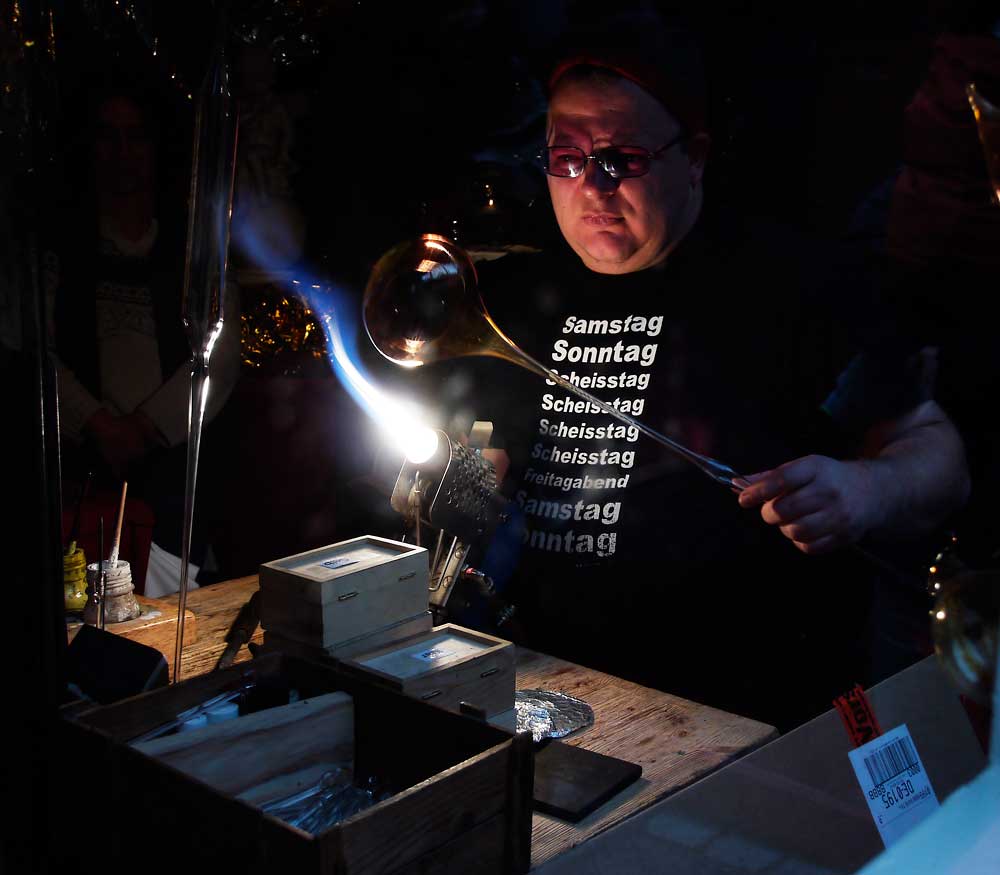
At the Fürth Altstadtweihnachtsmarkt (posted with permission).


At the Fürth Altstadtweihnachtsmarkt (posted with permission).
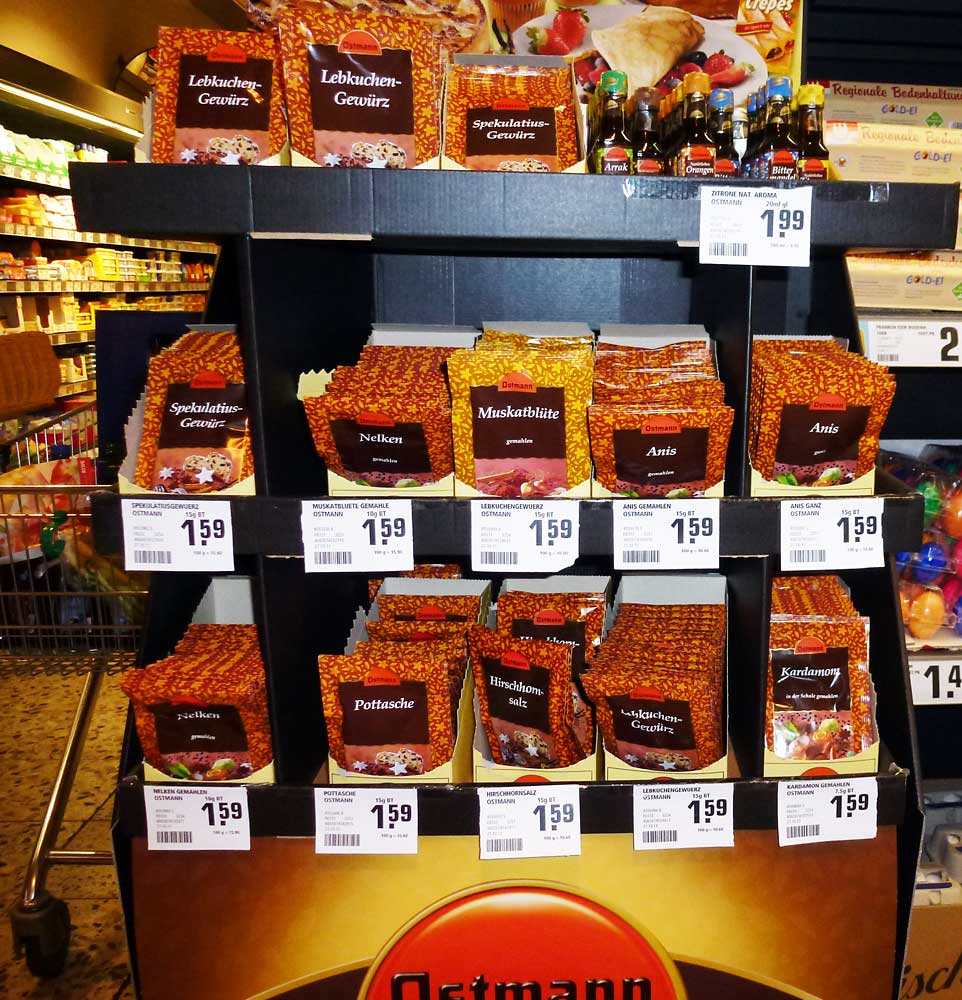
Suddenly a range of spices have become easier to find. This would have been the place to get mace for my pork pies a few weeks ago.
Speculatius-Gewürz speculatius spice
Lebkuchen-Gewürz Lebkuchen spice
Nelken cloves
Muskatblüte/Macis mace
Anis anise (probably star anise)
Pottasche potassium carbonate
Hirschhornsalz hartshorn, ammonium carbonate
Kardamom cardamom
The misleadingly named London Eats blog has something about Hirschhornsalz here:
Biscuits made, I did a little research on this stinky but effective raising agent. Ammonium carbonate was originally known by the more poetic name salt of hartshorn, and was apparently derived from the horns of the male red deer (!). If you’re worried this might be cruel, I’m happy to note the antlers appear in the spring and are naturally shed each year, and in any event, these days you buy the chemical powder in stores. It inevitably features in German and Nordic baking, given that these are the areas in which the red deer might be found wandering in the forest, and in a lot of recipes, nothing else will really do if you want the requisite lightness. If you’re a curious Londoner, and don’t have deer roaming in the back garden, then you can buy it here.
It sounds as if those two raising agents both work well for dry biscuits (in the US sense of cookies). I found a comparison of raising agents by David Manthey. He made biscuits (in the UK sense of scones) as follows:
Unleavened
Baking soda
Baking soda with vinegar
Baking powder
Bakers’ ammonia
Potassium bicarbonate
Home-made potash
Home-made potash with vinegar
Active dry yeast
Sourdough starter
Since hartshorn (bakers’ ammonia) and potash are not recommended for soft cakes, it is not surprising that baking powder came off best.
About.com on German language has some Christmas recipes in both languages for more information
Please go to this Wikipedia discussion page (English) if you think the entry on computer-assisted translation gives a deceptive impression of the market.
Lisa John has an article on her blog – in German – Hilfe, ein Wikipedia-Prinzipienreiter ärgert mich! The gist is this:
The list of proprietary CAT programs in the English Wikipedia (and the German Wikipedia) is woefully short. When she tries to expand it to what it originally was, a person called Smalljim edits out her additions, with the argument that Wikipedia is not an encyclopedia.
Wer sich einen Überblick über CAT-Tools verschaffen möchte, wird vielleicht zuerst bei Wikipedia nachschlagen, in dem Glauben, dort unparteiisch informiert zu werden. So wird unser Informationssucher zum Beispiel auf den Artikel Computerunterstützte Übersetzung stoßen, hier aber eine tabellarische Übersicht über die unterstützten Dateiformate und Betriebssystemvoraussetzungen der verschiedenen Übersetzungswerkzeuge vermissen. Also flugs den entsprechenden englischsprachigen Artikel (Computer-assisted translation) aufgerufen, und siehe da, dieser Artikel bietet eine recht ausführliche Auflistung von Übersetzungssoftwareprodukten. Unser Informationssucher freut sich.
Doch leider zu früh gefreut, denn diese Auflistung ist bei weitem nicht vollständig.
The list of proprietary software in the Wikipedia entry comprises AnyMem, SDL Trados, Web Translate It and Wordfast Classic. At the beginning of December other programs had been added, but Smalljim has now removed them.These were: CafeTran, Fluency, memoQ, MetaTexis for Word, NeuroTran, STAR Transit NXT, Swordfish, Worbee and Crowdin.
You can see the page with additions in early December in Lisa’s article.
I think Lisa has done a great job in replacing the list and hope it can be restored.
(This post has been corrected since I originally thought Lisa had added the longer list – in fact she replaced it).
Translators write and interpreters speak. This simple difference is often ignored in the press – usually by calling interpreters translators.
An amicus brief to the U.S. Supreme Court goes into the distinction in detail. Its main subject is that interpreting costs are easier for courts to administer than are interpreting costs. The case is Louichi Taniguchi v. Kan Pacific Saipan, Ltd. and the brief is by NAJIT, the National Association of Judiciary Interpreters and Translators as Amicus Curiae in Support of Petitioner. A PDF can be downloaded from NAJIT’s website as amicusbrief.pdf (36 pages).
At its most basic level, the distinction between interpreters and translators is simple: Interpreters speak, while translators write. As a result, interpreters must possess different skills from those of translators. Interpreters must have the “analytical skills, mental dexterity” and “exceptional memory” necessary to interpret spoken words from one language into another in real time. The act of translating a document from one language to another, however, is a more research-oriented, meticulous process.
There is more – a lot – including descriptions of what interpreting and translation involve.
Translators must know how to discover and convey a communication’s nuance. And whereas interpreters render communications from one language to another almost instantaneously, “[t]ranslators have time to reflect and craft their output.” Gonzalez, et al., at 295; see Liu, 6 Interpreting at 9–20. Indeed, a common saying among language professionals is that a translation is never finished, it is merely abandoned.
Another document online relates to interprets in Austrlian courts.
Interpreter Policies, Practices and Protocols in Australian Courts and Tribunals. A National Survey, by Professor Sandra Hale, University of New South Wales. It can be downloaded from Professor Hale’s web page (97 pages).
A good impression of interpreting in Germany, between French and German, is given by Caroline Elias’s Dolmetscher-Weblog (in German – here is a related site in French). In the post Schriftliches she shows two examples of her consecutive interpreting notes. These are in French, because she’s interpreting into French here. More information in the following entry, Zu den Notizen… and in the earlier entry Notizentechnik.
When Germans talk in German about Body Mass Index, they always pronounce it Mahss, like the German word for measure or litre of beer. I have found this odd, but it occurred to me that they aren’t actually saying the English word (mass like German Masse), but have converted it into a new German term with a slightly different origin.
Wesbite under construction.
