Language issues in US Supreme Court/”Person” und “persönlich” vor Gericht

The US Supreme Court recently decided a case in which language was discussed on the basis of corpora. The question was about the words person and personal.

The decision was FCC v. AT&T Inc.
(PDF file), decided on March 1. This is a slip opinion, which means it has not yet been officially published. It has a headnote, which they call a syllabus.

The situation was that AT&T Inc. claimed that as it was a person (all corporations are persons), it could rely on the right of personal privacy.

Language evidence was presented to show that it does not follow from the noun that the related adjective has the same meaning, particularly in compounds.

In fact, “personal” is often used to mean precisely the opposite of business-related: We speak of personal expenses and business expenses, personal life and work life, personal opinion and a company’s view. Dictionary definitions also suggest that “personal” does not ordinarily relate to artificial “persons” like corporations.

I can’t help feeling that the Supreme Court would have come to this conclusion even without the language evidence. It seems pretty obvious to me. But the definition of person has been expanded in recent years, and at all events the Court of Appeals for the Third Circuit found in favour of AT&T.

We disagree. Adjectives typically reflect the meaning of corresponding nouns, but not always. Sometimes they acquire distinct meanings of their own. The noun “crab” refers variously to a crustacean and a type of apple, while the related adjective “crabbed” can refer to handwriting that is “difficult to read,” Webster’s Third New Interna-tional Dictionary 527 (2002); “corny” can mean “using familiar and stereotyped formulas believed to appeal to the unsophisticated,” id., at 509, which has little to do with “corn,” id., at 507 (“the seeds of any of the cereal grasses used for food”); and while “crank” is “a part of anaxis bent at right angles,” “cranky” can mean “given tofretful fussiness,” id., at 530.

To see what linguistic evidence was presented, you can look at Neal Goldfarb’s amicus curiae brief, which ca also be found via his blog.

This amicus brief was filed on behalf of Project On Government Oversight, the Brechner Center for Freedom of Information, and Tax Analysts. The parties have to agree to a filing. The brief lists the dictionaries and other works cited. A partial quote:

The following are the pairings in each corpus that occurred at least ten times, listed in order of
their frequency:
COHA: personal life, personal income, personal property, personal interest, personal experience,
personal relationship, personal problem, personal reason, personal injury, personal thing,
personal appearance, personal contact, personal matter, personal friend, personal power, personal
opinion, personal fortune, personal gain, personal history, personal letter, personal use, personal
view, personal question, personal tragedy, personal physician, personal attack, personal affair…

The brief relied on three corpora: the Corpus of Historical American English (COHA), the Corpus of Contemporary American English (COCA), and the TIME Magazine Corpus, all of which are the handiwork of Prof. Mark Davies at Brigham Young University. What we did was to search for the string personal [NOUN], in order to find out what words most frequently filled the NOUN slot.

This decision seems correct and well-founded, but I can’t help wondering whether all judges can be relied on to interpret corpus evidence properly.

Via Mark Liberman on Language Log, who links to other weblogs on the topic.

Numbers/Randnummern

Paul McMahon has a post at Ex Tempore on paragraph numbers in Irish Supreme Court decisions.

I know these paragraph numbers from decisions of the European Court of Justice. They are called Randnummern in German.

German law books tend to have paragraphs numbered this way, but these are usually translated as marginal numbers. That means we have two separate translations of the word.

Recently I had to translate Randnummer in connection with a report from the Commission to the Council and to the European Parliament. The following several paragraphs were referred to as a Randnummer in German:

3.3.3. Cases of withdrawal of reception conditions
Articles 16(1)-(3) specify the situations in which reception conditions granted to asylum
seekers may be reduced or withdrawn (e.g. non-compliance with reporting duties, undue
benefits from material reception conditions).
Some Member States withdraw reception conditions in situations not authorised by the
Directive (FI, DE, NL and some regions of AT).
Only a few Member States choose, under Article 16(2), to refuse the reception conditions for
asylum seekers not submitting their applications as soon as possible (EL, MT, CY, UK). In
the latter case, however, use of the provision was seriously limited by the judgment of the
House of Lords concerning compliance with Article 3 of the European Convention on Human
Rights.

My feeling was to simply omit the word Randnummer and quote the 3.3.3. But I was told that the practice appears to be to refer to paragraph 3.3.3, (‘rather than section’ – but section was not the word I suspected, since this isn’t a statute).

Anyway, back to Ireland. Paul McMahon says that five of the eight judges don’t number their paragraphs, and the other three do. He is in two minds about these paragraph numbers, which seems appropriate. And he refers to the unobtrustive right-hand marginal numbers of the German Federal Constitutional Court as an elegant solution.

I’m in two minds about paragraph numbers in judicial decisions. They are rather unattractive, and I think they contribute to the exaggerated belief that explaining a judicial decision requires a technical form of writing, divorced from ordinary discourse. But my views are probably coloured by my experiences working in the American federal courts, where it’s unusual to see numbered paragraphs. (For more on the subject of judicial written style, I recommend Judge Richard Posner’s fascinating article on the subject (JSTOR access required)).

The post is taken up by Eoin in cearta.ie. He thinks the rise of paragraph numbers outside the US is for purposes of orientation.

It’s been a long time since I thought of the numbering system in published English reports. There you would have a report, and in the left-hand margin, every 5 lines or so, was a letter A, B C etc. and you would quote it by referring to the nearest letter: ‘p. 25, at B’.

But I use the internet now, and citation procedures are different.

(Via UKSC Blog)

Church and doughnuts/Kirche und Krapfen

I haven’t got much time to post and this situation is likely to continue for a few weeks. So here are some more local photos.

First of all, on Sunday, after the (Catholic) service in the church Unsere Liebe Frau, I wondered why the good stuff, icons, was being brought out only after the congregation had gone. But it turned out they were reorganising for the Greek Orthodox service later. One of the Greeks, perhaps sensing my lack of religious belief, pointed out Mary and Jesus to me.

And since it’s that time of year, here is a box of mixed doughnuts at Beck. I have seen two other such boxes at other bakers. I suppose it’s a good idea to get rid of all flavours at the same rate.

Local pictures/Fotos von Fürth

Time for some pictures of Fürth again.

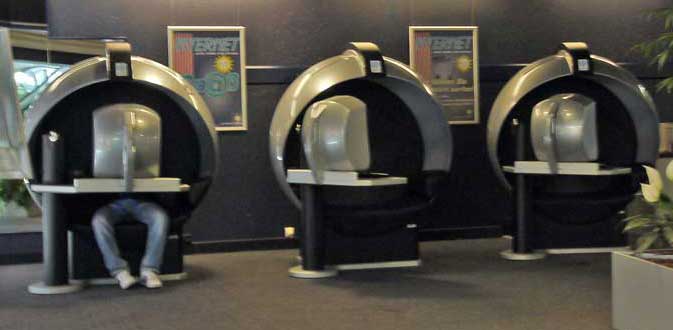
Fürth on the internet:

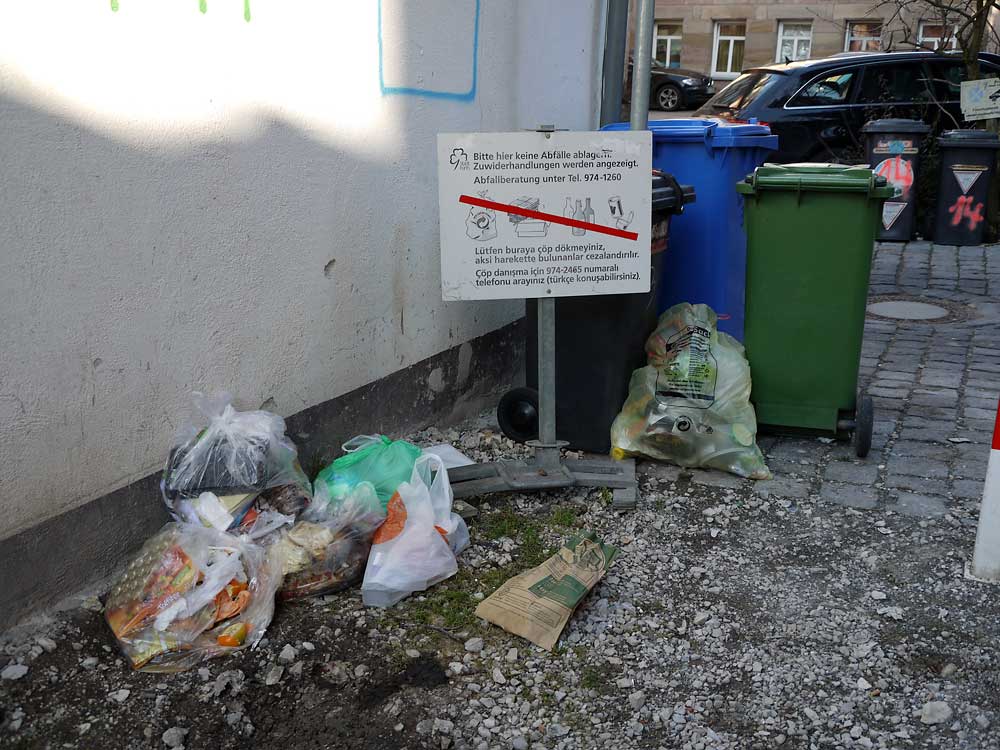
A sign in German and Turkish, but obviously not enough other languages:

Additions to timber-framed houses:

Dubious aesthetic qualities of an energy-saving light bulb:

A new flavour?

Number 17:

Plagiarism/Plagiat

Craig Morris has a post on the accusations of plagiarism against Karl Theodor zu Guttenberg, the German minister of defence, and he links to this PDF, containing the German review by Andreas Fischer-Lescano of the published thesis, which from page 4 on has a table showing Guttenberg’s Dr. Iur thesis and the alleged sources:

The attack is obviously politically motivated, with some of the main accusations coming from legal experts with close ties to the SPD – but no matter – if the shoe fits, wear it.

The interesting thing for me is to see how Germany will react to this. Plagiarism, in my estimation, is not taken as seriously here as it is in the US. During my five years as a lecturer at a German university, I found that the idea of failing someone for plagiarism was tendentious; I was told I could also just give someone a stern look and a slap on the wrist.

Despite being invited by Craig, I’m not sure I can add much. But here goes:

First, on the subject of plagiarism, I don’t think the Germans are at all complacent about it. True, I have encountered a lot among German students, who seem to regard it and getting marks as a game. When I marked essays together with others, they were usually British or American and we all came down on it hard. Of course, it is particularly obvious when the student’s native language is not English, but I think even in the native language, the stylistic shifts should be obvious. I can’t say whether German teachers are softer on it, but I certainly don’t think that those marking final university exams or theses/dissertations, or publishers, are any less offended by it than we are.

The German Ph.D. and Dr. iur. theses I’ve seen have often been relatively short – not Guttenberg’s, that is 475 pages long – and very dry, consisting of long recountings of the opinions of others, naming the source, but at the end there had to be an opinion, and that couldn’t be plagiarized, of course. (It is the bane of my life finding a book on translation that is a published thesis and where it would obviously be necessary to read the whole thing in order to find out the author’s opinion).

The subject of the thesis is US and EU constitutions; according to the review, Guttenberg at the end lays emphasis on the lack of God in the constitution, which he claims leaves an opening for fundamentalism. Fischer-Lescano says that this idea is not brought out well and that giving the thesis the mark ‘summa cum laude’ was more than flattering. I am also surprised that the corrector or correctors would not have noticed the plagiarism (perhaps 475 pages wore them down). After all, for example, an article in the NZZ, Gott hat keinen Platz in der europäischen Verfassung, should surely have come to their attention. If a student takes a particular line, is not the first thing one does to ask where he got it from? Bayreuth University is now investigating the matter.

A couple of other things come up: firstly, there are often accusations of people getting their thesis ghostwritten – Helmut Kohl was certainly accused of plagiarism too. An SZ article anticipates this and interviews a ghostwriting agency, which says that any of its staff who use cut-and-paste techniques are dropped. Another point covered by the same article is how much strain Guttenberg was under when he wrote it, which was the first thing that occurred to me: supposing he was getting to the end and noticed he couldn’t wind it up very well, then brought in a lot of extraneous material to shore it up. The article says he was a Bundestag member, chair of various committees and groups and of the local council, and he had two very small children. I can’t help wondering if this thesis was ghostwritten and Guttenberg can’t accuse the person responsible.

But none of this explains 1) why Guttenberg did not rephrase the bits he borrowed and 2) why he got the best possible mark without his apparent borrowings being spotted.

LATER NOTE: There is a Guttenplag wiki, where everyone can find plagiarism in the thesis.
I heard on the radio (18 February) that a criminal information laid against Guttenberg for making a false declaration that the thesis was his own work will not be pursued, because Bayreuth University does not require a declaration of this kind under oath – but surely there can be a complaint for something or other, if worded differently?