
Hairdressers’ names in Germany/Friseurnamen

Under Huns, Hair Salons and Puns, Strange Maps reprints a map from Die Zeit, showing the incidence in Germany of salons named Haareszeiten, Haarmonie and Haargenau. Plus link to a flickr pool on hairdressers with funny names.

The map shows little except that the names are widespread. According to the article in Die Zeit, there are fewer such ridiculous names in Berlin and Munich, where they have had their day, than in Stuttgart or North-Rhine-Westphalia.

Was in Stuttgart noch als originell gilt, ist in Berlin längst verpönt. Dort nämlich ist der Originalitätsdruck so groß, dass die Friseure sich kaum noch trauen, sich wie alle zu nennen. Friseure heißen in den Berliner Bezirken, in denen die jungen, ironischen Menschen wohnen, schon wieder “Friseursalon”.

It looks as if this topic has been covered in more depth elsewhere. Even Bastian Sick has done it. Maybe Die Zeit just took the first three names mentioned in this thread at www.haarforum.de and pinned them down in the Yellow Pages. www.wissen-friseur.de has many more listed. So does ronsens. All have more links, and Google is full of them. In fact, little else is written about on the Internet than hairdressers’ names.

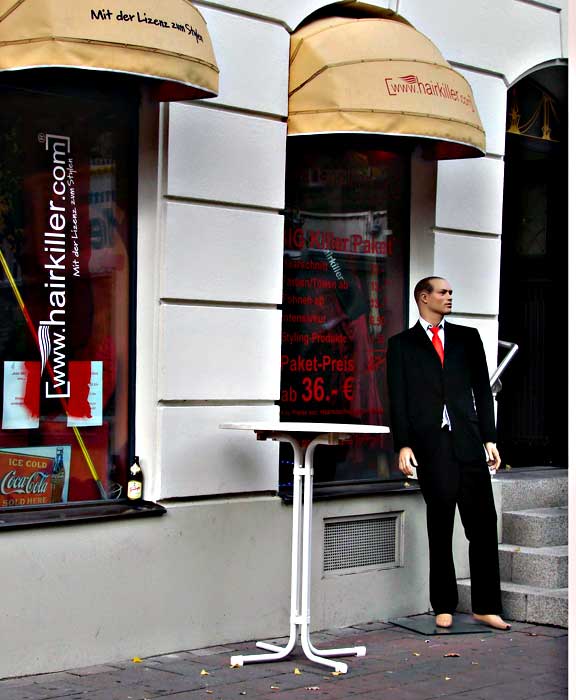
I’ve already shown a photo of the local Happy Hairy People.

This reminds me of opticians’ window displays.

ADDED LATER:
Before decimal currency – Dickens translation/Probleme vor der Dezimalwährung

Charles Dickens, David Copperfield, chapter 12, Mr Micawber:

Annual income twenty pounds, annual expenditure nineteen nineteen six, result happiness. Annual income twenty pounds, annual expenditure twenty pounds ought and six, result misery.

Fürther Nachrichten, and possibly the German translation of Dickens – this comment on the financial crisis puzzled me in the daily paper:

Jährliches Einkommen zwanzig Pfund, jährliche Ausgaben neunzehn Pfund und sechs Schillinge, Resultat Glück. Jährliches Einkommen zwanzig Pfund, jährliche Ausgaben zwanzig Pfund und sechs Schillinge, Resultat Elend.

No, Projekt Gutenberg has a better translation – presumably done before 1971 – the foreword is dated March 1909:

Jährliches Einkommen 20 Pfund. Jährliche Ausgabe 19 Pfund 19 Schilling 6 Pence. Fazit: Wohlstand. Jährliches Einkommen 20 Pfund. Jährliche Ausgabe 20 Pfund und 6 Pence. Fazit: Dürftigkeit.

Biting the hand that feeds you/Wenn Übersetzer den Kunden beleidigen

In Neukunden-Magnet, unter der Überschrift Entspammung vor dem Wochenende, beschreibt Thomas Kilian, wie er zweimal von einem Übersetzer angeschrieben wurde und zitiert den heftigen E-Mail-Austausch dazu.

Die Kommentare sind auch lesenswert.

This German blog entry quotes enough emails in English to show a translator’s overreaction after the blog author objected to receiving advertising of the translator’s services twice.

Via Susanne Aldridge

Washing your hands without mixer taps/Wie machen es die Engländer?

an old discussion on wer-weiss-was about the British and mixer taps (actually in this case a former Commonwealth country).

War jetzt zum wiederholten mal in einem ehemaligen Commonwealth-Land und hab mich wie immer gewundert:
Wie waschen die sich die Hände?
In der einen Ecke des Waschbeckens gibt es einen Brüh-Heißen Wasserhahn in der anderen Ecke einen Eis-kalten.
Gibt es irgendeinen Trick?
Und nur mal theoretisch ist EIN Wasserhahn (mit Mischregler) nicht billiger und einfachere/schneller einzubauen als ZWEI?

An Englishman replies:

but if having a good wash, then you put the stop in the sink and put hot and cold into the basin until temperature is ok for you

The Germans may not have thought of that one.

It’s one of those topics that heats national prejudices.

I ask myself: how long have the Germans had mixer taps? Were they introduced together with the autobahn?
I remember how impressed my brothers were when I was living in a ramshackle building in Germany with other students, and the fuse went. The fuse was a large round plug half the size of a rolling pin, and all you had to do was unplug some electrical device and push the fuse back in. They had been expecting work with a screwdriver. But I think that fuse system had existed since the early 1900s at least.

This follows a mailing-list discussion on u-forum about a use of the word spigot in British English and how to translate it into German.

I was proceeding in a northerly direction/Polizeisprech

In an article headed Cops Talk Funny, Val Van Brocklin points out some of the curious turns of phrase used by U.S. police in court. British police do this too, though not always using the same terms.

# He indicated… He said
# I have been employed by… I worked for
# I exited the patrol vehicle… I got out of the car
# I observed… I saw
# I ascertained the location of the residence… I found the house
# I proceeded to the vicinity of… I went to
# I approached the entrance… I went to the door
# The subject approached me… She came up to me
# I apprehended the perpetrator… I arrested the man
# I obtained an item that purported to be an envelope from the individual… I got the envelope from her
# I observed the subject fleeing on foot from the location… I saw him running away

She actually seems to believe that police could be trained not to speak like this.

(Via Boing Boing)

The trouble with foreign languages/Wenn man nichts versteht

Geoffrey Pullum was relieved that alle bagage is gelost does not mean all luggage has been lost.

Meanwhile, Sally, at No Hard Chords, finds that there are advantages to hearing The Three Bells in the original French – especially if you don’t understand the language:

Listening to a song in an unfamiliar language can be freeing. For me, bad lyrics can render an otherwise great song unlistenable. But as long as the singer, the production and the melody work, foreign-language lyrics can be clunky or insipid or cliched with me none the wiser. If an English-language version of the song is recorded with bad lyrics, though, a puzzle emerges: were the lyrics this poor in the original or did the poetry get lost in translation?

(Here are the Browns).