Claim or action?/Übersetzungen für England

Query from a colleague:

When the new Civil Procedure Rules were introduced in England and Wales in 1999, some terms were changed, e.g. “action” was generally replaced by “claim”, “plaintiff” by “claimant”, etc. What I am wondering about is this: How do you differentiate between Klage = “claim” and Anspruch = “claim” now?

My answer:

I must say that I hate the way English law changes terminology while the meaning doesn’t change that much. They did it with custody of (parental responsibility) and access to (contact) children after divorce too. But the word custody is internationally understood.
None of my work goes only to the UK, and most goes outside. I therefore always write ‘plaintiff’ and not ‘claimant’. I think I would do that even if I did work for a UK client, but if the client didn’t like it I’d change it. In Ireland and the USA, the term is still plaintiff.
As for claim, I think I would use the same word with both meanings, and hope that the context would make it clear what was meant. I most certainly use claim for Anspruch, I think I always have. I don’t think it can have lost that meaning in England, even if it’s taken on another one too. I do use action.
I am probably the wrong person to ask – you need to ask people who work for the UK.

My question to readers:

Do lawyers and translation companies in England and Wales insist on the term claimant for Kläger and claim for Klage?

There’s nothing wrong with the term plaintiff, but if the population of England have taken it over lock stock and barrel it has become the correct choice.

A different but related question: if people translate for Scotland, do they always use Scottish legal terms? I know you can study English law at Scottish universities – the population of Scotland is very much smaller than that of England and Wales, so not everyone wants to qualify in Scotland, and to qualify in England and Wales they want to have studied English law as well as Scottish.

LATER NOTE: I have now heard from two solicitors who deal with work from Germany. The conclusion from London is:

As a practitioner, I would certainly now expect “Kläger” to be translated as “Claimant”. That is how that party will be referred to in the Statements of Case (previously “pleadings”!), Orders, the Judgment etc. Using the term “Plaintiff” risks the criticism that the translator is unfamiliar with the correct terminology.

I therefore conclude, logically, that all translations relating to work for the courts in England and Wales must use the new terminology (I’ve discussed this before). And in consequence, probably all work for the UK will need to use it.

It was pointed out that the change from third party to part 20 defendant has been reversed.

Brochure: Law – Made in Germany – global, effektiv, kostengünstig

The Bündnis für das deutsche Recht (discussed earlier here and here) has now produced a bilingual brochure, available as a PDF on the site of the Deutscher Richterbund. (On the Deutscher Richterbund, the German American Law Journal has an entry today).

The brochure is about 30 pages in length and summarizes the reasons why businesses should base their contracts on German law rather than U.S. or UK law – there are a few explicit comparisons to the detriment of the latter from the Global Competitiveness Report 2008-2009. It has a preface by the German Minister of Justice, who looks younger with every photo, and at the end the responsible organizations are named – the various German Bar, judges’ and notaries’ associations, the editorial team (five lawyers) and the translation company (Stoke-Borchert Corporate and Financial Translations in Hamburg).

I think it’s a bit of a thankless task to translate a text like this, which probably has to be done in a short period of time, where the German has a tendency to be a bit pompous and the English is not just describing a legal system but also trying to market it at the same time. The following remarks on terminology choices are not intended as a criticism of the translation – the terminology choices are quite defensible.

One thing that strikes me, having read only part of the brochure, is that it doesn’t mention the biggest barrier against German law and in favour of US and UK law: language.

A couple of terminology choices struck me. Firstly, on page 5 and elsewhere, kontinentaleuropäisches Recht is translated as Continental European law. Normally it would be civil law, which has the problem that many people don’t understand the term. I don’t think the fact that it appears under a photo of the European Community flag made this translation essential, and it is not familiar, although it presumably conveys the right idea. I think it is really a new creation (Google has 51 ghits for UK sites, 70 for DE sites, and 840-odd overall, which isn’t many). I’m not suggesting it wasn’t the best choice in the circumstances, though.

Another choice was to refer to GmbH, by way of explanation, as private limited company (quite common) and AG as public limited company (not common and not usually advised, but there is no really good solution – stock corporation is the common term, which one could find fault with).

Personen- und Kapitalgesellschaften are translated as partnerships and corporations limited by shares, rather than the usual British partnerships and companies. Presumably this is an attempt to find a term that works in the U.S. as well, although company is used frequently too.

Something went wrong at the printer’s or in processing – when doesn’t it? – when German inverted commas were used (and why write “GmbH” in inverts in the English text?). Some of the word divisions look a bit iffy, but that is par for the course, and in any case I am not sure they aren’t American. But I haven’t seen the paper version – it may be that the inverted commas were OK there (I don’t have much hope, though, from past experience).

Translation Blogs / Übersetzerweblogs

At last week’s ATA conference in Orlando, there was a session on blogging, as a result of which Susanne Aldridge has started a blog (In-House Translators – A Dying Breed). As an outhouse translator, I’m still interested in this.

Translation Times has a report and a photo of the bloggers present. The Masked Translator may have been there too. (I could have sworn I had that blog on my blogroll, but the fact is that I read that and Translation Times by RSS feed – a blogroll is becoming a thing of the past).

Complaint/Beschwerde

When did Deutsche Post raise the postage on letters to other countries in Europe from 55 cents to 70 cents?

I liked it being the same in Germany and the rest of Europe, at least for normal weights.

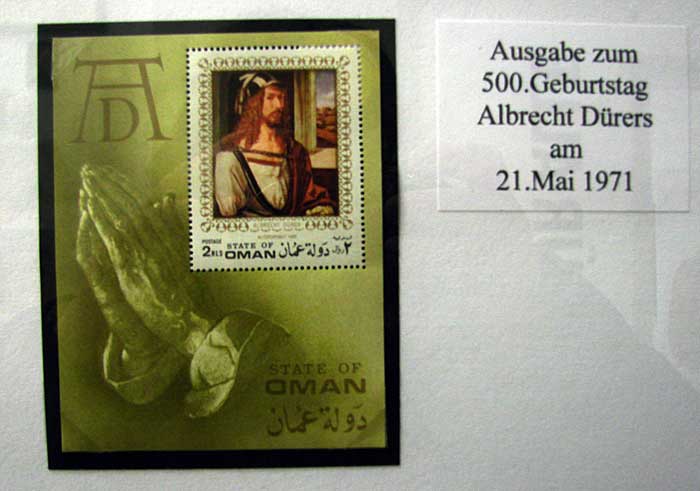
At all events, they have no 15-cent stamps to make up the sum, just the usual 5c and 10c, all boring flowers. I fear a lot of people are going to get the stamp Alte Rheinbrücke Bad Säckingen in future weeks.

There are a couple of 65c stamps that are OK (Riga and Frankfurt zoological society) if one adds the 5c crocus.
Some pictures here (if you click on the name).

Kings Gregory I-IV/Gregorianische Cottages

I watched a programme on John Le Carré on arte on Sunday and was surprised to hear that George Smiley lived near Baywater Street and that there was a row of gregorianische Cottages there.

I can’t explain the former, but I quickly realized that gregorianisch refers to the architecture that started in the reign of King Gregory I and continued through his other namesakes to that of King Gregory IV.

The text was a reading from the translation into German of Smiley’s People (Agent in eigener Sache), so I don’t know if this was the work of the translators or the reader. However, Google finds a lot of this architecture, seemingly always in Britain or Ireland, so my guess must be right.

Here’s one example:

Auf der Fahrt zu den Sehenswürdigkeiten auf dem Lande kommen Nordwales-Besucher immer wieder durch Städtchen, die zu einer Pause einladen. In St. Asaph ist ein Blick in die Kathedrale lohnenswert, Ruthin besticht mit einem Architektur-Mix aus Mittelalter, Tudor und gregorianischer Zeit.

Here’s the story of the unfortunate demolition of one of these obscure cottages:

Ein wirklicher dummer Zufall: Nachdem er für 400.000 Pfund die Angel Cottage in Windmill Lane, im Osten Londons, ersteigert hatte, fuhr der neue Besitzer Mubarak Patel für einige Zeit ins Ausland. Während seiner Abwesenheit rissen Bauarbeiter, die er eigentlich für ein anderes Gebäude bestellt haben wollte, das 1826 erbaute Anwesen ein – das einzige gregorianische Haus in dieser Gegend. Ein Versehen, so hieß es zunächst. Später wollte Patel sich zu dem Vorfall nicht mehr äußern.

And here is a pre-demolition picture and a British report:

A LISTED building in Stratford has been illegally demolished over the weekend.

Angel Cottage was one of the last remaining buildings dating back to late Georgian times.

Newham council and English Heritage are still trying to determine how it was destroyed.