IEL 1: Law of England and Wales: introduction for translators/Englisches Recht für Übersetzer

Introduction to English law for translators and/or non-lawyers

About this introduction

I’ve been considering revising some notes I used to use with students, originally entitled Introduction to English Law (should it be the Law of England and Wales, or Law in English?).

The original idea was that one booklet should briefly cover many areas of law. Then, if a written or at-sight translation text dealt with a topic that had not yet been taught, all the students could be referred to the relevant pages.

This was at the Institut für Fremdsprachen in Erlangen. At the SDI in Munich, I think the text used was Law Made Simple, by Colin Padfield (now by Barker and Padfield; ISBN of the 2007 edition is 978-0750684941).

But things have changed since 1994 (I was teaching till 2002, with more up-to-date handouts not integrated into the script). Indeed, the syllabus in Bavaria has changed and sounds much more useful for translators.

In the UK, Wales and Scotland now have their own parliaments. Some of the courts have changed their names. There is a Ministry of Justice.

The notes are intended for translators, and there is a place for both PC and non-PC terms. Thus The British Isles is a controversial term in some quarters, especially Ireland, but at the same time it’s used as a geographical term for all the islands without any intention to insult.

The whole complex of geographical and political terms is a tin of worms, to coin a phrase. I’ll introduce it in a separate entry. No comments on those terms under this entry.

Multicultural driving/Unterschiede beim Autofahren

The Frankenpost reports that a driver has been picked up on camera for speeding more than once in Bavaria, but as he has a right-hand-drive car, they could only identify the passenger, a large Ernie doll (Muppets). For picture, see there:

BINDLACH – Die Bayreuther Verkehrspolizei glaubte zunächst, einen Schnellfahrer am 8.8.08 um 11.11 Uhr bei einer Geschwindigkeitsüberwachung auf der A9 in Richtung Berlin erwischt zu haben. Beim genaueren Hinsehen stellten die Überwacher jedoch fest, dass es sich um ein englisches Fahrzeug mit einer Rechtslenkung handelte und die Puppe “Ernie” auf dem Beifahrersitz Platz genommen hatte.

(Via Werner Siebers)

Meanwhile, Gizmodo UK shows a hand that can be installed in the rear window and will give a choice of seven miscellaneous gestures.

Anyone showing the middle finger would soon find themselves in court in Germany, but might one get away with the V sign? But then again, it wouldn’t be much use if no-one else understood it.

Here’s the source.

GmbH managing director contract translated/GmbH-Geschäftsführervertrag ins Englische übersetzt

Via the German American Law Journal: rechthaber.com has started putting online German contracts translated into English.

They’ve started off with a GmbH managing director contract, translated by Bernhard Schmeilzl (difficult for me to say, but easier than another of the team, Prof. Dr. Dr. Herbert Grziwotz, Notar):

Wer englische Verträge oder Mustertexte sucht, wird künftig auf Rechthaber.com fünfig. Wir bauen ein Archiv hochwertiger Dokumente in englischer Rechtssprache auf. Zum Start ein zweisprachiger GmbH-Geschäftsführer-Vertrag (deutsch / englisch)

I have no intention of going through this with a fine tooth comb looking for things to disagree with. It looks good. But I will agree with Clemens that ‘loophole may not always be the proper equivalent of the German term Regelungslücke‘. It is also on the heavy side and has some instances of ‘the said’ that I wouldn’t use, for example.

Only yesterday I wrote on a translators’ mailing list: ‘Loopholes are for exploiting, and gaps are for filling’. (And a later commenter would have preferred lacunae).

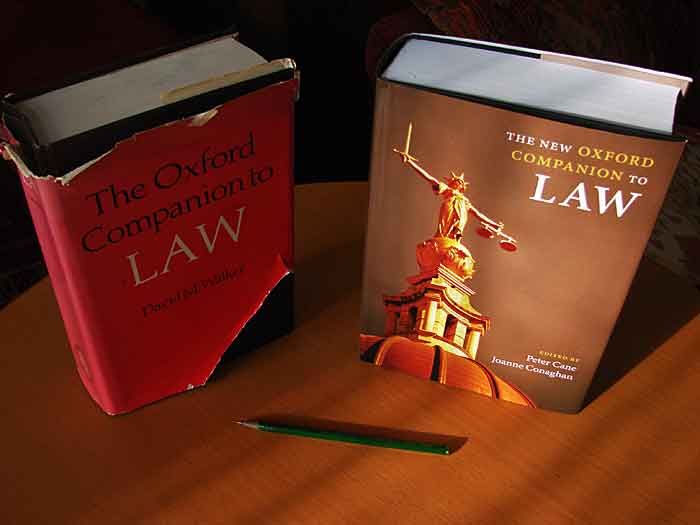
New Oxford Companion to Law

Here’s an exciting update.

The Oxford Companion to Law (1980) was done completely by David M. Walker, a Scottish lawyer.

The New Oxford Companion to Law (2008) is edited by Peter Cane and Joanne Conaghan and written by a huge team.

(To click through to amazon.de – scroll down on right)

Both intended for non-lawyers, but they aren’t intended to give advice on rights.

Both are about 1300 pages long.

The new book has quite a lot of illustrations, some in colour.

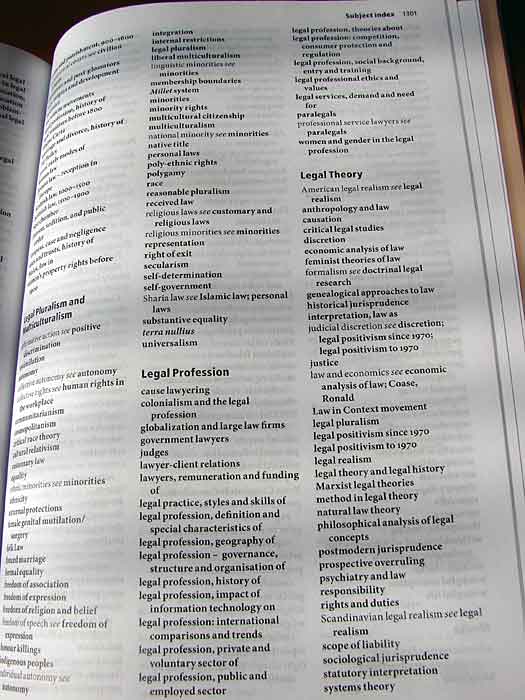
Organization of the new book: about forty subject headings were chosen, each with a number of subcategories. These are listed at the back:

Other methods of navigation: a lot of cross-references (words in bold) and some zero-word alphabetical entry headings, referring the reader elsewhere. There are also further cross-references at the ends of some of the entries.

What has struck me so far: lots of great stuff, but a strange selection in some cases. See the picture above: I find a huge amount of legal theory, which to me seems out of place. There is an entry on ‘the Other’, and one on governmentality (Foucault), which makes the book very academic. There is more about gangmasters than the High Court (there isn’t much about the courts, although there is a diagram somewhere). A short entry by Peter Goodrich on Language and Law, but no entry specifically on forensic linguistics. Don’t be put off by this, though: the book contains masses of useful stuff.

Walker’s entry on German law was fuller and had a better bibliography (this just has two books by Norman Foster).