The election campaign continues outside, and I now have more SPD pens than CSU. The Green Party offer a green version of the folding cow:
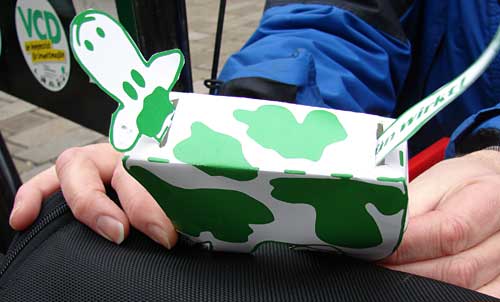
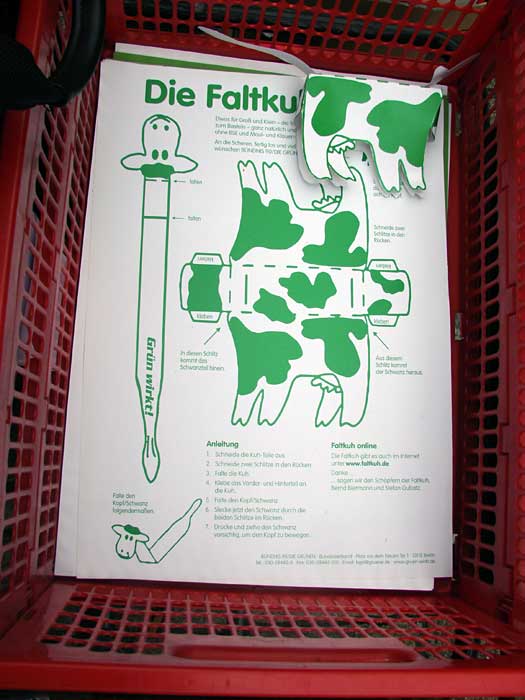
This can be found online: direct link, indirect link, or just use Google. Or maybe you prefer the origami cow:


The election campaign continues outside, and I now have more SPD pens than CSU. The Green Party offer a green version of the folding cow:
This can be found online: direct link, indirect link, or just use Google. Or maybe you prefer the origami cow:

According to cnet news:
Gawker has unearthed a rather odd bug in the Google Translate software: its English-to-Spanish translator converts the name of the actor Heath Ledger, who died tragically on Tuesday, to the name of another actor–Tom Cruise. So if you enter in “I will miss Heath Ledger,” Google Translate will come back with “Voy a perder Tom Cruise.”
Google says the problem has been sorted out.
(Via Derek at www.flefo.org)
Ein Treffen im Nachb*zensiert*aftshaus, Gostenhof:
Wenn im August und September unser Treffpunkt, das Nachb*zensiert*aftshaus, wegen Ferien geschlossen ist, treffen wir uns in einem Biergarten um uns auch privat besser kennenzulernen. So entstanden, wenn nicht Freundschaften, so doch zumindest gute Bekanntschaften, die im täglichen Umgang mit unseren Rechnern oft sehr hilfreich waren.
Best wishes to all those celebrating Burns Night, and even those who aren’t.
Yahoo Answers dealt with the question of whether it is safe and ethical to eat road-kill haggis, and Mostly Eating recommends a haggis and winter tzatziki wrap for the leftovers. Winter tzatziki is apparently identical to summer tzatziki (via the Guardian).
Incidentally, the OED says the derivation of ‘haggis’ is unknown, but until the beginning of the 18th century it was equally common in England.
This is a story from May 2007 that has only just reached Legal Juice (and me). I’ll just note this for translation purposes:
Netzeitung, German:
Mit einem lebensgefährlichen Atemalkoholwert von 5,08 Promille hat die Polizei in Mecklenburg-Vorpommern einen Rollstuhlfahrer aus dem Verkehr gezogen. Der 31-Jährige sei am Samstagabend einer Streifenwagenbesatzung in Ventschow aufgefallen, weil er mitten auf der Straße fuhr, teilte die Polizei am Montag mit.
Der Spiegel, English:
When he was given a breathalyzer test, they were stunned to find that he was a whopping ten times over the legal limit for drivers. He had a 0.5 percent blood alcohol content (BAC) — the legal limit in Germany is 0.05 percent.
Comparable UK text from the Guardian:
Mr Paul had 176 milligrams of alcohol per 100 millilitres of blood; the legal limit in the UK is 80 milligrams while it is 50 milligrams in France, the hearing was told.
Explanation from a UK drink-driving site:
The UK legal limit for drivers is 80 mg of alcohol per 100 ml of blood, often referred to as a BAC or blood-alcohol concentration. In US terms this would be expressed as 0.08%. This is alternatively expressed in terms of breath alcohol – 35 礸 (microgrammes) per 100 ml (which is now the usual official measure in the UK), or alcohol in the urine – 107 mg per 100 ml.
This is often reckoned to be equivalent to two pints of ordinary strength beer which, for a man of average weight, is broadly true, but should not be used as a general rule – see Drink-Driving Guidelines. It is impossible to draw an accurate correlation between the amount of alcohol consumed and the resulting peak BAC, and anyone trying to “drink up to the limit” runs a serious risk of exceeding it.