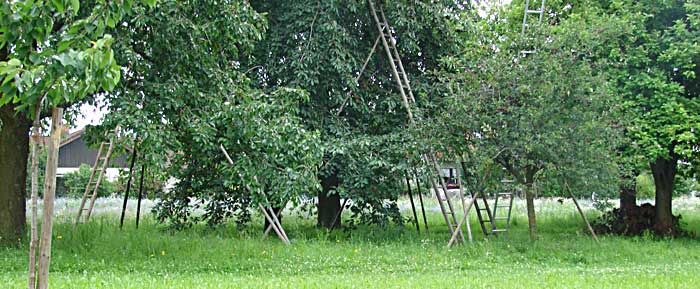
Harvesting cherries:
Hardware:


Harvesting cherries:
Hardware:
The Solicitors Journal reports that from January 2008, judges’ clothing in England and Wales is to be simplified and their dress allowance reduced. This was announced on July 12. Media release here.
Judges will no longer wear wigs, wing collars and bands when sitting in open court in civil and family proceedings. The Circuit Bench, in accordance with their current wish, will continue to wear the same gown. All other judges will wear a new, simple, gown which is in the course of desigm-
In criminal proceedings, High Court Judges will wear the present winter robes. At the moment, High Court Judges have five different styles of dress for different situations.
Advocates (mostly barristers but some solicitors) will similarly not wear wigs, wing collars and bands in civil courts.
For a picture of the High Court Judge dress to remain, see earlier entry.
Wikipedia has some information on current court dress. Examples with pictures here.
The judges of the House of Lords wear no wigs and gowns, just dark suits. That is apparently because they are sitting as a committee of the House of Lords rather than a court in the usual sense.
I don’t always understand what’s going on outside my office:
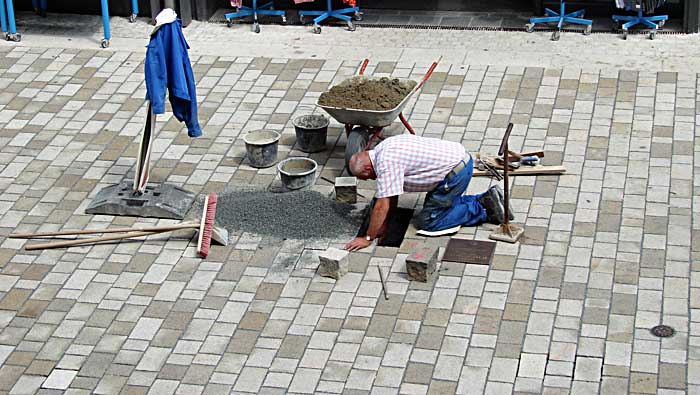
even when it’s over:
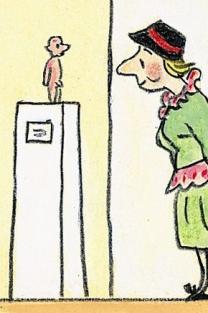
Something in this picture was too much for Boyds Mills Press in the USA. They wanted to publish a translation of Rotraut Susanne Berner’s children’s book, but without this picture and another picture of a nude, both exhibits in an art gallery. The author insisted on the censorship being made obvious, for example by the pictures being blacked out, so it seems the book is unlikely to appear. Die Welt writes:
Erst im Februar hatten US-Bibliotheken ein preisgekröntes Kinderbuch aus ihren Regalen verbannt, weil auf der ersten Seite das Wort scrotum (Hodensack) vorkam. Zuvor geriet selbst Harry Potter wegen angeblicher Bezüge zum Satanismus unter Beschuss der selbst ernannten Sittenwächter.
Author’s nude drawings too hot for US publisher, from the Independent.
Kein deutscher Mini-Penis für die USA, from Die Welt (with 4 illustrations).
LATER NOTE: for visitors from the Absolute Write Water Cooler, here’s the other offending picture:

This subject is generating as much traffic as my old entry on how IKEA names its furniture.
This vocabulary doesn’t seem familiar to me. Go to the Obergericht, click on Dolmetscherwesen and then on Strafrechtsterminologie der Bundeskanzlei (D, F, I, E). It can’t be copied, but here’s one entry, scanned, to give an impression (scanned, OCR’d but not spellchecked for the various languages):
20
Täter (1); Täterin (2); Straftäter (3); Straftäterin (4); Delinquent (5); Delinquentin (6); Straffälliger (7); Straffällige (8)Person, die rechtswidrig und schuldhaft einen gesetzlichen Tatbestand erfüllt hat.
PS: CH; USG: (7)(8) zu vermeiden
(1) Schweiz. Strafgesetzbuch, Art. 7 (SR 311.0): (2) BSG 321.1 G 150395, Art. 46 Abs. 1 Ziff. 1; (3) BFS/BJ,
Anstaltenkatalog, 1998, S. 11: (4) POMBE, Baechtold, 1995; (5) BFS, Rückfallraten, 1997, S. 21; (6)(DF)(USG)
T. Freytag, Universität Freiburg, Seminar für Strafrecht, 2001; (7)(8) BFS, Bewährungshiffe in der Schweiz, 2001,
S.4
auteur (1); auteure (2); auteur de l’lnfraction (3); auteure de l’lnfraction (4); auteur de l’acte (5); auteure de l’acte (6); auteur de l’acte punissabie (7); auteure de l’acte punissabie (8); deltnquant (9); delinquante (10); auteur dlrect (11); auteure directe (12); auteur materiel (13); auteure materielle (14); auteur immediat (15); auteure immediate (16)Personne qui accomplit personneilement, avec la consclence ou ia volonte extgees par la loi, les actes
materlels constitutlfs d’une infraction.
PS:CH
Code penal suisse, (1) art. 7, (3) art. 27 a\. 3, (5) art. 18 ai 3, (9) art. 42 eh. 1 (RS 311.0); (2)(6)(8) CHA BE,
SCTerm, 1997; (4)(12)(14)(16)(GRM) ACH; (7) RSB 321.1 L 150395, art. 235; (10) Cornu, Voc. juridique, 1990,
p. 248; (11)(13)(15) Graven, Infraction penaie punissabie, 1995, p. 282; (DF) d’apres source (10), p. 83 sous
“auteur”
autore (1); autrice (2); autore di un reato (3); autrice di un reato (4); autore di reato (5); autrice di reato (6); autore diretto (7); autrice diretta (8); agente (9); delinquente (10)
Persona che realizza I presupposti oggettivl e soggettivi 6\ un reato. PS: CH: GRM: (9M10)f./m.
(1)(2)(3)(4)(5)(6)(7)(8)(DF) aw. M. Hohl Tattarietti, 2001; Codice penaie svizzero, (9) art. 7 cpv. 3, (10) art. 42 n. 1 (RS 311.0)
offender (1); perpetrator (2)Person who commits a crimlnal act with the mens rea required by the law.
PS:CH
(1) Home Office, Digest 2, Criminal Justice System, 1993, p. 7; (2) Romain, Dict. Legat Terms, part 1, EN-DE, 1989;
(DF) adaptation ofFrench definition
On the subject of Swiss German, Jens Wiese at Blogwiese has just announced that he has reached the end of his topic. At the moment he is rehashing old topics. He says that he often gets queries and they are all words he has already discussed. He still writes a weekly column in a couple of Swiss newspapers.
(Thanks to the ubiquitous Urs Wolffers)
Euralex, the European Association for Lexicography, has interesting resources and links, and most recently the International Bibliography of Lexicography, which is being developed in the form of a wiki.