More stupid in English / Dümmer auf Englisch

An article by Stefan Klein in the FAZ yesterday, headed Dümmer auf Englisch, discusses the death of German as a language of science. He mentions a conference where six of the speakers were Germans, three Americans and one British:

Und alle sprachen Englisch oder, im Fall der deutschen Redner, mitunter auch so etwas Ähnliches. Seltsam gewählte Worte und verschlungene Sätze ließen so manchen Vortrag weniger brillant wirken, als er inhaltlich war.

Klein also mentions that of 1976 master’s courses at German universities, 250 have English as the sole language. There’s also some discussion of terms that are preciser and more easily comprehensible in scientific German than in English.

Wer Wissenschaft nur in einer Fremdsprache begegnet, bezahlt selbst dann mit Verlusten, wenn er dieses Idiom hervorragend beherrscht. „We are dumber in English“, zu diesem Schluss kamen Untersuchungen in Schweden und den Niederlanden, wo Kinder von ihrem ersten Schultag an mit dem Englischen vertraut gemacht werden. Vorlesungen auf Englisch sind dort Teil jedes Studiums, doch die Prüfungsergebnisse fallen im Schnitt zehn Prozent schlechter aus als bei Lehrveranstaltungen in der Muttersprache. In englischen Seminaren stellen und beantworten die Studenten weniger Fragen, sie wirken insgesamt hilfloser. Weder Studenten noch Lehrern ist das Problem gewöhnlich bewusst, weil alle ihre Gewandtheit im Englischen überschätzen.

(In the comments, a retired engineer says that Tragflächen is the right word for the wings of an aeroplane – wings makes him think of duck wings (large meaty ducks?) and gives him an appetite. To say nothing of the ‘medieval’ system of inches, feet and yards).

This could also be the death of English as a language of any depth.

Petite anglaise judgment

Journal d’un avocat reports on the decision of the employment court after petite anglaise lost her job at the accountancy firm Dixon Wilson for blogging. The text of the decision has now been published (Dixon Wilson may yet appeal). The advocat discusses the translation into French of the word twunt>:

‘Lorsque ça se passait mal en début d’année j’ai failli créer un blog parallèle secret nommé mon patron est un enculé [a twunt] pour me défouler. Je raconterai ces histoires un jour, quand je ne travaillerai plus pour lui … »

Je précise que la traduction de twunt par “enculé” a été proposée par le Cabinet DIXON WILSON. On ne saurait les blâmer : ce sont des comptables, pas des littéraires. Mais ils restent débiteurs de la vérité.
Twunt est un néologisme argotique, composé d’un mélange de deux mots grossiers, twat et cunt, qui désignent tous deux l’organe sexuel féminin. Dès lors, le traduire par “enculé” démontre une méconnaissance de l’anglais, de l’anatomie, et de la grammaire, car ils traduisent un génitif par un participe passé.
Cry in shame, o Britannia, for thy sons have turned into illiterates.

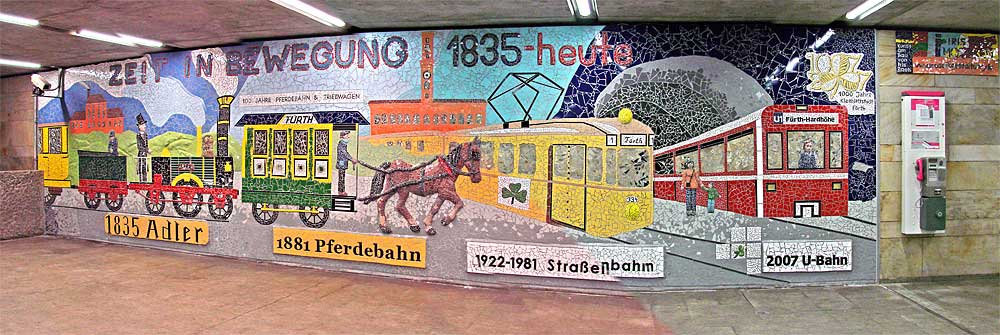
Fürth pedestrian precinct / Fürth Fuzo

„Dekorative Gestaltung statt Optischer Lasten“ – Agenda 21 Fürth
Führung durch die Fußgängerzone am Mittwoch, 27. Juni 2007 zwischen 18.00-19.30
Roland Loock, Fachlehrer für visuelles Marketing und Sabine Gauditz, Unternehmensberaterin, Visuelles Marketing (Arte Perfectum) zeigen, was wir eigentlich schon immer wussten: Entgegen kommerzieller Trends sind die Menschen letztlich doch Ästheten.

I recently found myself on this tour of the city centre. It was interesting to hear some problems discussed by people who had thought about these things in a wider context.

Some points made:

1. We all have everything, so shopping in the inner city should be fun and encourage you to shop (I think that’s why I like department stores, which we haven’t got, and bookshops, where you can look at things properly)

2. It needs more green, and running water (I was relieved they didn’t suggest turning the whole thing over to growing vegetables)

3. Note this non-convivial seating (cold to sit on, I am told, and btw with matching bike stands – in background – and tree guards, all with 70s-style bronze effect). My belief that the intention is for people not to sit down, especially in the evening, and not to converse in groups, seemed to be shared.

DSC08481w.jpg

4. Places where people love shopping, like Wertheim Village, have fake historical architecture. Fürth has genuine historical architecture and should make the most of this. (I have a feeling there are more differences between Fürth and Wertheim Village, but let’s overlook that). Some shops have a projecting roof, no longer necessary, which blocks the view to the ornate façades. These ought to be removed. This is good (and they liked the colours):

DSC08441w.jpg

Fielmann at the far left good, Backwerk and Vodaphone at the right bad. And the Vodaphone sign interferes with the architecture:

DSC08440w.jpg

5. I had the feeling Vatan Kommunikation wasn’t really appreciated:

DSC08484w.jpg

For more on the situation in the inner city, see the Oberbürgermeisterchat transcript on 15 May.

bq. Engel: Ich find nicht das in der FuZo viele schicke läden sind, es gibt vielleicht viel Bäcker, Händyläden und 1Euro läden und die guten Geschäfte kann man an einer Hand abzählen!!!
OB Jung: Wir können natürlich nicht mit der Maximilianstr. in München mithalten, aber spontan fallen mir Beispiele wie das neue street one oder die Schuhläden La Pelle und Wetsch ein. Auch Chocolate and More oder der Juwelier Weigmann, Bonakdar, Scherneck Lederwaren… sind chice Läden.
Handy-Geschäfte dominieren alle Fußgängerzonen in Deutschlan, da die einfach am meisten bezahlen.

The trouble with Scherneck – I bought a purse there recently and it was completely empty apart from the owner and two assistants. It felt like going onto a stage to be interviewed in public. I think I got out of the habit of personal service in England.

Next OB chat on July 24th at 6 p.m.

Service for the blessing of the ‘No Smoking’ signs / Segnung des Rauchverbots

In search of information on St. John the Baptist, I came across what I thought was a serious religious site, Ship of Fools.

Minister: Therefore let us stub out our cigarettes with gladness, and cast off the works of darkness by joining together in the words of the Smoker’s Prayer.
All: Can you give us a light?

and later

THE DISMISSAL
Minister: God hates fags.
All: In the English sense of that word.
Minister: May the marketing of St Peter Stuyvesant, St Benson and St Hedges not be with us all, evermore.
All: Amen.

The site, a kind of newspaper, has some interesting regular features. I was particularly taken by the Mystery Worshipper, a column of reports on secretly visited church services. Here from a report on St. Columba’s, Anfield, Liverpool:

Did anything distract you?
This must be the best-heated church in Christendom and by the end we felt we had been in a sauna. More distracting than the heat, though, was the noise of the fans which were pushing it out. Other distractions were the cocktail-bar altar and wondering which saints were being veiled from sight by the Passiontide drapes (presumably Our Lady and St Columba).
Was the worship stiff-upper-lip, happy clappy, or what?
Modern Anglo-Catholic liturgy (Common Worship Order 1) with incense. The ceremonial was neither fussy nor sloppy; priest and servers – in particular the young girls who served as thurifer and boat-bearer – seemed relaxed and at ease as if worshipping God was the most natural thing possible. The priest, however, during some of the prayers, sounded if he were addressing a class of slightly slow children rather than Almighty God.

I suppose this fits well with the Vatican’s Ten Commandments for Motorists.

Laws and Acts / Gesetze

It’s puzzled me for many years why so many legal dictionaries translate Gesetz (later addition: in the sense of ‘statute’) as law. The term Act (capital A required) is OK for Britain and the USA both. We use law as a superordinate term for both statutes and delegated legislation. One theory a colleague of mine had was that German lawyers simply think Gesetz means law and so that must be the translation. Another theory is that the procedure for passing a Gesetz in Germany and an Act in the UK are so radically different that never the twain shall meet.

Working Languages reports that we have been saved from a change in EU law terminology that was intended in the constitutional treaty. The intention was to change regulation (Verordnung) and directive (Richtlinie) into law and framework law respectively.

I’m glad I didn’t hear of this earlier. Working Languages discusses the problems of these terms and also the term European law. There is also an excellent link to a House of Lords select committee report on the matter.