Palazzo Vecchio, Florence:
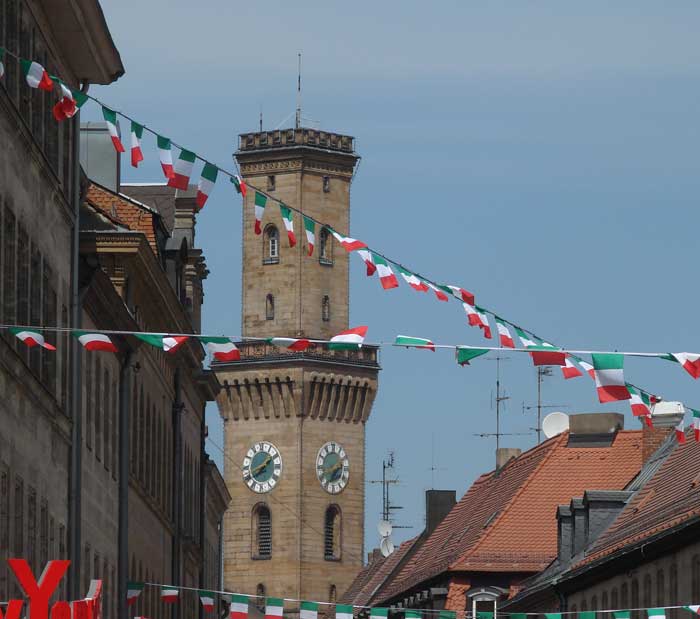
Rathaus, Fürth:
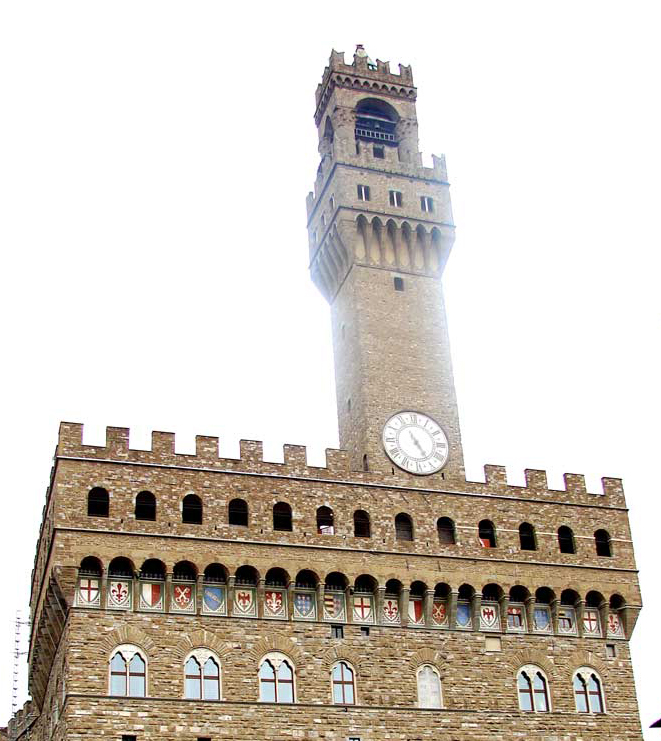

Palazzo Vecchio, Florence:
Rathaus, Fürth:
The Hopperesque landscape outside my office window is endangered. I only have to go away for a week and someone puts a tree there.

And I really have to keep an eye on it. Look what I saw today. What does this mean?
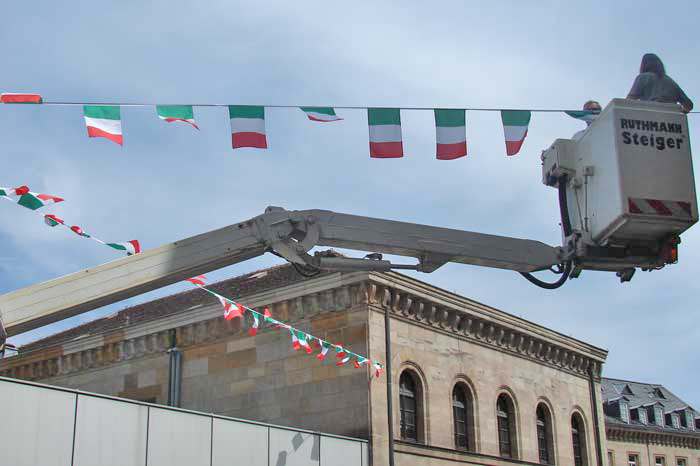
I’m a bit late on this story of a freelance subtitle translator slipping a joke into the programme (accidentally?)
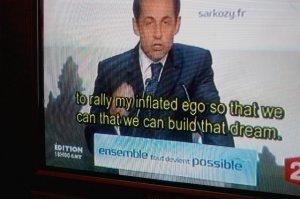
This was apparently an American freelance and the subtitles were seen in the USA on April 23:
Le 23 avril, un reportage du journal montre un discours de Nicolas Sarkozy. A un moment, le candidat UMP invite les Français à «sunir à moi». Ce qui, traduit avec un brin de fantaisie en anglais, donne: «rally my inflated ego» («unissez-vous à mon ego surdimensionné»).
English reports here and here.
A top official with France 2 swiftly blamed the gag on American freelance journalists who play with the translations to amuse each other, including this one that managed to surface on television instead of their PCs.
None of this explains how you can ‘fire’ or ‘sack’ a freelance.
Via Enig
1. 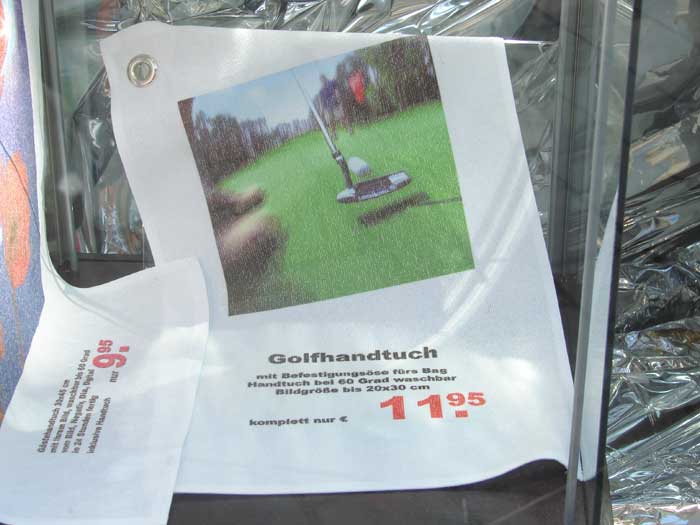
(Print your own photos on)
Golfhandtuch
mit Befestigungsöse fürs Bag
Handtuch bei 60 Grad waschbar
Bildgröße bis 20 x 30 cm
Komplett nur EUR 11,95
Sommergrüns geöffnet
Sehr geehrte Mitglieder und Gäste,
ab sofort sind die Sommergrüns wieder geöffnet! Trollies sind ebenfalls erlaubt!
Auf Grund des geringen Wachstums besteht die Möglichkeit, dass bei schlechten Wetters die Sommergrüns wieder geschlossen werden.
Vielen Dank für Ihr Verständnis!
Ihr Team der GolfRange Nürnberg
I thought summer greens were something you ate. Or is that spring greens?
LATER NOTE: My attention has been drawn to this poetic description of some holes (apparently regular players were each invited to describe their favourite):
Ein unbeschreibliches Gefühl des Glücks steigt in einem auf, sobald der Abschlag des 10. Loches betreten wird. Der Rundblick, der sich von hier aus auf die Voralbberge und die Täler der Fils, Lauter und des Reichenbaches bietet, gibt jedem ein Gefühl der Weite und Schönheit unserer Heimat.
This is not golf as I remember it, the game where the angrier you got with the ball, the worse your score became, and looking at the view was quite out of the question.
In the Guardian
(via Astrid Paprotta)
ck’s comment on a recent entry warrants more discussion so I reproduce it here:
Dieser Gedanke “I will be more likely to devise some rules of etiquette and consider how to phrase comments to the author, rather than seguing into a rant about stupid foreigners who think they can write English.” sollte irgendwie standardisiert werden. Zu einem aus dem Deutschen uebersetzten Vertrag machte ich mir kuerzlich diese Gedanken, die gegenueber dem Uebersetzer hoffentlich fair sind:
“Zunaechst ist der englische Text fuer den amerikanischen Juristen sowie Gerichte, Schiedsgerichte und die Geschworenen im Zivilprozess nicht verstaendlich. Das gilt bei einzelnen Passagen ganz besonders, aber im Ergebnis auch fuer den gesamten Vertrag.
Dabei will ich nicht die Uebersetzerarbeit kritisieren. Die amerikanische Juristensprache ist schon fuer Amerikaner schlimm genug. Fast kein Uebersetzer kann bei der Uebersetzung von Begriffen aus einer Sprache in die andere auch die hinter jedem Begriff stehenden Rechtsbedeutungen kennen. Um der rechtlichen Bedeutung jeden Begriffs gerecht zu werden, muesste der Uebersetzer ja auch den Vertrag umschreiben.”
Ist das fair? Wieviel Toleranz haben Uebersetzer fuer die Kommentierung ihrer Arbeit durch Anwaelte? Wenn Anwaelte und Uebersetzer unabhaengig voneinander fuer einen Auftraggeber arbeiten, kann sich die Arbeit verdoppeln. Wenn sie zusammenarbeiten – oder dem Anwalt zumindest mitgeteilt wird, ob der Vertrag von einem Uebersetzer uerbersetzt wurde oder nur einen Versuch darstellt, einen Vertrag auf Englisch zu verfassen -, lassen sich einige Probleme vermeiden.
I can’t have made myself clear. I was referring to corrections of guides to churches and castles, where the correction contains wrong grammar. For instance, I once had my name omitted from a brochure where I had written (rather stiffly) ‘The boot [a bootmaker’s diploma work] has a height of 2 m’ and this was changed by the author into ‘The boot has a high of 2 m’, on the assumption that I couldn’t write English. The example ck refers to, where a lawyer, who may be a German who has lived in the USA for a long time, corrects the translator’s knowledge of English law. That is certainly not what I meant by a native speaker being corrected by a non-native – in fact I don’t see the connection.
So, what does a translator think if a lawyer corrects the translator’s legal English?
I don’t know! My legal English is sometimes corrected by German lawyers. Indeed, I can well imagine that they change whatever they like and don’t report back to me. After all, the translations aren’t often published. And I can’t remember getting a comment on the few occasions when my work was received by an English lawyer.
There surely might be problems. ck is thinking of using terms appropriate for a U.S. lawyer or layperson. I might not have the right ones for an English lawyer or layperson. My translations go to more than one country and not just to native speakers of English. That’s why I was interested in the presentation referred to. If I suddenly started translating regularly for people solely in the England and Wales legal system, I think I would have to be broken in. I would have to be grateful for any correction.
But what do they want? Examples, ck? I have a feeling I would be wanted to translate Rechtsanwalt as solicitor and Kläger as claimant. I am afraid there would be cases where I would not be happy about this. Much as I like to do a lot of what the customer wants, there is a limit to how many specialized vocabularies I can keep apart.