I didn’t think this sort of thing was encouraged.


I didn’t think this sort of thing was encouraged.
Marienplatz, Munich, 12 noon
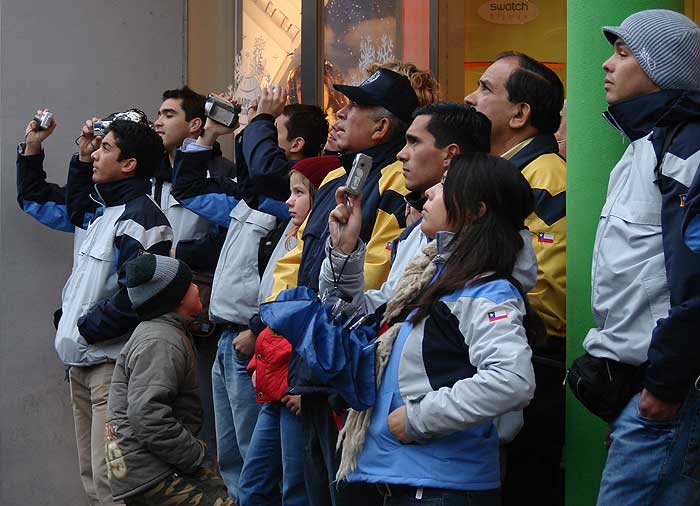

Here’s the explanation (click to enlarge):

A tourist site says:
The Christmas fairs and markets of Germany are unique. If you’re tired of commercialism taking over this holiday period and would like to get right away for a real traditional Christmas you might consider heading to Germany where gifts are not mass-produced but craftwork of real quality.
Here you can buy all kinds of Christmas merchandise and gifts, especially traditional things such as crib figurines, toys, wood carvings, marionettes, candles and lambskin shoes. Many are difficult to resist – as will be the glass of delicious mulled wine you are offered and the baked apples that are very welcome on crisp winter days.
(My italics). That is the trouble. By the eiusdem generis rule, the expression ‘all kinds of’ followed by ‘crib figurines, toys, …’ etc. excludes things that would not fit in that list, such as computer games, plastic reindeer heads, the new Hannibal Lecter novel, MP3 players and mass-produced confectionery – even though some might associate these with Christmas.
Here is Lord Rooker speaking in the House of Lords on the eiusdem generis rule (Romain says Auslegungsregel der Beschränkung eines Sammelbegriffs auf Gegenstände der aufgezählten Art):
As I understand it – I am not a lawyer – No, I am not, but I say to my noble friend that sometimes I have a little more common sense than the lawyers and I do not use as many words as they do. I apologise for that but I cannot read in long paragraphs. However, I am reliably informed that in the definition of conditions of service is the word “includes”. That is an important word, as are the words that follow it. So far as concerns the lawyers, it means that only certain things may be added to the list of pay, allowances, hours of duty or leave. The list is not as long as a piece of string.
I sought expertise because I was wondering how on earth to pronounce eiusdem generis. I am sure the lawyers say that this is the same kind of thing; in other words, that the word “includes” means that only things of the same kind can be added to a list.
Here’s a Christmas market in the German style outside Winchester Cathedral.
The Cathedral will source the very best exhibitors to fill the chalets, to satisfy and inspire the most discerning shoppers. Professional artists, craftspeople or international exhibitors would be most welcome. The variety of stalls will include gifts for all tastes and budgets. From traditional wooden Christmas decorations from England and Germany to gifts from Provence, Danish hand-blown glassware, fine linens, studio pottery, knitwear, silk screen designs and much more.
Only for the discerning, but (to quote the first site) an odd way of ‘getting away from commercialism’.
Btw, non-natives might note the ‘hand-blown glassware’ (mundgeblasen). Blowing is obviously a variable activity.
Thanks to kalebeul.
The Complaints Choir of Birmingham on You Tube. Apparently this follows Helsinki.
These gardening gloves come from Räder (click on Collection and click through a few pages). On the green thumb is the word Bloom, which I suppose is intended to be Neudeutsch. At all events, a person whose native language is English might be mystified. An ideal Christmas present for the person who wants to create an air of mystery, perhaps.

The reason I came by Ben’s notes on translations from the German was because I received an email from Jean-François in France, or at least via wanadoo.fr, on the topic of resp., which he said is OK in mathematics contexts. He had read on my blog that the abbreviation resp. doesn’t exist in English.
It is used in mathematics.
For an example, go to:
http://home.att.net/~numericana/answer/symbol.htm
And search for “resp.” in the page.
Or do a Google search with: resp. mathematics.
I have to admit that this page and numerous other Ghits (© Trevor) cast serious doubt on my opinion. However, I do note that the author of this page is called Gérard P. Michon. He did his Ph.D. in Los Angeles, but there’s something not quite American about his name. And so it is with other Ghits (I haven’t looked at all of them).
So I wrote to Ben, who translates maths, but he didn’t seem too keen on resp. either.
Jean-François had been asked by an American technical writer from his company what he meant by resp. He also added – ‘just for fun’ – the following, which I pass on as I haven’t been able to digest it:
On supports of induced representations for symplectic and odd-orthogonal groups.
Abstract:
Let G be Sp(2n,F) (resp. SO(2n+1,F)), where F is a p-adic field of characteristic zero. In this paper, we give a correspondence which associates to an irreducible representation π of G an m-tuple of irreducible representations of lower rank symplectic (resp. orthogonal) groups based on the supercuspidal support of π. We show that this correspondence respects the induction and Jacquet module functors (in a sense to be made precise), as well as verifying a number of other useful properties. In essence, this correspondence allows one to isolate the effects of the different families of supercuspidal representations of general linear groups which appear in the support of π.
Meanwhile, someone else came to my site looking for resp. The search also threw up a discussion between some people in the USA on the use of respectively. One of them had written ‘Respectfully submitted by …’ and had this corrected to ‘Respectively submitted by …’ It was posited, of course, that this might be British usage. Finally the questioner decided to omit the word altogether.