Blog translation carnival for June/Blog-Übersetzungen

Wer einen im Juni veröffentlichten Blog-Beitrag in irgendeine oder aus irgendeiner Sprache übersetzen will, kann dies tun, im eigenen Blog veröffentlichen und Chris davon in Kenntnis setzen (sie kann auch sehr gut deutsch!). Details auf Englisch und Französisch hier.

Chris reminds me of Blog Translation Carnival, which I mentioned in February but have shamefully not been following since. Post a translation of anyone’s blog entry in any direction on your own blog and notify Chris. I’m not sure what happens then.

Apparently this carnival is hosted by a different weblog each month. I have now discovered that you have to look on the blog in question on the given day (what day is that, Chris?). So the first one, on February 28, is here at Altalk Blog. The second is at Em Duas Línguas. The Bitter Scroll had the April one, and sauvage noble the one for May.

A hint is that the Carnival takes place at the end of a month, so you can look for May in June, and today’s invitation is to participate in the June carnival.

Rooney’s educated uncle / Falscher Dolmetscher legt ARD rein

Apparently the German TV station ARD broadcast an interview with an ‘uncle’ of Wayne Rooney’s. To quote the Independent:

bq. Mr Rooney describes himself as a freelance author and interpreter. He says he moved from Manchester to Germany in 1973, apparently completing a PhD at the University of Bremen, after learning German by reading the works of Heinrich Heine and Gotthold Lessing and the German football magazine Kicker.

German report in Spiegel Online.

It seemed odd that the man has the surname Rooney but claims to be a brother of Wayne’s mother. Perhaps the complexity of German names law confused the reporter.

bq. “He is a fantastic footballer. I always told him that he could be one of the greats if he could keep injury-free.” Asked how he reacted to news of Wayne Rooney’s broken metatarsal, he said: “I thought, it’s happened again. Oh shit!”

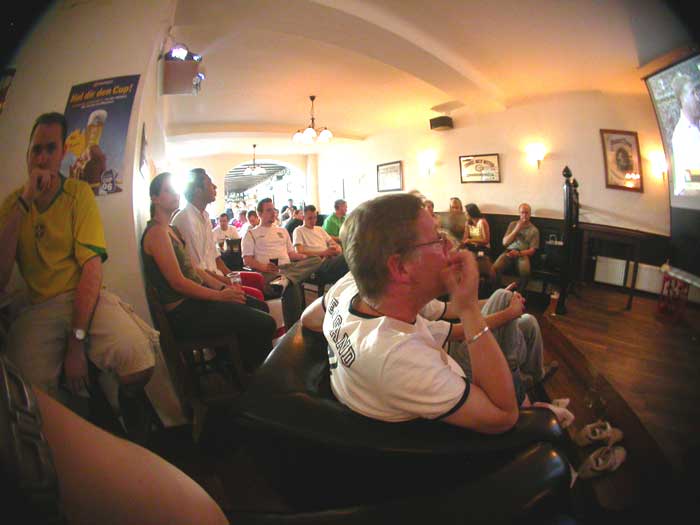
I wonder what he’s saying now. Nailbiting times at Wheeler’s Pub in Erlangen:

wheel1w.jpg

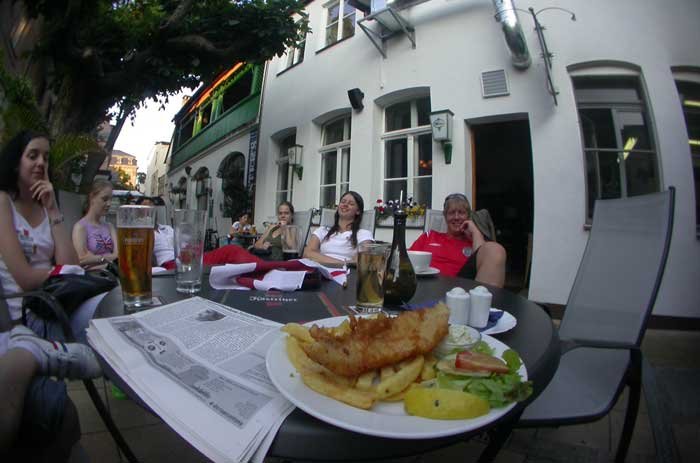
And recovering outside with fish and chips after the game:

wheel2w.jpg

Dutch weblogs / Niederländische Blogs

There’s a thread in the non-English sections of ProZ, in non-English, about translators’ weblogs (Blogs van vertalers). This has some links.

Jonathan Faydi has started Batavisme, which is French and Dutch.

Wouter van den Berg has Over vertalen en wat de vertaler verder hoog zit.

Anjo Sterringa has lost in translation. He is in Spain, with dogs, a cat, and donkeys, and translates between Spanish and Dutch and English and Dutch.

Bartvb (English) is by Bart B. Van Bockstaele, who is Flemish and lives in Toronto. So is Wondere Wereld (Dutch). Bart also writes on De Standaard Online.

Saskia Steur writes Wording.

Having the last word/Stimme aus dem Jenseits

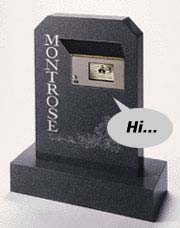
Tombstone.jpg

The Talking Tombstone speaks to passers-by. I feel it would be cheaper to get a number of those toy parrots with the voice mechanism and sit them on top of the stone. Of course, they might say the wrong thing.

Gizmodo (German / Deutsch, which has further links) suggests using it for insults:

bq. Noch in der Grube kann man mit diesem sprechenden Grabstein seine Nachwelt beleidigen, Verwandtschaftsstreitigkeiten bis zum Ehrenmord schüren und generell das letzte Wort behalten.

I don’t think one could get away with that in Germany, although it might be hard to pin down a defendant.

Football exhibition at Jewish Museum/Kick it like Kissinger 2

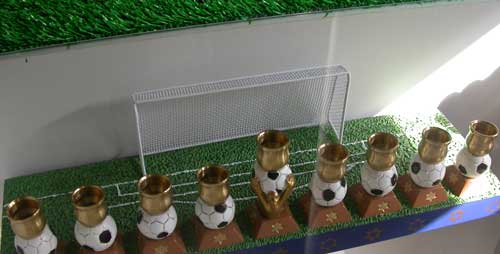
chanw.jpg

Hanukkah lights

When I mentioned the football exhibition in the last entry, I forgot to say that the film Bend it like Beckham was translated into German as Kick it like Beckham, hence the title of this exhibition: Kick it like Kissinger, rather than Bend it like Bensemann. And Rabbit-Proof Fence appeared here as The Long Way Home. In the old days they would have been called something like Jessica will es endlich wissen and Drei Aborigine-Mädchen gegen die Welt. Either way, it’s often difficult to guess what film is showing.

The catalogue asks whether football can be presented in a museum and says:

bq. Die Frage, ob Fußball überhaupt ausstellbar ist, verweist auf eine besondere Eigenart der Überlieferung im Fußball: Seine Anhänger bilden eine klassische Erinnerungsgemeinschaft. Sie gruppiert sich um gemeinsame Erlebnisse, die überwiegend mündlich tradiert und immer von neuem erzählt werden.

It’s organized as an alphabet: A for Abseits, B for Bensemann, C for Cup. There are recordings, for instance of football crowds chanting and drumming:

bq. Das Fußballstadion ist zur Kathedrale der Neuzeit geworden: Fußballspiele ersetzen für viele die Kirchenbesuche. Dabei weist das Verhalten von Fangemeinschaften starke rituelle Züge auf. … durch Kleidung in den Vereinsfarben, Gesichtsbemalungen, den Genuss von narkotischen Mitteln und Fangesängen. ….Lieder und Rhythmen entstehen meist spontan während der Spiele und werden durch Klatschen und Paukenschlag unterstützt. Dabei treten unbewusst archaische Elemente in Dreitonfiguren auf, die der Kirchenmusík entspringen, sowie Melodien aus der Volks- und der Popmusik wie auch der Klassik. Die aggressiven Gesänge dienen der Unterstützung der eigenen Mannschaft wie auch der Entmutigung und Abschreckung der gegnerischen Mannschaft und ihrer Fans.

There’s a film of the Theresienstadt football game organized by Nazi propagandists for the International Red Cross delegation – all those shown and many others, almost 20,000, were deported to Auschwitz when the delegation left.

One reason Jews played such a big role in the early days of football championships was because they were excluded from the nationalist German Turnvereine (sports clubs). Hirsch died in Auschwitz, Fuchs escaped to Canada. Sindelar (Austria’s greatest player) died in 1939 at the age of 36 in mysterious circumstances. Friedrich Torberg’s poem associates his death with the Third Reich (it was probably suicide – he’d refused offers from teams abroad – and the Gashahn reference is to the carbon monoxide poisoning found):

Es jubelte die Hohe Warte,
der Prater und das Stadion,
wenn er den Gegner lächelnd narrte
und zog ihm flinken Laufs davon –

bis eines Tages ein andrer Gegner
ihm jählings in die Quere trat,
ein fremd und furchtbar überlegener,
vor dem’s nicht Regel gab noch Rat.

… Er war gewohnt zu kombinieren,
und kombinierte manchen Tag.
Sein Überblick ließ ihn erspüren,
daß seine Chance im Gashahn lag.

The whole poem is here. And the exhibition isn’t like that throughout.