Early live translation / Maschinelle Übersetzung im 19. Jahrhundert

Trevor’s scholarly translation (with footnotes disguised as sidenotes) of a chapter in Pío Baroja’s novel The adventures, inventions and mystifications of Silvester Paradox / Aventuras, inventos y mixtificaciones de Silvestre Paradox (1901) introduces an English conman called Mr Macbeth:

bq. Still not satisfied, Macbeth, drunk and impassive as ever, explained to the public an apparatus of his invention, the optical and acoustic translatoscope. The translatoscope was a simple apparatus—how simple!—based on the learned and little-known principle of Dr Philf, by which words, spoken or written, expand as they advance to the tropics and contract as they recede. Hence, the construction of a translatoscope requires nothing more than the combination of a system of convergent mechanisms that pass gradually to flat menisci and then to divergent menisci and place them in a tube. The menisci may be optical or acoustic, as is wished.
If one talks through one end of the tube in English, the words will issue from the tube’s other extremity in Spanish. The same occurs when one looks through the tube, since the translatoscope translates everything. The secret lies in nothing more than the calibration of the screws.

They are still trying to make this kind of thing work today.

English in Nuremberg / Engländer in Nürnberg

Some curious statements from the local rag (most of them yesterday, so probably no longer available online):

In Britain, 29 per cent of the population are Anglicans, 11 per cent Protestants, 11 per cent Catholics and 1.5 m Moslems. 41 per cent have no religion.
(Who did they get this from – a Presbyterian?)

An English woman who has lived in Nuremberg for fourteen years had terrible trouble getting a job when she first came and it was almost impossible to get a residence permit (Aufenthaltsgenehmigung) – Pardon? What happened to the EU?

Green party city councillor Brigitte Wellhöfer on the number of English fans who go around with their shirts off: ‘Die Männer hier sehen doch alle nach Feinripp-Unterhosen aus’. (The men here all look as if they had fine-ribbed underpants.) – I find this hard to understand – does she mean you can see the imprint of their jersey underpants on their skin? Just as well the fans couldn’t hear it.

Insgesamt ist Großbritannien eine Inselgruppe zwischen Atlantik und Nordsee.
(Haven’t they left someone out?)

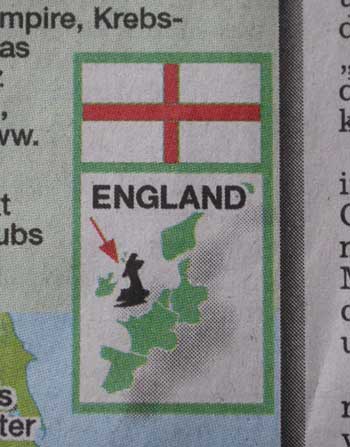
They also have a map entitled England, where Scotland and England are marked black, whereas Ireland and the Hebrides have been left green.

engnnw.jpg

Well, they didn’t get that from a Presbyterian.

Dutch for Alsatians / Fremdsprachige Hunde

British police dog handlers are having to learn some Dutch commands to deal with imported dogs:

LONDON (Reuters) – Police dog handlers are having to take language classes — to communicate with their latest recruits.
Finding it increasingly hard to find suitable German Shepherds in Britain, some police forces are bringing in dogs from continental Europe.
But there’s a problem.
Although the latest arrivals possess all the attributes needed for police work, they only respond to commands in their native language.
Dog handlers at Avon and Somerset police for example,
which has recruited three dogs from the Netherlands, have been given a sheet of practical commands in Dutch.

Thanks to TranSlater.

Football fans / Fussballanhänger

jackr2.jpg

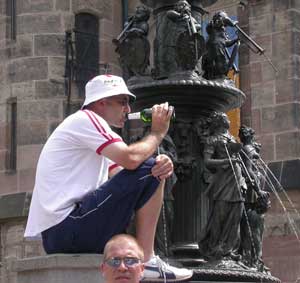
Just a few pictures since, as I have already said, this blog has nothing to do with the World Cup!

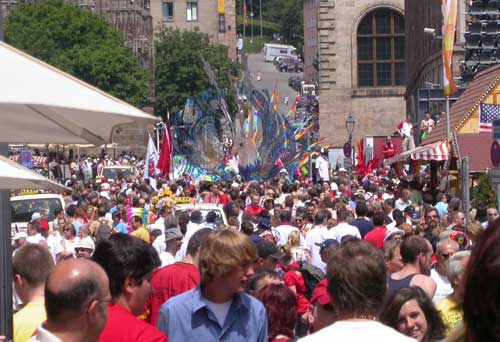
There is a webcam of the main marketplace in Nuremberg, where fans can drink and watch, either the scene at present or a speeded-up film of the past 30 minutes, at the Nürnberger Nachrichten site (scroll down).

carnivw.jpg

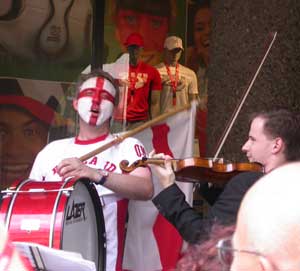
This was ‘God save the Queen’ by a fan with drum who had gatecrashed a classical music busking duo:

drum2w.jpg

This one needs some Photoshopping:

tug2w.jpg

Note the Lebkuchenherz slogans: Wir holen den Titel and Elf Freunde müsst ihr sein

dt2w.jpg

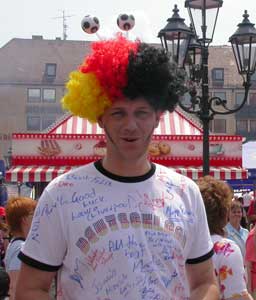
I’m afraid this person’s friends tried to put paint on my face in the German colours!

dtw.jpg

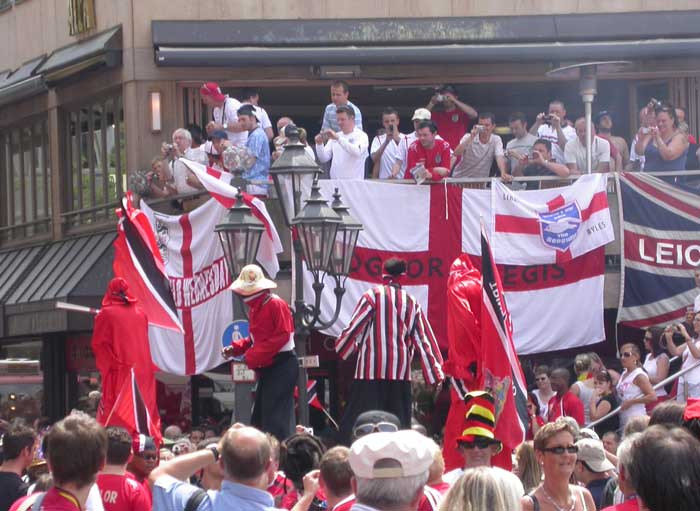
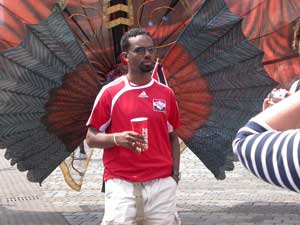
Trinidadians on stilts:

gallw.jpg

The baker Beck:

beckw.jpg

Some people will get in the way of the camera:

photw.jpg

scilicet / ss.

In an earlier entry I referred to various meanings of the abbreviation ss.

That is one of the problems, that ss. can mean a variety of things, and my summary may be a bit confusing. Ian Harknett points out that there is an 1856 Bouvier law dictionary online that says ss. means scilicet:

SCILICET. A Latin adverb, signifying that is to say; to wit; namely.
2. It is a clause to usher in the sentence of another, to particularize that which was too general before, distribute what was too gross, or to explain what was doubtful and obscure. It neither increases nor diminish the premises or habendum, for it gives nothing of itself; it may make a restriction when the preceding words may be restrained. Hob. 171 P. Wms. 18; Co. Litt. 180 b, note 1.
3. When the scilicet is repugnant to the precedent matter, it is void; for example, when a declaration in trover states that the plaintiff on the third day of May was possessed of certain goods which on the fourth day of May came to the defendant’s hands, who afterwards, to wit, on the first day of May converted them, the scilicet was rejected as surplusage. Cro. Jac. 428; and vide 6 Binn. 15; 3 Saund. 291, note 1, and the cases there cited. This word is sometimes abbreviated, ss. or sst.

Merriam-Webster’s Dictionary of Law says the same – enter ss here and you get the same result as in the paper version (but there’s no entry for scilicet):

ss
Latin scilicet that is to say
specifically (used in the statement of venue which follows the caption of a legal document and esp. between the name of the state and the particular subdivision (as county))

Actually, this information is hidden in my earlier entry. T. Carter in the third comment mentions that example. Here are two uses of ss. to illustrate the problem:

1. State of Maryland ss. County of Price George’s

2. District of Columbia, ss.:
John Rand, being duly sworn, deposes and says that he has read the foregoing bill by him subscribed and knows the contents…

In 1, ss. can be taken to mean ‘more specifically’. In 2, it can’t. The layout is also different, that is, it doesn’t look as if the subdistrict has simply been omitted.

At all events, whether the interpretation is 1. ‘scilicet’ or 2. ‘some meaningless letters that have been copied mindlessly over the years’, the ss. can be omitted in a translation into German.