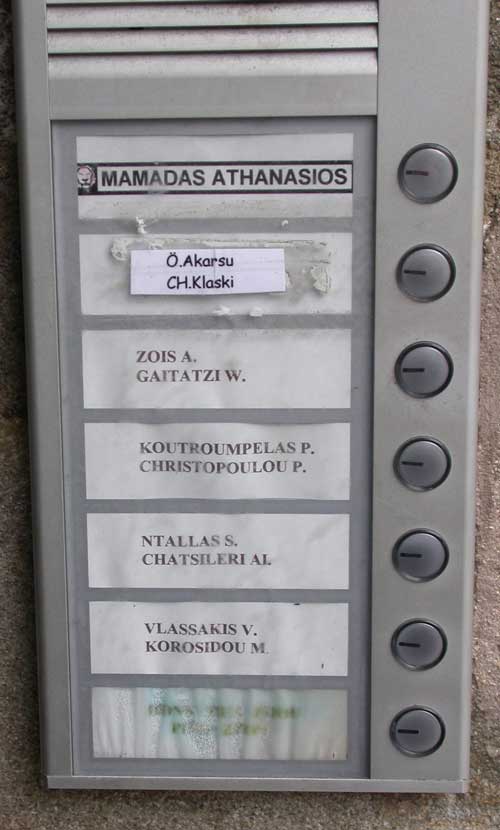
Broken sequence / Fürther Türklingel die wievielte
Reply

A client would like me to send my invoice to a different address.
bq. Ihre Rechnung rückübersenden wir Ihnen zu Ihrer Verwendung.
Just a note that both Language Log and languagehat have entries about poor court interpreting and its effects for the defendant. Bill Poser in Language Log talks about people who can speak two languages but don’t know anything about interpreting, and the fact that they may abridge.
bq. Interpreters may be highly qualified, or they may be the bailiff’s sister who took a little Spanish in high school. No one really knows how often this leads to miscarriages of justice, in part because it is very difficult to appeal on these grounds because appellate courts normally consider only the written record of the trial, and the written record contains only the English translation of the testimony, not what was actually said.
Poser compares Canada and the US, but I fear there is nowhere in the world you could be guaranteed a good interpreter. In Germany, there are sworn interpreters, but not for all languages, and the judges don’t always call sworn interpreters (and, dare I whisper it, not even all sworn interpreters are perfect). The thing that worries me most is the inability of some judges and presumably of most people to understand what interpreting involves.
Steve at languagehat picks up the point about the difficulty of appeal:
bq. This strikes me as a serious problem, and it seems to me that trial records should include a taped record of foreign-language testimony so that if there is a complaint about the translation it can be checked. Otherwise, what’s to prevent an ignorant or malicious interpreter from completely distorting, or even inventing, testimony?
He asks what the situation is in other countries. Bill Poser says in all common-law countries appeals can be based only on the written record. I feel I should know the answer to this. I think the written record is only a big deal in the USA. However, I don’t know how far one can appeal against misinterpretation. Btw, don’t miss the comments at languagehat.
Some good descriptions of the interpreter’s position at the court interpreter weblog. A German interpreter, but with a broader weblog range, here at Plain English.
Michael Kadlicz links to a wonderful video advising Germans to learn English, a Berlitz ad.
It’s rather reminiscent of Tony Hancock’s Radio Ham (possibly downloadable here), but more concise.
Do I need an MP3 player?
bq. The Pope has joined the Queen, George Bush and millions of others by getting himself an iPod.
Pope Benedict XVI was given a white, 2GB iPod nano by a group of Vatican Radio employees on Friday at an event to celebrate the station’s 75th anniversary.
They had pre-loaded it with some of the station’s programmes in English, his native German and Italian, and some tunes. Staff are presumably hoping that the Pope will be able to use his new gadget to keep up to date with Vatican Radio’s podcast for all the latest Vatican news and gossip.
From the Guardian. Commenters are invited to suggest more music for him to have on it.
An article in Egypt Today on Denys Johnson-Davies,who is translating the Koran:
bq. Johnson-Davies returned to London, where he stayed from 1954 to 1969, but could not find a job working in Arabic. Instead, he became a barrister, practicing specialized equity law.
It is a question of akl aish [daily bread], as they say, confiding that he was never happy attired in his wig and gown, It bored me to tears. He later gave up law and set up an office specializing in Arabic translation. Clients hired him to translate in negotiations for contracts, especially in Saudi Arabia.