The Times Online also has David Pannick’s review of 2005:
Cartoon of the year was by Pat Byrnes in The New Yorker. One lawyer says to another, Remember, we can only afford to do all this pro bono because of how much anti bono pays.

The Times Online also has David Pannick’s review of 2005:
Cartoon of the year was by Pat Byrnes in The New Yorker. One lawyer says to another, Remember, we can only afford to do all this pro bono because of how much anti bono pays.
David Luke, who has died at the age of 84, is described by the Times as:
Translator of the German classics whose versions were regarded in some quarters as being better than their originals. Some of my translations are better than the original, but they aren’t by Goethe. The comparison was made by Stephen Spender.
According to his own account, it was the realisation that most of his pupils simply lacked the linguistic knowledge to understand and enjoy the great riches of German literature that led him to embark on the sustained work of translation that began with his translation for Penguin of the poetry of Goethe in 1964 and continued almost until his death. His published translations, which included much or most of Kleist, Mörike, Stifter, the Brothers Grimm and Thomas Mann as well as almost all the poetry and much of the prose of Goethe, are likely to be his most enduring literary legacy. …
(He once complained to the chaplain at Christ Church that his pupils took no interest in German grammar; all they were interested in was fornicating. To this the chaplain replied: But you must admit, David, fornicating is much more interesting than German grammar. He did admit it.) …
Eventually he was received into the Russian Orthodox communion. For some years he was an active member of the North Oxford congregation where he sang the Church Slavonic liturgy with great gusto and delight. Finally, however, he found it impossible to reconcile the facts of evil with the hypothesis of a benevolent creator.
I would like to know more about how most of Luke’s doctoral thesis was typed on lavatory paper (I write that as someone whose thesis should have been typed on lavatory paper).
There’s an obituary in the Independent too (link updated 26.3.2026).
LATER NOTE: The quote comes from an obituary in The Times, now in 2026 behind a paywall. There is plenty of information online, including a Wikipedia article.
David on TEFL Smiler asks:
bq. Finally, for the moment here’s a totally unrelated question: shirts have sleeves, right? But what about jumpers? I say they have arms, whereas someone I know here (from London) insists that they have sleeves, just like shirts. Any thoughts?
And here’s the rub: two of his commenters actually agree with him!
This is almost as bad as Germans calling a sleeveless (armless?) jumper a Pullunder.
Is it correct to translate ‘Quel jeu doit-on jouer vis-à-vis des autorités de Californie?’ as ‘What game must we play with the California authorities?’
This question came up for consideration by a United States District Judge recently. He certainly felt competent to answer the question with the help of a bilingual dictionary (I think I could work twice as fast if I had the self-confidence about legal translation that some judges have). I can’t really judge this French, though.
bq. 10/02/2005 : John Garamendi, vs. Altus Finance S.A., et al. – Order Denying MAAF’s Motion to Preclude the French Phrase “Quel jeu Doit-on Jouer Vis-a-Vis Des Autorities De Californie?” as Used in Mr. Simonet’s Notes From Being Translated as “What Game Must We Play With the California Authorities?” [Motion 12] Case No. CV 99-2829 AHM (CWx)
Eugene Volokh writes that French will never rise to the importance of Yiddish in court opinions. Here is a paper on that subject by Volokh and Judge Alex Kozinski
bq. The more likely explanation is that Yiddish is quickly supplanting Latin as the spice in American legal argot. As recently as 1970, a federal court not only felt the need to define “bagels”; it misdefined them, calling them “hard rolls shaped like doughnuts.” All right-thinking people know good bagels are rather soft. (Day-old bagels are rather hard, but right-thinking people do not eat day-olds, even when they are only 10 cents each.) Weve come a long way since then.
(Thanks to Chris Durban. Netlex blog (French)
Familien-Landhotel Moerisch, Towersuite/Chimneysuite:
bq. Elegant suite with Italian style furniture in the 3rd cane, large living room, equipped with minus bar, desk, telephone, internet connection, safe, Sat-TV, south balcony. Bathroom with Whirlbowl and large panorama window, divided shower, WC, make-up mirror and hair blower. The bedroom is in the terminated upwards and controls Sat-TV.
Furthermore in that upwards: infrared sauna, shower and extra WC… One grants himself otherwise naught….
bq. My grandfather Sigismund Eduard opened an inn with a Gemischtwarenhandel with its woman Elisabeth in the between wartime and he managed the agriculture. My father Sigismund Albert in the year 1955 harbored the first guests – at that time yet as a bachelor with its mother. Instead of large bathroom, there were Waschschuesseln and water pitcher at the room.
But Power Walking should not have become Power Whale King, should it? Or Golfpauschale Gulf Lump Sum. Or die verschiedensten Wanderwege as the most deceased.
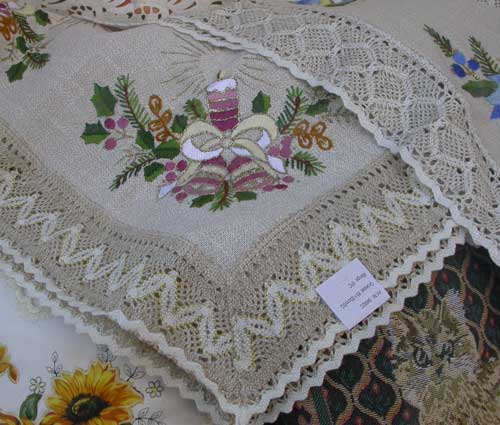
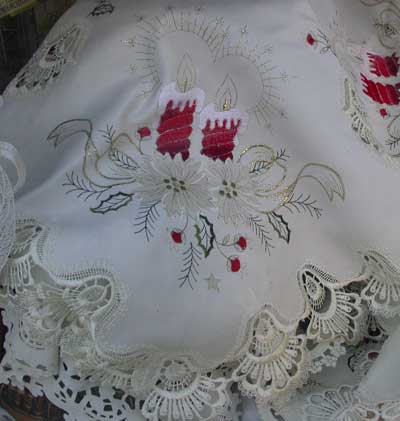
These are German Advent tablecloths. You don’t often see them except in December. Each of the four corners stands for one of the four Sundays in Advent. At the end of the day, the corner for that Sunday is ceremonially burnt, so after the fourth Sunday, there is only a charred heap remaining, and at the beginning of January embroidery starts on the one for the following December.