
Derrida’s rhubarb crumble

A query and its answers on ProZ, followed up by a quick Google, showed me that people do really talk about deconstructed clothing. I had only ever, I thought, heard of unconstructed, which I think means untailored. But in fact Collins English Dictionary mirrors my Google search: “having no formal structure: a deconstructed jacket” (although it does not mention the jacket potato and deconstructed rhubarb crumble I also found. Can anyone at the Cambridge Science Park in the UK tell me if that rhubarb crumble is baked normally and then dissected on the plate before serving? Because to my mind deconstructing implies dissecting, physically or otherwise. – I mean ‘deconstruction’ in the popular sense rather than in the Derrida sense). A deconstructed jacket would be one where all the seams have been unpicked. But of course, language change is not a logical thing.

But perhaps Wikipedia’s failure to find a definition is the answer:

bq. In Philosophy and Literary Theory, deconstruction is a strategy of critical analysis closely associated with Jacques Derrida, which aims to expose unquestioned metaphysical assumptions and internal contradictions in philosophical and literary language. However, because a deconstructive approach challenges the transparency of language (and especialy the ability to ever arrive at a single final meaning of a word), most of deconstruction’s key proponents would object to such a definition. Derrida especially avoided defining the term and resisted the attempts of later academics to turn “deconstruction” into a coherent strategy or system. As a result, it is all but impossible to describe deconstruction in a perfectly satisfactory way.

Copyright prevents me from adding Gary Larson’s cartoon of ‘Giorgio Armani at home’, which shows the distinction between deconstructed clothing and slobdom.

Crumble derives from German and Austrian Streuselkuchen – I believe this because we never had it at home – my mother (b. 1905) regarded it as newfangled. To quote iVillage.co.uk:

bq. Although crumble has been around as long as our grandmothers and great grandmothers can remember, there are no such recipes in old English cookbooks. They only began to appear in print in the twentieth century and it seems likely that crumble really came on to the scene during World War II.

bq. A crumble topping uses basically the same ingredients as pastry – flour, butter, sugar and sometimes spice – but is much simpler to make. (During wartime when butter was in short supply, cooks had to use whatever was available.)

bq. It’s possible that the great British crumble is a derivative of Streusel, a sweet topping for tea breads and cakes originating in Austria and Central Europe and almost always containing ground cinnamon. Streusel comes from the German word streusen, to scatter, [MM: if only language were that simple!] which is also how we apply our crumbly topping to fruit. Streusel has more sugar in relation to flour than crumble, and the result is a crisper (and naturally sweeter) topping. The Americans also have a version of a fruit-crusted pie called cobbler. The cobbler topping is sometimes used for meat stews as well as fruit.
Reading other blogs

Here is some miscellaneous weblog reading:

Claire at anggarrgoon has been reporting on fieldwork on an aboriginal (I think) language, I presume on some island near Australia – unfortunately not all under the category Fieldwork, but from about May 13 to July 14:

bq. We can’t tape stories because there’s always someone getting up to go outside for a smoke (the door creaks badly and they try to open it quietly, ergo slowly) or making tea (boiling jug, running water) or humbugging me for jam and sugar (last time I had all the ladies here at once we went through nearly half a kilo of sugar just in tea) or having another conversation in the background. We did some of the motionland videos and some of the “cut” and “break” stimuli. I didn’t want to do them with LM there because she always wants to say things in the simplest way possible, why use a verb meaning “split something lengthwise in half with a sharp tool” when you can use a generic word like “cut”? Why use “slide” when you can use “move”, the same word you’ve used for all the previous sentences?

From kalebeul: Buying goldfinches:

bq. I’m beginning to suspect that a lot of people come out walking principally for the bizarre drinking opportunities encountered on the way. This morning we were having coffee, shots and doughnuts in an Andalucian bar in Nou Barris (one of the many variations on the Collserola ridge route) when a ridiculously sleek blue car with XXL wheels drew up outside and a gent with gorgeous black locks came in carrying a couple of small canvas-covered cages. … “Stuff you and your fucking canaries,” said the gypsy, “have you never heard an Andalusian finch sing?”

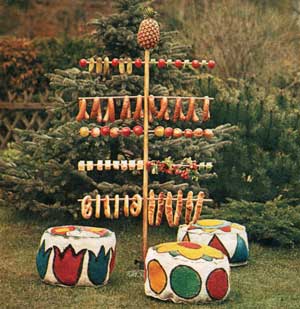
And for the hot weather: Ostblog had some wonderful pictures of barbecuing in the GDR in 1967. This was on June 22. The following photo is smaller than the original:

tom-gartenfest2.jpg

bq. Eine besondere Überraschung für Ihre Gäste ist der Schlaraffenbaum, an dem Sie allerlei Appetithappen anbringen können. Er läßt sich ebenfalls leicht herstellen. Nehmen Sie einen 1,20 m langen Besenstiel und bohren Sie in Abständen von 20 cm Löcher hinein.
Durch diese Löcher werden 40 cm lange Dübelstangen gesteckt. Auf die waagerecht zueinanderstehenden Stangen die Nahrungsmittel aufspießen. Gurkenscheiben, Apfel, Salzstangen und Käsehappen erhalten vorher ein Loch. Zum Ausstechen eignet sich am besten ein Apfelstecher oder ein Tablettenröhrchen aus Kunststoff oder Metall. Um das Holz schmutzunempfindlich zu machen, sollte man das Gestell nach vorherigem Abschmirgeln mit farblosem Lack überziehen. Der Baum findet in einem Weihnachtsbaumständer guten Halt.

History of the fingerprint/Siegeszug des Fingerabdrucks

In 1911 the Mona Lisa was stolen by an Italian who cut it from its frame. Attempts to trace him failed. They were based on Alphonse Bertillon’s portrait parlé:

bq. He had devised a method of taking measurements of the nose, ears, eyes and so forth and, rightly claiming that the odds of two criminals having two of the same height were four to one. If a second measurement was taken the odds lengthened to 16 to one and if there were 11 identical measurements the mathematical probability was staggering. This was his so-called portrait parlé.

This is mystifying: how can you measure a criminal’s nose, ears, eyes etc. if you haven’t got him there?

Sir Francis Galton developed the science of fingerprinting, that is, classifying fingerprints. In this case, the thief had left a fingerprint on the frame and the police already had his fingerprints; he could therefore have been caught this way.

From an article by James Morton in the Law Gazette, the journal of the Law Society, the society of solicitors in England and Wales

(French / English site with wonderful pictures of fingerprints)

Fingerprint reader:

2498506740651474.JPG

Theodor Storm translator wins prize/Übersetzer von Theodor Storm ins Englische

Dieses Jahr geht der britische Weidenfeld Preis für Übersetzung an Denis Jackson, früher bei Siemens, für Übersetzungen von Theodor Storm, dessen Werke in Großbritannien vergriffen waren. Jackson hat eine Storm-Website (Englisch, aber mit teilweise deutschen Links).

This is fun: Denis Jackson retired from Siemens 15 years ago and noticed that the only translations of Theodor Storm into English had appeared in 1900 and 1910 and were out of print. He compares Storm with Thomas Hardy, and set about translating him himself (mind you, Storm doesn’t have the length – but he does have poetry too).

This is via translation eXchange, which quotes the Isle of Wight County Press:

bq. The translations are done in the winter months using old 19th century dictionaries but Mr Jackson also has to contend with the local dialect and ‘low’ rather than ‘high’ German language.
“Before you can understand his work and translate it you have to learn the culture, language and environment,” said Mr Jackson, who used the prize money to buy a laptop computer.

This was all from the Literary Saloon, which mentions the other contenders too. Jackson has a Storm website.

Links on association page/Link zu eigener Homepage

BDÜ conditions for its members to have links to their websites put in the database:

BDÜ-Mitglieder können in der BDÜ-Datenbank einen Link zur eigenen Website setzen lassen. Voraussetzungen:

bq. Die Website muss den vollen bürgerlichen Namen des Mitglieds auf der Startseite enthalten und die Inhalte müssen in Einklang mit der Berufs- und Ehrenordnung des BDÜ stehen.

bq. Der Preis je Weblink beträgt €58,- inkl. MwSt. pro Kalenderjahr.

(Aus MDÜ 1/05)

Wie sieht es z.B. im Deutschen Anwaltverein oder in anderen Übersetzerverbänden aus?

Übersetzersuche / Finding a translator online
BDÜ (auf “Datenbank” klicken, oder auch auf Mitgliedsverbände, denn beim BDÜ BW gibt es z.B. eine lokalisierte Suche.
ADÜ-Nord
Aticom
Bonner Übersetzer- und Dolmetscherforum
ITI
IoL
ATA