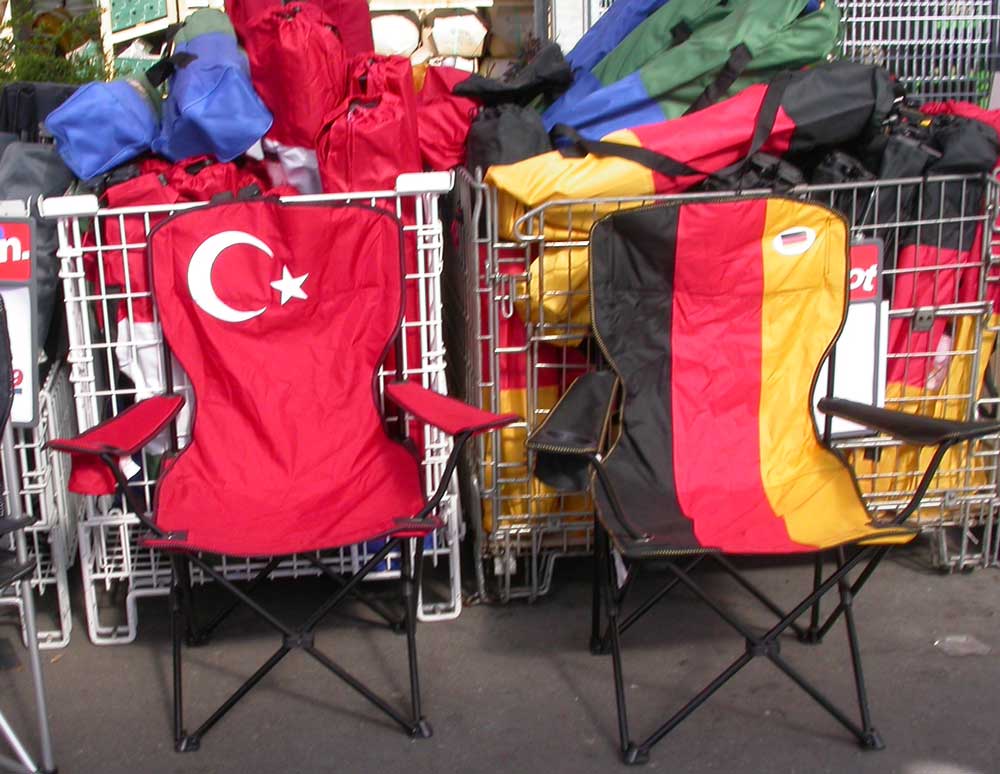
Taken at a local supermarket about ten days ago.
FR>EN DE>EN translator blog
Here’s another translation weblog, Translation Musings. The blogger seems to have been active in April but not in May, however. (Via blogroll of The German-English Translator)
Interpreters and Piano Man
It sounds as if Piano Man may come from the Czech Republic:
bq. The behaviour of the unidentified stranger, who is in a secure unit in north Kent, has left health professionals flummoxed. All attempts to coax him into communication, including the use of interpreters from Poland, Lithuania and Latvia – but not the Czech Republic – have failed. He cowers when approached by strangers and is constantly anxious.
What I wonder is why did they try Poland, Lithuania and Latvia? Or did they try whoever they had at hand in North Kent? Or did they try many, and are just naming the East European ones?
Latin domains and names
Markenbusiness News reported (in German) that a Munich court ordered a lawyer to release the domain name fatum.de to a Mr or Ms Fatum.
bq. Nach einem Urteil des LG München (Az: 27 O 16317/04) steht das Recht an der Domain fatum.de dem klagenden Namensinhaber zu. Ein Rechtsanwalt hatte den Begriff im Jahr 2000 angemeldet, seitdem aus Zeitgründen aber keine Inhalte auf der Website hinterlegt. Jetzt muss er die Domain bei der deutschen Domainregistrierungsstelle DENIC freigeben.
The lawyer has never got round to putting up a horoscope site (Latin fatum, German Schicksal, English fate).
In the baroque period, if I remember right, a lot of German names were latinized. I once shared a flat with a Noltenius (originally Nolte). How Fatum became a surname is more mysterious.
The court held that the name could be generic, but in this case the owner of the name had priority.
This matter has also been reported by domainblog (in German), which got the information on a list from a lawyer called Noogie C. Kaufmann. Now there’s a good name! It reports the court as saying that one reason for not defining fatum.de as purely generic was that the German translation is only familiar to persons with a knowledge of Latin [or English? MM], but this ‘does not apply to the majority of the population’.
(Thanks to Lisa of Luxus Linguae)
Fachzertifikat Deutsche Gerichts- und Behördenterminologie
The following entry is about a certificate that is only in German.
Zum Gerichts- und Behördenterminologie Buch, das ich neulich erwähnte, gibt es die Möglichkeit, ein “Fachzertifikat” zu bekommen. Das ist vielleicht interessant für diejenigen, die Kenntnisse vorweisen wollen.
Diese Möglichkeit wird von Senator E.h. Reinold Skrabal in Baden-Württemberg geboten (nachträglich möchte ich Dr. Daum seinen chinesischen Professorentitel zurückgeben). Es heißt “nach der Methode Prof. Dr. Jur. Ulrich Daum”, aber ob das bedeutet, dass die Prüfungsfragen denen der bayerischen Staatsprüfung ähneln, weiß ich nicht. Man soll das Daum-Buch studieren und dann per Post 200 Fachfragen beantworten. Es gibt Prüfungsvoraussetzungen – Übersetzer und Dolmetscher, die weder beeidigt noch staatlich oder akademisch geprüft sind, müssen mehrere Jahre Berufserfahrung haben.
Preis und Details können bei Herrn Skrabal, der für Französisch und Italienisch in Bayern und Baden-Württemberg beeidigt ist, in der Form eines 5-seitigen Merkblatts bestellt werden. Hier seine Webseiten, dort auch andere Studienangebote.
ES>EN brochure translation
LATER NOTE: the original Spanish and English versions are both online, and Geoff Pullum has established that the translation deviates only slightly from the Google translation, which suggests a native speaker revised the MT.
Geoffrey K. Pullum of Language Log has been given a brochure in Spanglish and wonders how it was created.
bq. When one has finished giggling, and one has noted that The development business is reserved the right to make any change that be necessary, one finds oneself wondering: who on earth could approve English this bafflingly dreadful for publication in a full-color brochure that must have cost thousands of euros, while knowing so little English that they could not see they were signing off on impenetrable gibberish? Why was no one who knew English from long acquaintance brought in to cast an eye over it?
Is it machine translation? It lacks the untranslated words that aren’t in the dictionary, a feature usually associated with this kind of thing.
bq. Could it be pride, an unwillingness to admit to not being adequately fluent in the nascent global language of commerce and the most frequently encountered language spoken by visitors to Spain? (“I speak English,” as the waiter Manuel from Barcelona in the John Cleese “Fawlty Towers” series, proudly and dramatically; “I learn it from a book!”) The frequent uses of “its” for “is” suggest the material above really was typed by someone who thought they knew what they were hearing, and did know various common English words. Or could it be that someone called up a web-accessible translator, typed in the Spanish text, and actually trusted the output to be fit to print, not realizing that the machine translation problem has yet to be solved?
Here’s an example of the use of its for is:
bq. In the south of the Valencian Community, opening step to the Costa Blanca, its found Pilar de la Horadada. Its coastal seaboard of more than 4Km.,its spring climate during all the year an the behavior of its peoples do of this municipality a privileged place to pass some unforgettable holidays.
All I can speculate is that it was probably done by a human being, or else a machine translation was done and a secretary asked to type it up. If I knew more Spanish, I might make a better guess.