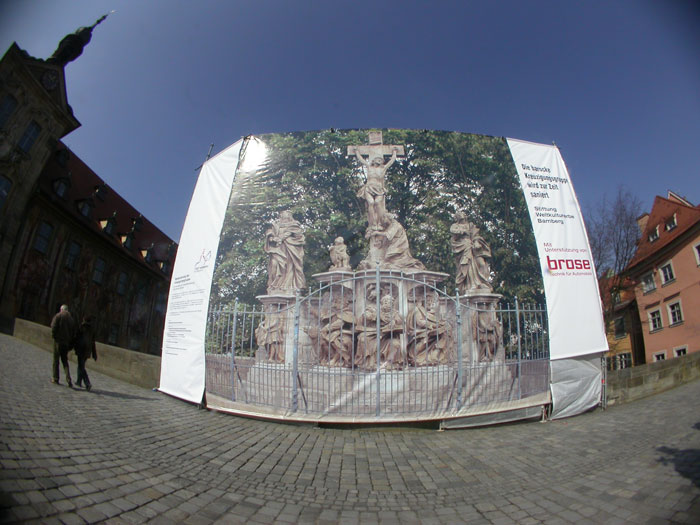
Die barocke Kreuzigungsgruppe wird zur Zeit saniert. Stiftung Weltkulturerbe Bamberg. Mit Unterstützung von brose – Technik für Automobile.
The small shadow at the bottom right edge, the shadow of a person with a cross, is not me, btw.

Die barocke Kreuzigungsgruppe wird zur Zeit saniert. Stiftung Weltkulturerbe Bamberg. Mit Unterstützung von brose – Technik für Automobile.
The small shadow at the bottom right edge, the shadow of a person with a cross, is not me, btw.
Translation in the Trenches – ‘a blow-by-blow [account?] of a dog-eat-dog world’ is a translator’s weblog I’m unfamiliar with. I have my suspicions as to who Trench Warrior might be, but perhaps I’m wrong. Anyway, he mentions a number of translation problems that are familiar to me, so I may take one up in a separate entry.
This rings true:
bq. An entire German ad campaign was slung onto my virtual doorstep today. The catch: the one-hour turnaround.
bq. I’ve never pulled my hair or gnashed my teeth like an Edgar Allen Poe character, but I came damn close today. The copywriter had crafted a miniature masterpiece: tight copy that felt loose. The ads allegedly sported quotes from real people, but someone had obviously sweated over those lines for hours until they were just so.
bq. The bastard. I knew, I just knew he was only being that good to piss me off.
Are there Swiss legal blogs? I asked myself this question, and at the same time found the NZZ had published an article on specialized weblogs in Switzerland, from which it appeared that there are very few weblogs of any kind there. The article, in German, is no longer available free of charge (search in archives for Wissensbeschaffer im Frondienst / Fach-Blogs im Internet als neue Informationsquelle, 25 February 2005).
I found circle.ch, ‘A weblog about libre software, law, technology, politics and the like’. Here’s a January 2005 entry:
bq. Man mag es vielleicht gehört haben, dass das Bundesstrafgericht seinen Betrieb am 1. April 2004 in Bellinzona aufgenommen hat. Nun, Bellinzona liegt nun wahrlich nicht gerade zentral, dafür kann man dem Charme südlicher Gefilde fröhnen; wenn man denn dazu kommt. Jedenfalls ist man aus der Region Bern schon fast darauf angewiesen, sich vor Ort eine Unterkunft zu organisieren, wenn man denn rechtzeitig am Gericht sein will.
bq. Es hat sich nun herausgestellt, dass Hotels in Bellinzona gar nicht etwa einfach zu finden sind [1]. Befriedigend waren dann aber die Resultate der beiden anderen Links [2,3]. Fand das irgendwie mitteilungswert ;)
Here is a collection of Swiss blogs.
Kookie’s Welt is by a lawyer but not about law.
While inspecting, I found a just.graham, a Swiss-British (non-legal) blog and a link to a BBC article on the hygiene inspection made when you move out of a Swiss flat.
bq. When the inspection ended, I was given a six-page list of improvements I needed to make and, as I ushered him towards the door, he had one last instruction.
Passing the fuse box, he pulled it open.
“Look”, he said triumphantly. “Dust!”
A week later, the house is clean, my muscles ache and my hands are sore from cleaning fluids.
Signandsight, Perlentaucher’s English site went online on March 1.
It is subtitled ‘Arts, Essays, Ideas from Germany’.
Perlentaucher.de is a site that collects, summarizes and links to German-language books and reviews. The English site presents these to the world. The editor is John Lambert.
Terms related to the Internet defined in legal texts, mostly German. By the way, is there an English equivalent of DAU (dummster anzunehmender Anwender), or is it a purely German phenomenon?
Peter Müller hat eine hübsche Sammlung von juristischen Internet-Definitionen entdeckt, DAUFAQ.de:
Frage: Womit bearbeitet man Homepages?
Antwort: Es antwortet LG Düsseldorf, Urteil vom 25.11.2000, Az. 2a O 106/00:
Zur Bearbeitung von Homepages werden FTP-Programme benötigt.
Man sieht wieder mal, mit welchen Vorlagen die Übersetzer konfrontiert werden.
Frage: Wie verbreiten geschickte Täter Viren?
Antwort: Es antwortet Müller / Wabnitz / Janovsky, Wirtschaftskrimininalität, 4. Auflage, 1997, Kap. 3, Rdn. 17:
Ein geschickter Täter kann nicht nur den Rechner der jeweiligen Firma dadurch verseuchen, dass er den Virus auf den Rechner selbst programmiert; es genügt vielmehr schon, “infizierte” Disketten in den Rechner einzubringen.
Und was machen die ungeschickten?
Frage: Warum verwirrt das Internet insbesondere Juristen?
Antwort: Es antwortet Kuner, Christoph, Internet für Juristen – Zugang, Recherche, Kommunikation, Sicherheit, Informationsquellen, 2. Auflage, 1999, Seite 4:
Juristen sind von Berufs wegen an hierarchische Strukturen gewöhnt. Das Internet stellt jedoch eine neuartige Struktur dar, da es nicht hierarchisch aufgebaut ist, […]
Siemens paid for Gizmodo’s flight to CeBIT and hotel there. Gizmodo on arrival at CeBIT:
bq. Did you know that the famed German sausages are really just giant hot dogs covered in a curry?
Let’s hope the gadget reports are more accurate. But worryingly, a picture by Joel of Gizmodo showing a Chrysler convertible done up as a German emergency doctor’s vehicle, suggests some confusion among Americans of emergency doctor (Notarzt) and notary (Notar) – compounded by the confusion of a German notary with a U.S. notary public.
bq. assuming Notarzt means emergency, unless Germany has a pressing need for on-call notary public services.

So be careful if you’re in Germany and want to have something certified – go to the parish office, not the notary, and don’t call out the emergency doctor either – you may find yourself with no will but a stiff bill to pay.
Thanks to Abnu of Wordlab for the tip.