LEO online dictionary/LEO Online-Wörterbuch

I mentioned online dictionaries earlier, including LEO. I don’t use it myself, but I see Chris of Crooked Timber is learning German and says how useful it is for him.

bq. Not only is Leo invaluable as you’re trying to decipher that article in Der Spiegel or FAZ, it also enables registered users to enter the words they don’t know into a little personal list and then to test themselves repeatedly on their chosen vocabulary. Leo is also very easy to integrate with Mozilla Firefox both by adding to the search engines box and — this is really great — by installing the ConQuery plugin so you can highlight the German text and then have the dictionary open with a translation in a new tab.

According to a commenter (Tobias of Fistful of Euros), LEO is also ‘Google-enabled, though only for google.de queries’, if you enter ‘de-en’ or ‘en-de’ as part of the search. I haven’t quite got that to work, but I see in the latest Firefox, although I have English in the language settings, the original Google toolbar takes me to Google.de, and on top of that the start page has a Google search bang in the middle, but where that takes me I don’t know. Ah yes, the first real hit for Bisamratte is for me, but before that is a link to take you straight to Leo.

(Thanks to Abnu for the link)

Künstlersozialkasse to end?/Künstlersozialkasse vor dem Aus?

Für den deutschen Bericht siehe journalismus.compact:

bq. Glaubt man der Grüchteküche im Netz, dann steht die Künstlersozialkasse unmittelbar vor dem aus. In zahlreichen Mailinglisten wird derzeit eine “E-Mail-Lichterkette durch die Republik” organisiert:

bq. Tatsächlich tagt am Montag (22.11.) die Enquete-Kommission Kultur in Deutschland im Berliner Paul-Löbe-Haus über zur Zukunft der Künstlersozialkasse. Eigentlich sollte es sich um eine Anhörung zur “Wirtschaftlichen und sozialen Absicherung für Künstlerinnen und Künstler” handeln. Doch davon ist in der Pressemitteilung der Enquete-Kommissions Vorsitzenden Gitta Connemann, CDU-MdB, nur nebenbei zu lesen. Ganz offen wird dort die Frage gestellt wird, ob die KSK überhaupt erhalten bleiben soll.

Some freelance translators who work mainly for publishers and therefore at a pittance, and also journalists, singers, artists and others, pay their social and health insurance to an institution called the Künstlersozialkasse (Artists’ Social Insurance). It sounds as if this arrangement may be ended tomorrow. I’m posting because I’m sure some people reading this site are affected.

Expatica gives a report by Nick Woods, a freelance journalist who moved to Germany, dated November 2004:

bq. For social security you must join the ‘Künstlersozialkasse’ (KSK) – www.kuenstlersozialkasse.de.A form can be accessed on the net.
bq. A special perk for freelancers working in media and the arts is that half these costs are paid by organisations who use my work (30 percent) and the State (20 percent).
The remaining half is my responsibility. I declare my anticipated earnings to the KSK when I register and for each forthcoming year.
A bill is sent out in due course while the KSK should be notified of any differences in target in actual earnings.
The agency collects money from the media organisations separately by levying a percentage charge – 5.8 percent in 2005 – based on each outlet’s annual payment to freelancers. Other self-employed people and entrepreneurs are liable for the total cost of their social security bill.

(Thanks to Christiane on the pt list at Yahoogroups)

Stern on True Stella Awards/Stern über bizarre U.S.-Gerichtsfälle

Stern has an article on the True Stella Awards, quoting (in German) the 2003 awards.

There are fake Stella Awards around, but this was news in April, not November.
However, Stern joins the throng of those misreporting the original Stella Liebeck case:

bq. 1992 kaufte sich die damals 79-jährige Stella einen Becher Kaffee bei McDonald’s, nahm ihn mit ins Auto, klemmte ihn zwischen die Beine und fuhr los. Leider schwappte das Heißgetränk über und verbrannte ihre *ähm* intimen Stellen. Ein Gericht in New Mexiko sprach ihr daraufhin eine Schadensersatzsumme von 2,9 Millionen Dollar zu.

No, she wasn’t driving, yes, the jury’s award was corrected – actually, there was a settlement and it isn’t public knowledge what the eventual sum was. And the sum was not purely damages, but punitive damages. Here’s some correction.

(Via Handakte WebLAWg)

Medlars/Schöne deutsche Wisbeln

mispelnw.jpg

Although many fruit and vegetable names have regional variants in German, I don’t believe this is one of them. Mispeln are medlars, not to be confused with Japanese medlars or loquats, also sometimes called Mispeln in Germany – I’ve also seen the Turks selling them as nespole, which is Italian for medlar. The Oxford Book of Food says medlars are inedible until kept over winter in moist bran or sawdust.

I can understand the B for P, but the W for M seems more mysterious. Perhaps this is a chance to have the only Internet site displaying the word Wisbeln.

Milk bottles/Milchkartons

I noticed when reading the Adventures of an American Girl in Germany that she showed pictures of U.S. gallon milk jugs and said the standard German equivalent is 1-litre tetrapaks of long-life milk (H-Milch).

She may well be right – I would have said the common type is 1-litre tetrapaks of fresh milk.

There also appears to be a difference in frequency of full-fat and low-fat milk. The U.S. gallon jug has 1% fat milk. In Germany I usually see 3.5% or 1.5%. There are even half-litre cartons, and there are also bottles.

Personally I don’t like the taste of heat-treated milk (there’s some new stuff in the refrigerated department that lasts for 2 weeks or so that I haven’t tried), but then I can buy milk next door if I run out. But maybe a lot of people do buy the H-Milch.

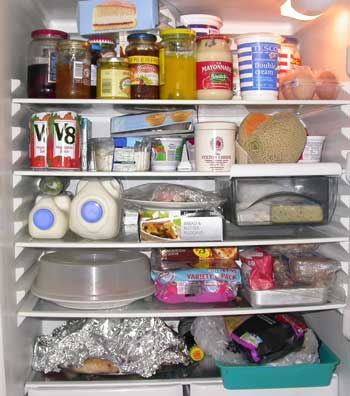
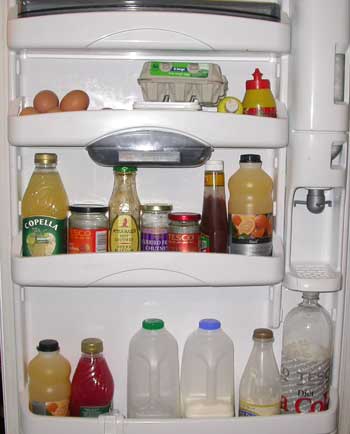
In Britain, the system has changed over the years. I most often see one-pint or two-pint plastic jugs that fit in the fridge door (although probably American fridges have bigger doors). Here are two pictures of a British fridge:

fridge2w.jpg

fridgew.jpg

I looked on the Net for a milk bottle picture, and I found ‘old-fashioned milk bottle’ next to what I would call a ‘new-style milk bottle’. I can remember two shapes of bottle. There are so many antique milk bottles out there that it’s difficult to find definitive pictures. Many at Milk bottle of the Week. Then there’s a Euromyth that the EU wants to ban the UK glass milk bottle (still the standard if you have milk delivered, I believe).

Here’s a picture of a variety of milks from a dairy.

The rich man in his castle, the poor man at his gate

The Guardian reports that Prince Charles’ household is described as ‘elitist’. I didn’t realize the Sexual Discrimination Act applied there, but of course it does.

bq. Ms Day told the tribunal the royal household was run in an “Edwardian” fashion. She said: “It’s hierarchical, elitist, everyone knows their place and if we forget our place the system will punish us.”

Well, I thought that was the whole idea.

bq. The prince wrote: “What is wrong with everyone nowadays? Why do they all seem to think they are qualified to do things far beyond their technical capabilities?

bq. “This is to do with the learning culture in schools as a consequence of a child-centred system which admits no failure. People think they can all be pop stars, high court judges, brilliant TV personalities or infinitely more competent heads of state without ever putting in the necessary work or having natural ability.

bq. “This is the result of social utopianism which believes humanity can be genetically and socially engineered to contradict the lessons of history.” The memo concludes: “What on earth am I to tell Elaine? She is so PC it frightens me rigid.”

bq. [Most hymnals omit the following verse] [Click on MIDI at ‘Bright and Beautiful’ by William H. Munk for the better tune]

bq. The rich man in his castle,
The poor man at his gate,
He made them, high or lowly,
And ordered their estate.