





Via jurabilis and Handakte WebLAWg: there is a new weblog (in German) by the apparently fictitious German member of the Bundestag Jakob Maria Mierscheid. Here’s his Bundestag entry. Here we see, for example, that in 1967/1968 he published a four-part series on the route taken by a probably invented species of pigeon – a hooded and collared dove – and its flight characteristics.
There is a famous German invented creature called the Steinlaus (stone louse), which was invented by the German comedian whose stage name is Loriot and found its way into the Pschyrembel medical dictionary, but I had never heard of this ‘phantom of the Bundestag’ (there is a reference to a Steinlaus symposion in his bio linked above).
Mierscheid has apparently been around for quite a while and has his own page on the Bundestag website.
Steinlaus in the German Wikipedia.
Mierscheid in the German Wikipedia.
Bundestag page on Dr. Dietrich Sperling, a ‘friend’ of Mierscheid’s.
Mierscheid’s new blog, Geschichten aus dem Bundestag.
Recently someone posted a comment on one of my entries advertising not one URL, but 176 URLs. With Jay Allen’s MT Blacklist plugin for MT 2 (I believe there’s a variant for MT 3), it’s easy to remove. And I can block comments altogether if I go away. Every time I look at the Activity Log, I can see many attempts to post URLs that are already on my blacklist being warded off.
Then there are comments that are not spam. There is a school of blogging that won’t remove anything without a note saying something has been removed, and won’t alter a spelling without indicating by strikethrough what the original error was. I have deleted a few comments, but not always with a note. I remember once deleting a comment by an Austrian who felt the other comments had been getting at Austria and used a swearword or two. I don’t see why swearwords should be smeared all over my comments, unless we’re discussing them, of course.
Werner Patels, who has a German-English translation weblog and sometimes comments here, has stopped comments altogether, in part because some people who comment on his site are just advertising themselves:
bq. In case anyone has wondered: I have disabled the comment feature on this blog. There is simply too much spam flying around out there (not to mention some wise guys who think that their less-than-intelligent comments will get them those “15 minutes of fame”……).
Absolutely right – as the Germans say, ‘Wo er Recht hat, hat er Recht’. I think I’ll take this as my model and if I feel like it, I’ll remove a comment that is just posted for self-aggrandizement. Of course, if I myself post such comments on other people’s weblogs, I would not like to be removed.

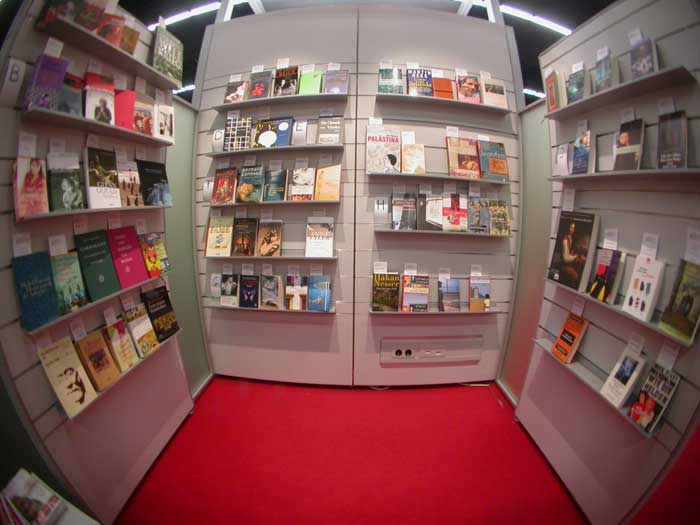
Übersetzerzentrum bei der Frankfurter Buchmesse. Mit Kreide geschrieben: “Literaturnobelpreis 2004 Elfriede Jelinek”.
Bücher mit Übersetzernamen.
Zu Jelinek siehe www.perlentaucher.de und Wikipedia.
The photos show the translators’ area at the Frankfurt Book Fair. The words in chalk announce that Elfriede Jelinek has been given the Nobel Prize for Literature. The books all show the names of the translators, on cards. The translators’ area also has a space with chairs for presentations to an audience, and it’s beside a coffee station, so it looks suitably large and professional.
Some observations on Jelinek: she has recently translated and adapted, together with Karin Rausch, ‘The Importance of Being Earnest’ (‘Ernst ist das Leben (Bunbury)’) and is working on ‘An Ideal Husband’. She has also translated Feydeau and co-translated Pynchon (list of works).
As I was in Frankfurt all day, I missed interviews and discussion on TV except for about ten minutes. The anger and narrowmindedness of some Austrians when confronted with something they don’t like is astonishing and may be untranslatable. It reminds me of the Nurembergers standing in front of the rabbit sculpture that commemorates, with irony, Dürer’s hare. It used to be fun to stand there and hear the complaints. But I haven’t heard this amount of personal affront in Franconia when it comes to literature.
I didn’t realize how much autobiographical content went into ‘The Piano Teacher’ (‘Die Klavierspielerin’). According to the German biography on Wikipedia, she was sent to a convent school, and from the age of 13 she studied organ, piano and recorder at the Vienna Conservatory (having previously had piano, guitar, flute, violin and viola lessons) and at the same time attended a normal grammar school (Gymnasium). She married in 1974, and I presume the novel is based on the idea of what might have been if she had continued her mother’s plan.
Jelinek was born in Mürzzuschlag: I remember a translator once asking on a mailing list how to translate it (Zuschlag is a translatable German word, but Mürzzuschlag isn’t).
‘The case of the missing writers. America has John Grisham and Scott Turow. But why have so few British lawyers made it as novelists? Marcel Berlins investigates’ appeared in the Guardian on October 5 (via Isabella).
Berlins lists about 16 lawyer-authors and describes this as ‘few’. Why so few in Britain and so many in the USA? (For the US, see my earlier entry). But just a minute – why do lawyers have to write thrillers? I used to read a lot but reached saturation point. I found British ones less convincing, including Frances Fyfield, who is described as the best (but I probably read a very early one). I see one name is Nicola Williams, who I remember from a TV programme, ‘Called to the Bar’.
Berlins answers his own question as follows:
bq. To practise the law in Britain requires learning a new language, Lawspeak. It’s not just a question of knowing specific legal terms or jargon. The whole structure of a sentence changes. The tense is largely passive, long words are preferred to short ones and convoluted locutions are de rigueur. The trouble is that when lawyers then try to write fiction – in a voice understandable to the general reading public – they find it difficult to make the transition. It’s a problem many lawyers also have when they appear on television or radio. However knowledgeable they are on the subject, translating it from Lawspeak into ordinary speech is often beyond them.
I’m not convinced by this. American Lawspeak is just as odd as British. However, it may be a class thing. It’s easier to think of John Mortimer as a person who writes fiction about lawyers, and Rumpole has that slightly outdated touch that one doesn’t want to see many imitators of. The gulf between the way many barristers talk and the way their potential readers talk is a class gap. I think there’s a sense of a different world that’s different in kind from the sense of a different world you get in American fiction with lawyers in it.
A slightly different book is Lawrence Joseph’s ‘Lawyerland. What lawyers talk about when they talk about law’, published in the USA in 1997. On checking now, I am surprised to find it is to be filmed. It is a semi-fiction work, with eight composites representing lawyers of our day, talking about work, clients, lawyers, and the law.

Marc Prior reports that the website for Omega T has been done up.
Omega T is a free translation memory program written in Java. It can be used by Mac and Linux users, and others.
In Blogos, Andrew Joscelyne reports on a site by Jeff Allen that collects links to translation memory and machine translation materials online.
As Andrew points out, the Jeff Allen site is not a single author site – you need to scroll down. There are the links to the Michael Benis articles that I can find only through Google when I want to recommend them. This is an excellent resource. I can’t discuss tools I don’t know, and most translators don’t know enough about the systems. I recently wrote some comments on Trados Workbench and Multiterm, which a client has kindly made available to me, which I implicitly compared with Transit, which I know quite well. But that’s as far as I can go. These articles will fill the gap.
I was having a look at a copy of the Language Technology Supplement (late 2002) to Multilingual Computing and found this article by Jonathan T. Hyne, Jr.:
bq. Tom had just reached 55 km/hr down his favorite mountain road when he felt the pager buzz against his back. At the bottom of the hill, he turned his bicycle onto a side street and checked the number in the pager window.
It was a translation company in Paris. He found a quiet area near a picnic table and called them back with his cellular telephone.
bq. A half-hour later, he took a shower while his computer booted up. When he sat at his desk, he connected to the Internet and opened his e-mail. The message from Paris contained the specifications of the job and a twomegabyte compressed file attached to it. While the file downloaded, he opened his accounting software and started an estimate/job order form. Within a half-hour, he had opened the files, inspected them, verified the clients word count and sent his estimate as an e-mail attachment to the client. He decided not to use dictation software for this assignment, so he put a CD of Schuberts Third Symphony on the stereo and went to work.
bq. The assignment consisted of engineering reports to the main office of a multinational oil company. Tom had done some of these the year before, so his translation tool had them in memory. He opened the tool, imported the job
and examined it on the left side of the screen.
It reminds me of some children’s sci-fi writing. But it isn’t much unlike what I do, except 1) I haven’t been cycling down a mountain road 2) TM does not help me with sentences and 3) No Schubert’s Third – I’m listening to Sandi Toksvig on LBC on Internet radio.