Derek Thornton on picking cucumbers

Today’s guest blogger, unknown to himself, is Derek Thornton, technical translator, erstwhile bilingual blogger. I don’t know why his website describes itself as außer Betrieb, as the links seem to work. But I think part of the structure is down.

Derek reports (I pinched this from CompuServe, Foreign Languages Forum):

The Daily Reflector, Greenville, North Carolina, reports today some preliminary results of a $250,000 federally-funded study to determine whether farm workers are more uncomfortable picking cucumbers on a hot day than on a cold day.

A Spanish translator played a significant part in the study, testing cognitive impairment by getting migrant Mexican farm workers to count numbers forwards and backwards from 5 am to 5 pm.

I am attempting to obtain funding for a follow-up study to determine whether listening to Spanish numbers being translated backwards in a hot cucumber field is more uncomfortable at 5 am or 5 pm for independent freelance translators or for migrant translation agency serfs.

The design of my study takes account of my observation that translating efficiency is also affected by ambient temperature and that the symptoms of deteriorating translation skills (impaired ability to recite Spanish numbers backwards, headaches, sore throats, faintness and heavy perspiration) are shared equally with exploited migrant cucumber pickers, especially after starting work at 5 am and translating right through to 5 pm.

Object of my study is to help reduce the mortality amongst Spanish translators from heat stroke and unprovoked attacks with cucumber hoes.

bq. ECU-based researchers are collecting the final data in a four-year heat stress study that explores how temperature affects farm workers. The study has gathered information ranging from the impact of buildings near the field to the type of crops workers are harvesting.
….
Funded by the U.S. Department of Agriculture and the National Institute for Occupational Safety and Health, the study cost nearly $250,000 for the four-year period.
….
After analyzing the data, which they expect to finish collecting in September, the scientists and educators hope to release findings that will help farms improve the health, safety and productivity of the laborers who work their land.
….
Because deterioration of cognitive skills is a symptom of heat stroke, Amanda Fields, the 23-year-old Spanish translator working with the study, tests workers’ memories.

Adminicle ADMINICLE.

Language hat found the word adminicle recently (quoting Cassell Concise Dictionary):

bq. 1 an aid, support. 2 (Sc. Law) corroborative evidence, esp. of the contents of a missing document.
I particularly like the OED’s last citation:
1872 Daily News 2 Oct. 5 Floriculture and other adminicles of civilisation.

I seem to have lost one of my Scot law glossaries,but the Butterworths one has it (here’s the Lockerbie trial wordlist, which mentions both glossaries at the top – the Lockerbie trial was held in the Netherlands, part of which was declared Scottish soil for the duration, although they got by without the word adminicle):

‘adminicle – an item of helpful evidence’

That adds a lot, doesn’t it?

LATER NOTE: But I lie – of course the word was used in the Lockerbie trial (as a Google search on adminicles showed):

bq. 16 The conclusion regarding the presence of this
17 clothing within the suitcase containing the bomb then
18 becomes a fixed point around which all other adminicles
19 can be tested and examined.
20 And once it’s understood that the plot was of
21 Libyan origin, using the resources of the Libyan
22 Security Service, the conclusion relating to the bag
23 from KM 180 can be further fortified by other
24 adminicles of evidence.

However, I do think Shanghai United Food Additives Co. gets it wrong:

bq. So we can satisfy factories’ needs for kinds or quantity of food additives and special food adminicles and we can give clients much help on delivery, QC, payment and service.

It would also appear to be a Catalan word (like ‘Woddy Allen’).

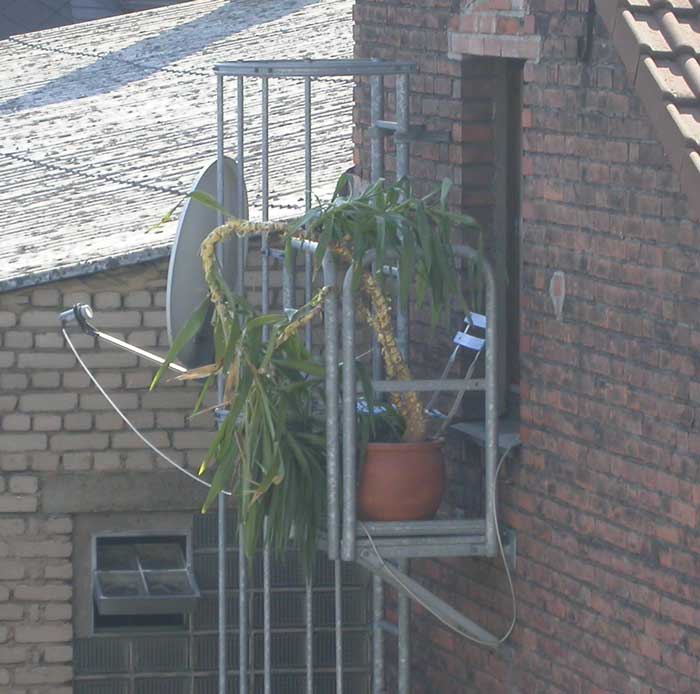
Balcony /Balkon

Germans are always keen to have a balcony, especially in this weather. (Indeed, the popular press often says they are saving money by spending their holidays in Balkonien).

balconyw2.jpg

German spelling reform / Rechtschreibreform

Last weekend there were traffic jams on the northbound motorways as the school holidays came to an end in some parts of Germany. It was a brilliant tactic by the Axel Springer Verlag and Der Spiegel to dump the spelling reform at this time. I remember thinking to myself that the German authors were a bit slow to come out against it after it had started at schools. I wonder how many extra copies Der Spiegel sold today?

And it’s a perfect topic for discussion in the dog days, meatier than most. My favourite idea is a referendum. I wonder what percentage of those who would be referendumed can spell anyway? Translators’ mailing lists have been polarized on the topic for days. Either you are waving a flag and jumping for joy, or you are muttering about the poor children who would have to relearn everything.

Taccuino di traduzione links to Arts & Letters Daily, whence we see that the topic has hit the English-language press too. It’s often referred to as German language reforms’, perhaps because people can’t understand the excitement elicited by mere spelling, and certainly not in the singular. Marcel Reich-Ranicki apparently called the reform ‘a national catastrophe’ – I suppose he doesn’t care too much about the Swiss and Austrians. Here he is in the Guardian version:

bq. Leading literary critic Marcel Reich-Ranicki dismissed the changes last week as a ‘national catastrophe’. In an essay, he declared: ‘Chaos has broken out … In no other major European country is the gap so deep between the language of the people and the language of literature.’

Surely he must be speaking about Switzerland here? We have to interpret ‘major’ to work that one out.

At the moment taz and Frankfurter Rundschau are keeping to the new system. I like the Neue Zürcher Zeitung, which says it never used all the reform suggestions. The paper was always somewhat sceptical of the reform and treated some changes as desirable and some not. It published a guide to its own approach in May 2000 – see here. The NZZ departs from the reform in cases like sitzenbleiben, for instance, keeping sitzen bleiben for remaining seated and sitzenbleiben for the figurative use, meaning to repeat a year at school.

(Of course the Swiss don’t use ß but ss, which would have helped the German translator who proudly wrote that she decided long ago to use the new spelling and is sticking to it – and ended her message with Grüsse, which of course is not permitted in either old or new spelling except in Switzerland).

I am a bit uncertain on this topic. I tend to agree that the reform should be kept in part, but I can see there are problems in replacing two systems by multiple. However, it definitely makes the news more fun. The other main topic in Germany is whether, if you demonstrate against Schröder on Monday, you can call it a Monday Demonstration, recalling those that helped end the German Democratic Republic. I suppose if they demonstrated on Tuesday it would be just as reminiscent.

Testing Meme Propagation in Blogspace: Add Your Blog!

This posting is a community experiment that tests how a meme, represented by this blog posting, spreads across blogspace, physical space and time. It will help to show how ideas travel across blogs in space and time and how blogs are connected. It may also help to show which blogs are most influential in the propagation of memes. The dataset from this experiment will be public, and can be located via Google (or Technorati) by doing a search for the GUID for this meme (below).

The original posting for this experiment is located at: Minding the Planet results and commentary will appear there in the future. Please join the test by adding your blog (see instructions, below) and inviting your friends to participate the more the better. The data from this test will be public and open; others may use it to visualize and study the connectedness of blogspace and the propagation of memes across blogs.

The GUID for this experiment is:
as098398298250swg9e98929872525389t9987898tq98wteqtgaq62010920352598gawst
(this GUID enables anyone to easily search Google (or Technorati) for all blogs that participate in this experiment). Anyone is free to analyze the data of this experiment. Please publicize your analysis of the data, and/or any comments by adding comments onto the original post (see URL above). (Note: it would be interesting to see a geographic map or a temporal animation, as well as a social network map of the propagation of this meme.)

INSTRUCTIONS

To add your blog to this experiment, copy this entire posting to your blog, and then answer the questions below, substituting your own information, below, where appropriate. Other than answering the questions below, please do not alter the information, layout or format of this post in order to preserve the integrity of the data in this experiment (this will make it easier for searchers and automated bots to find and analyze the results later).

REQUIRED FIELDS (Note: Replace the answers below with your own answers)

* (1) I found this experiment at URL:
http://shamrockshire.yi.org/
* (2) I found it via Newsreader Software or Browsing the Web or Searching the Web or An E-Mail Message”: Browsing the Web
* (3) I posted this experiment at URL:
http://www.transblawg.co.uk/uploads/MT_archives/000951.html
* (4) I posted this on date (day, month, year): 7th August 2004
* (5) I posted this at time (24 hour time): 1135 (UTC+2)
* (6) My posting location is (city, state, country): Fürth, Germany

OPTIONAL SURVEY FIELDS (Replace the answers below with your own answers):

* (7) My blog is hosted by: myself
* (8) My age is:
* (9) My gender is: female
* (10) My occupation is: translator
* (11) I use the following RSS/Atom reader software: FeedDemon
* (12) I use the following software to post to my blog: MT 2.64
* (13) I have been blogging since (day, month, year): 16 April 2003
* (14) My web browser is: Mozilla Firefox
* (15) My operating system is: Windows XP Professional