Spiegel online has a quiz on abbreviations such as z.K. and a.a.O. I got them all except u.u.R!
(Thanks to Udo Vetter’s law blog)

Spiegel online has a quiz on abbreviations such as z.K. and a.a.O. I got them all except u.u.R!
(Thanks to Udo Vetter’s law blog)
Anklicken zum Vergrößern.
Here are some pictures from Fürth that I’ve been meaning to post for some weeks now. Click to enlarge.
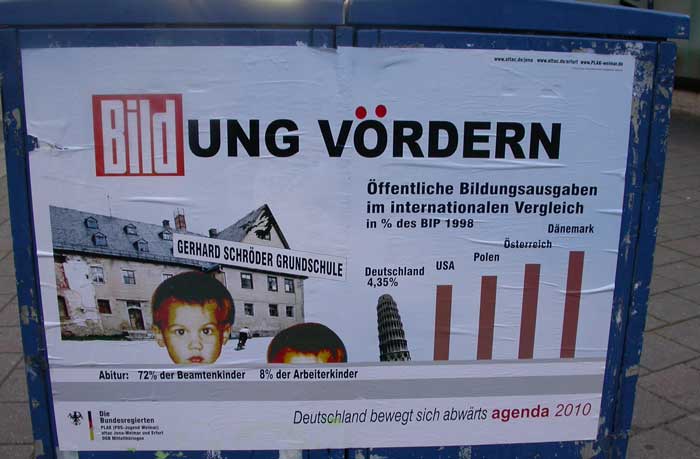
This poster seems to be saying too much at once. It seems to come from attac, an anti-globalization organization. What is the message? Germany did badly in the Pisa tests and isn’t spending enough on education, and it’s all Gerhard Schröder’s fault. But the Bild newspaper seems to be involved too.
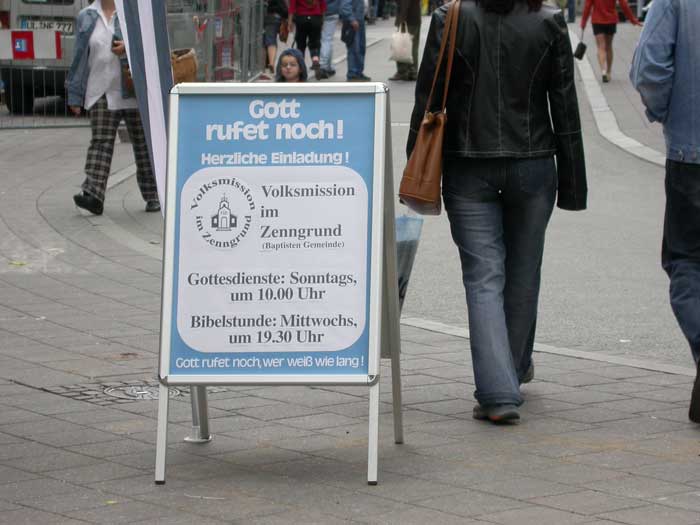
Here’s a religious one, using the somewhat archaic rufet instead of ruft (God is calling), but incorporating a capitalization error (Sonntags/Mittwochs for sonntags/mittwochs) and a hyphenization one (Baptisten Gemeinde).

Finally, this car sticker is directed against the extension of shop opening hours: Without Sunday there would only be weekdays (and vice versa, I imagine).
Robin Stocks pointed out an article in the Stars and Stripes on this topic, entitled ‘German lemon law sweetens car purchases’.
bq. In January 2002, under a European Union directive on consumer protection, Germany changed its laws on tangible property sales to better protect the consumer. All German dealerships must provide a 12-month warranty for every used car they sell.
bq. Ensuring that a dealership provides the warranty will save the buyer a lot of heartache and legal hassles if a dream BMW or Mercedes turns out to be a lemon, said German lawyer Roland Schwengebecher, who is representing Pullum in his dispute with the car dealer.
(The client referred to is Lewis Pullum, presumably no relation to Geoffrey K. Pullum of Language Log).
bq. The German lemon law, Bürgeliches gesetz buch, para. 434ss, states that if a used car bought from a dealership is defective, the dealer must take the car back or pay for repairs. The law does not apply to private sellers.
It’s odd to see a section/paragraph of the Civil Code being referred to as ‘Germany’s lemon law’, even though it doesn’t deal specifically with cars. I also think the ss. should be ff. (or et seq.). Probably the reference should be to § 437 in conjunction with §§ 280 ff.
Nicht mal in England kann man ein Tier zum Alleinerben machen, trotz deutschsprachiger Presseberichte. Salzburger Nachrichten:
bq. london (SN, dpa). Eine im Alter von 89 Jahren verstorbene Engländerin hat ihren beiden Hunden ein Millionenerbe hinterlassen. Laut “Daily Mail” vermachte Nora Hardwell den Collie-Mischlingen Tina und Kate ihr Vermögen in Höhe von 675.000 Euro. Außerdem haben sie alleiniges Wohnrecht in ihrem Haus mit weitläufigem Garten.
The Salzburger Nachrichten and other reported last week that an Englishwoman left her estate to two dogs.
They quoted the Daily Mail, but the report is not available online, at least no longer.
The Bath Chronicle has a slightly more detailed report:
bq. A Recluse has left a staggering £450,000 in her will to her two beloved dogs. Spinster Nora Hardwell earmarked more than half of her £800,000 estate to ensuring that rescue dogs Tina and Kate would be well cared for after her death.
Neighbours say she lived for the Collie Cross dogs, who now have the run of her house in a village near Bath.
Although the first sentence says she left the money to the dogs, the article makes it clear that £450,000 was set aside to pay for care for the dogs for as long as they live, including keeping her house run for them.
bq. Miss Hardwell’s last will and testament reads: “I give the sum of £450,000 to my executors on trust to invest it and to apply the income from it for the maintenance of any dog or dogs which I may own at my death for the period of 21 years from the date of my death or until the death of my last dog.”
bq. She said a home had to be kept and maintained for her dogs and carers employed to look after them.
bq. The residue of her estate – and any cash left at the end of the 21-year period – will go to the Cinnamon Trust, a national charity for the elderly and their pets; the Animal Health Trust, the Royal National Institute for the Blind and the Cancer Research Campaign.
Originally the testatrix had four dogs, but two died shortly after she did.
Die Süddeutsche berichtet über die neue Sprache, KOD, von Johannes Vielberth (72) aus Regensburg.
A German report on the new artificial language KOD includes a sound clip. The website of the inventor also has English pages (the Spanish and French pages are not ready, which may explain why KOD is needed). Just for fun, it looks as if the language even has a new alphabet.
The language has no grammar of its own, however. That is, the speaker uses the grammar of his or her own language.
It seems the name Kod has a D sound at the end, which the Germans are bad at, leading to the Kot sound (= excrement). The name Eufo-Institut also uncomfortably recalls UFO, a word used in German as well as English.
According to the Süddeutsche, Kod is not a new language, but the sum of the most fundamental common features of fifteen languages spoken by 4,8 billion of the total of 6.3 billion people on earth.
(Via Persistent Illusions, which I now quote again. There is a reference there to Sommerloch, literally summer hole, the silly season). PI also gives excellent links to Wikipedia in Esperanto and in Interlingua.
At Language Log, Arnold Zwicky has a post on the misuse of allegedly and reportedly:
bq. I’ve seen numerous reports of some potentially felonious event, like an assault or a drive-by shooting, in which it is said that “the alleged perpetrator/assailant fled the scene”. We’re talking about an unidentified — in fact, for the moment, unidentifiable — person here, so it’s not that anyone’s rights are being protected. The hedge is just cautious icing on the journalistic cake.
This is a problem Ive seen in students translations from German, although Im not sure why. But at all events, if the German original misuses angeblich, its best to correct it in the translation. As is often said, if the style is bad, the translator takes the blame.
This reminds me of the problem of translating in der ehemaligen DDR (in the former German Democratic Republic). Its often used where it doesnt make much sense in German. In English, this misuse looks seriously wrong, partly because the expression is much less common than in German. For example, if someone was born in Karl-Marx-Stadt in 1970, they were born in the GDR, not in the former GDR. Nor were they born in Chemnitz, strictly speaking, or at least, if you translate a birth certificate, you do not translate Karl-Marx-Stadt as Chemnitz, a name the city had before and after the GDR.
Zwicky quotes a police blotter (as they say over there). It reminded Mark Liberman (and me!) of the Arcata Eye police blotter (my earlier entry).
Apparently it isnt fictitious after all. Heres one of Marks quotes illustrating the style:
bq. A man sat with a dog four to six feet from one of the signs that says “NO DOGS” on the Plaza. He claimed an officer said he could sit there and dog up the place, but a City ranger said hed warned the man to remove his dog a half-hour earlier. He was cited, while the dogs uncomprehending face glowed with unconditional love for all concerned.
(The last sentence is not typical, but the ‘dog up is). Arcata Eye.
The police blotter is a text form new to me. It explains itself, even to British readers (provided they remember ink).