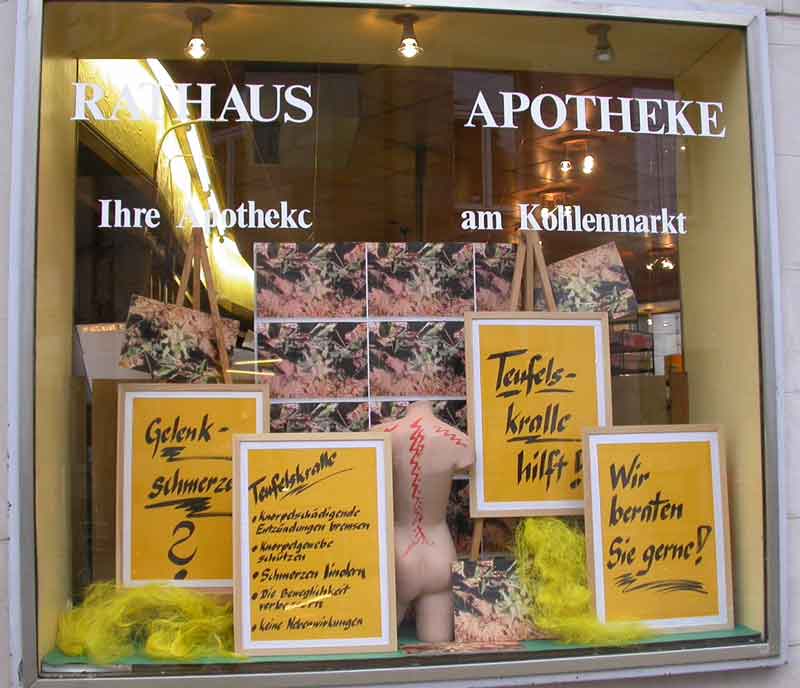
Teufelskralle – Harpagophytum procumbens – devil’s claw or grapple plant.
Afrikanische Teufelskralle.
Very good if you’ve been attacked with a red felt marker.
Particular uses are for pains in the joints and rheumatism.


Teufelskralle – Harpagophytum procumbens – devil’s claw or grapple plant.
Afrikanische Teufelskralle.
Very good if you’ve been attacked with a red felt marker.
Particular uses are for pains in the joints and rheumatism.
Manche Deutsche, wenn sie englisch schreiben, benutzen nur nicht-Muttersprachlern bekannte Wörter / Abkürzungen, z.B. resp., a.o., f. ex. und furtheron. Zitat von einem Engländer, der kein Deutsch kann und resp. überhaupt nicht verstehen konnte.
Ever since I first taught English to Germans – that was at Cologne University in 1974 – I have been amazed at people’s ability to regularly use non-existent English words.
When I don’t know a language well, I know there are words I lack, or I make spelling mistakes in existing words.
But who coined the word furtheron, which seems like a combination of weiterhin and furthermore?
And then there are all the abbreviations: f.ex. instead of e.g., and resp. standing for German beziehungsweise, which very rarely means respectively. Recently I saw a.o., clearly meaning among others. Of course, German unter anderem really means inter alia or among other things, not among others, so that too was misused.
For a summary of the problems with resp., see below.
Now I have read a query from someone on a forum with a German member whose English is very good. However, he keeps including the abbreviation ‘resp.’ in his postings, and English speakers can’t make sense of it. Here are two examples:
There are two kinds of suitable Polyurethane foam. One is single
component. Works well, only requires some water moisture resp. wetness to
react and set.And I see that the vast majority of users resp. members still would like
to post ‘Wanted’ ads here.
To quote the questioner:
I thought at first it meant “with respect to”, but I think he’s actually using it to offer an alternative word for the one he has just used. I suspect he’s using a literal translation of a German abbreviation, but it doesn’t quite get his meaning across in English.
This is interesting, because every time I read resp. I know from German what the writer means. Beziehungsweise usually means and or or. But respectively has a narrower meaning:
‘each separately in the order mentioned’, to quote the Longmans Dictionary of Contemporary English. Example:
Classes A, B, and C will start their exams at 9.30, 10.00 and 10.30 respectively.
Beziehungsweise can mean this, but more often it is used the way the German uses resp. above: water or wetness, members or users.

I haven’t actually seen this book, by Christine Demmer and Heide Huck, but it was mentioned on the TV news programme this lunchtime.
There is a recommendation (in German) on the Berliner Morgenpost site.
The book discusses how to offer praise and criticism, how to deal with special jobs and special payments, how to register the job with the authorities if necessary, and above all: a large glossary with the most important expressions and sentences in the seven most common languages spoken by many cleaning women in Germany.
I would like to know which languages, and what expressions are the ones you normally use to a cleaner.
By the way, I believe that is a non-Islamic headscarf.
The Trademark Blog links to New York Lawyer’s article on disclaimers used on lawyers’ websites, saying
bq. The article contrasts Mayer Brown’s 4000 word disclaimer to Davis Polk’s “The information on this site does not convey legal advice of any kind.” I looked at its site, it doesn’t.
The article has a link to a fuller version at law.com, which requires a subscription (a 30-day trial subscription is free, but I didn’t try it).
See my earlier entry on the language of email disclaimers with German examples.
The study described in the article is by Evan Schaeffer, well-known to law webloggers. Well, at least to those of us who made the Defense Team yesterday – thanks, Evan!
Law.com (The Legal Intelligencer, by Shannon P. Duffy) reports:
bq. Finding that attorney Brian Puricelli’s courtroom work was “smooth” and “artful” in securing a $430,000 verdict in a civil rights suit, but that his written work was “careless” and laden with typographical errors, a federal magistrate judge has ruled that his court-awarded fees should be paid at two rates — $300 per hour for the courtroom work, but $150 per hour for work on the pleadings.
U.S. Magistrate Judge Jacob P. Hart wrote a 12-page opinion on fees.
bq. Hart said he recognized that the case was a complicated one, but said he found some of Puricelli’s writing in the amended complaint to be “nearly unintelligible.”
bq. When defense lawyers complained that the typographical errors in Puricelli’s work were “epidemic,” Puricelli’s response included several more typos, Hart said. The judge quoted a paragraph from Puricelli’s response, adding “[sic]” after each typo.
bq. Puricelli wrote: “As for there being typos, yes there have been typos, but these errors have not detracted from the arguments or results, and the rule in this case was a victory for Mr. Devore. Further, had the Defendants not tired [sic] to paper Plaintiff’s counsel to death, some type [sic] would not have occurred. Furthermore, there have been omissions by the Defendants, thus they should not case [sic] stones.”
I haven’t read the whole of this long article, which is not all about typos.
One of the big problems of translators is errors in the original, of course.
Via The Legal Reader.
Britischer Privatdetektiv erklärt den Beruf.
The Guardian Weblog’s pick of the day is Private Investigator:
bq. I hear so many people ask how to become a Private Investigator or a Private Detective, what does it involve etc. so I thought I would dedicate a blog to this particular field of work. I’ll cover everything you want to know from training, to getting that first Job, to running your own business and to the latest developments in the Industry. Nearly forgot! This is Private Investigation in the UK.
It seems more of an information collection gradually building up than a diary.