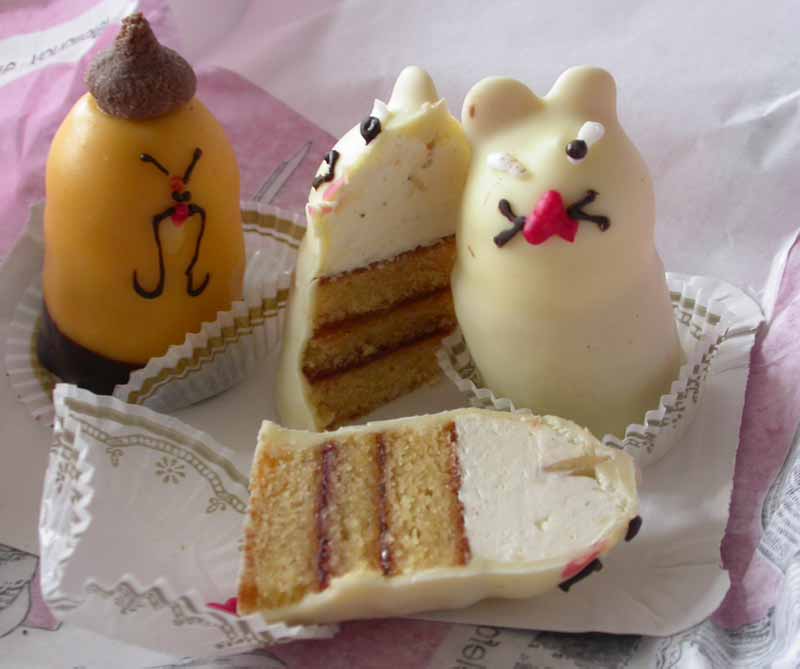
Petits fours ingredients solved

Further to my entry of January 2nd, I have now solved the mystery of what is inside these little cakes.

pf1w.jpg

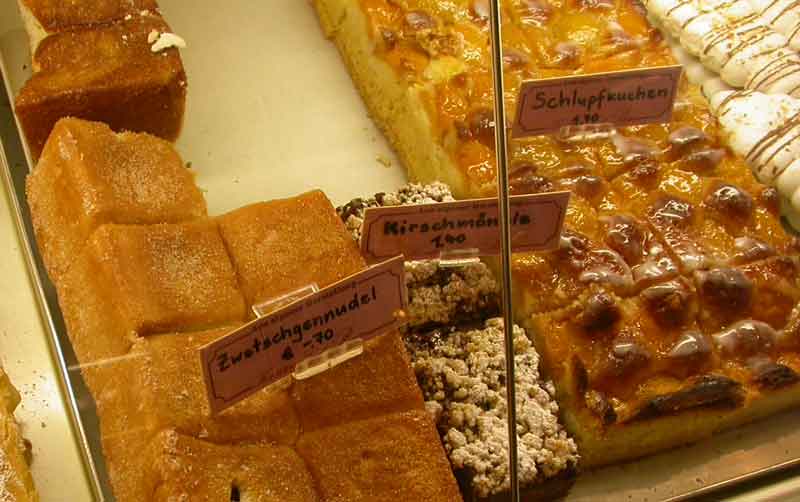
They really are New Year cakes, but maybe they keep them till Fasching (Carnival), or maybe this cake shop – Beers Konditorei, Breite Straße, Nuremberg – makes a special display of them.

The contents are superior to the faceless British equivalent. The cake seems to be soaked in something, possibly with an almond flavour. The ears are white chocolate, but I think there’s a sliver of almond in there too. I am afraid the intact white mouse has an eye missing, and I don’t think I did that. So be careful what you buy.

I think their stuff looks a lot better than the photos on their website, so here are two more photos.

Here is what most bakeries have in the run-up to Shrove Tuesday:
Das übliche Faschingsangebot:

beer1w.jpg

And here is more everyday stuff:

beer2w.jpg

English job titles in Austrian/Englischsprachige Berufsbezeichnungen in Österreich

kohlehydrat reports that the Austrian Verfassungsgerichtshof (Constitutional Court of Appeal) is to consider the use of English job titles. The postal workers’ union has filed a constitutional complaint.

bq. Geht es den Anglizismen an den Kragen?
Der Verfassungsgerichtshof soll über englische Berufsbezeichnungen entscheiden. Die Postgewerkschafter haben eine Beschwerde eingebracht. Welche Chance hat diese Beschwerde?

Elsewhere, Werner Butschek, a Personalberater (career adviser?) is quoted, saying the new titles are a good thing. Some of them, he says, represent new jobs; others are now internationally understood; they also help advertise a company, and they make staff feel more important and work better.

I do find this kind of thing irritating. I agree with kohlehydrat that foreign words should not be imported just because they are fashionable or if they sound artificial.

If I understand the articles right, the new terms include CEO, Key Account Manager, Controller, Sales Manager

bq. Wir stehen vor dem Problem, dass vielfach unsere Bediensteten sich ein Wörterbuch für Wirtschaftsenglisch kaufen müssen, damit sie verstehen, was da in dem Schreiben überhaupt drinnen steht, in dem Schreiben oder vor allem in dem Bescheid, den sie gekriegt haben. Früher haben wir zum Beispiel eine Personalstelle gehabt, heute heißt das ‘Human Resources’. Einer, der früher in einer technischen Dienststelle gearbeitet hat, dessen Dienststelle heißt jetzt ‘Customer-Service-Ordering’ – in dem Fall ‘liance’ noch als Beisatz”, so Zangerle.

(We are confronted with the problem that our employees often have to buy a dictionary of economic English so they can understand what is in the letter or notification they have received).

Austrian statutes in English/Österreichische Gesetz auf Englisch

How did I miss this?

All translations are unofficial. They have been prepared with great care, but linguistic compromises had to be made. The reader should also bear in mind that some provisions of these laws will remain unclear without a certain background knowledge of the Austrian legal and political system.
Please note that these laws may be amended in future and check occasionally for updates.

(Übersetzungen nicht offiziell. Werden in Zukunft noch geändert).

Use of an interpreter seen by jurors as devious

A recent article in The Independent discusses the privacy of the jury room in England and Wales. Unlike in the USA, jurors are not allowed to say what went on in the jury room, even after the trial has ended. Section 8 of the 1981 Contempt of Court Act forbids research into how juries decided.

There was a borderline case a few years ago when the jury were in a hotel and used a Ouija board to try to communicate with the murder victim. Somehow this became known and the case had to be reheard.

The article recounts a case last summer when Richard Latham, QC, prosecuting, was handed a note from a woman juror saying, ‘What does a lady need to do to attract your attention?’

Appeals criticizing what went on in the jury deliberations are very restricted.

bq. [An appeal] involved an allegation that there was racial bias among jurors who convicted a man of indecent assault. Shabbir ali Mirza, a chef from east London, was jailed for four years after his conviction, by a majority verdict, in February 2001. After the trial, a juror wrote to his barrister alleging bias on the part of members of the jury. This woman, a nurse, claimed that fellow jurors had accused the defendant of being “devious” for using an interpreter when they thought he could understand English. When she objected she claimed that she was “shouted down” by “bigots”.

This sounds bad, although we can’t exclude the possibility that the defendant was being devious. Interpreters are sometimes used to buy time in international company negotiations: while the interpreter is speaking, the party ‘relying’ on the interpreter has time to consider how to react.

In this case, the appeal was dismissed, but the matter is being taken to the European Court of Rights.

Burns Night revisited / Schottisches Englisch

When I posted on Burns Night, I was unfortunately unaware of anentry in Scots by a Scot in Germany (can’t find a permalink – look at January 25th) – main page here.

bq. The ither year, Burns nicht : me a ree ray in ma waddinbraws. Twa faikin fums (agnats) shue laik scowpers. I lerb twa jutes, muckle manky jutes, an gledge a redhieded peronall. Ah skleush ower tae her, fer tae splunt thae loorach. Wi thae fower bask jutes, ah thrammle like a kenspeckle kensy, an partle tae rush instead o ma whaisk frae sculduddery.

Since my mother’s side of the family are Scottish, I at least remember ‘Dinnae fash yersel!’ (related to French se fâcher), but I would need to work on the rest. I think he’s gone out of the way to confuse us Sassenachs. There are a number of Scots language links there too.

Via Armin’s Ministry of Propaganda.