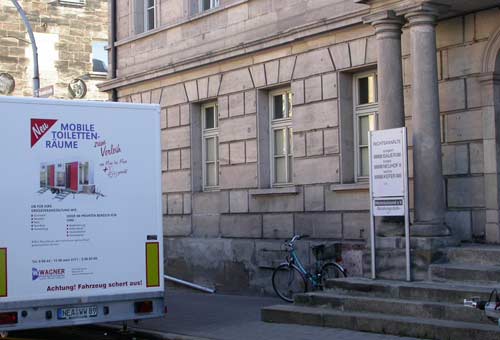
Fürth Amtsgericht photo

Here is the Amtsgericht (local court, lower court of first instance in criminal and civil matters) in Fürth on October 4th (back to normal from October 16th).

amtsg3w.jpg

And here is a picture of the law firm mentioned earlier. Perhaps I did them an injustice: it’s clear that the 2.5 m moving of the vehicle lets both parties’ advertising appear in the best light.

law1w.jpg

Man ordered to speak English to daughter

This story from Salon News was reported on the Forensic Linguistics mailing list (thanks to Gillian Grebler).

The girl is 5 and her Hispanic father has been in prison for 5 years, so she doesn’t speak Spanish. Her mother requested that speaking Spanish be a condition of visitation (or access as we at least used to call it in BE – in BE we talk about a visitationof the plague but not of a parent).
The father talks English some of the time, but also tries to teach his daughter about Spanish and some terms.

bq. The judge did not oppose such instruction, but said the rest of the communication should be in English for the sake of the girl’s education.
“The principal form of communication during the periods of visitation is going to be English,” Reagan said. “That does not mean that you can’t instruct and teach her the Hispanic language.”

IAS adopted by EU online /EU IAS-Texte jetzt abrufbar

Good news from Robin Bonthrone, of Fry and Bonthrone:

The EU has adopted some of the International Accounting Standards (but not yet IAS 32, IAS 39 and related interpretation (SICs).

The text is available online: English version / German version.

You have to click on the little ‘1’ to get a PDF file of the Official Journal.

The texts are available in the other 9 official languages too (click on abbreviation at top of page).

This is great news, as the easiest way to get them so far has been as thick books often updated.

See also Robin Bonthrone’s article on German Financial Accounting translation in the Translation Journal.

Guantanamo Bay: ATA on lack of Arabic translators

Since the September 11th attacks, there has been a lot of talk about the U.S. not having enough translators and interpreters for Arabic and other ‘terrorist’ languages, and now this is in the news in connection with Guantanamo Bay, familiarly known as Gitmo (16 languages).

In this connection, the American Translators Association (ATA) has had national U.S. TV appearances by its PR co-Chair Kevin Hendzel (of ASET).

These can be seen online or downloaded via the ATA website (streaming audio and video).

German court names in English revisited

This is an endless topic. I discussed it here and here, and ‘district court’ as a term here, and a similar question arose with Austrian court names here.

Alexander Hartmann has now given a reference to the list of translations suggested by the Auswärtiges Amt on the Triacom site. They are in Per Döhler’s archive there. For a long time that was the only place they could be found on the web, although when I came to mention them in the first entry, I couldn’t find them in the archive, but that was obviously my mistake.

Hartmann writes:

bq. allemal nützlich für international tätige Juristen und alle diejenigen, die gerne mal über den Tellerrand der nationalen Rechtsordnung hinausblicken

(certainly useful for lawyers with an international practice and everyone who enjoys looking at the world outside the confines of the German legal system)

Since the translations were created in Germany, this statement is a little mysterious.

Hartmann was quoted by Walter Simon, who writes a German legal weblog with summaries in English. We had quite a discussion in the comments boxes (in German), once I had made the effort to register (I have one effective and one ineffective sign-in name with antville – it drives me mad registering there, but I suppose this deters comment spammers).

It’s striking that Walter Simon found the names unfamiliar. One wonders what the Auswärtiges Amt is doing. The list dates from 1974 and it isn’t that well known. I got a copy when I was sworn as a translator.

I don’t regard myself as obliged to use those names when I translate for the courts. I have rarely been asked to translate for them, and nearly all my sworn translations, being into English, go outside Germany, to places where the names are even less well known. I wouldn’t go as far as a French colleague of mine, who says as soon as she hears that a translation into French has been prescribed by a German authority, she knows not to use it. But it is absolutely vital for the original German name of the court to be there at least once (provided the court name is of any significance to the final reader – it isn’t always).

At all events, we don’t have anything like the Netherlands Nederlandse Rechtsbegrippen Vertaald, a book containing a few hundred Netherlands legal terms and their prescribed translations into French, English and German, that comes out every few years in an expanded edition. The 1998 second edition is described as follows in the Asser Newsletter No. 1:

bq. Nederlandse Rechtsbegrippen Vertaald : Frans-Engels-Duits
Second, revised edition
Eds.: K. Boele-Woelki en F.J.A. van der Velden
Revision: J.H.M. van Erp, C.B.P. Mahé and G.J.W. Steenhoff
When translating Dutch legal texts one is regularly confronted with specific Dutch legal terms for which there is no equivalent in the target language. `Nederlandse Rechtsbegrippen Vertaald’ provides translations for such legal terms. Apart from being an indispensable tool for translators, the aim of this book is to harmonize foreign words and expressions for typical Dutch legal terms, making this a unique publication. A second, revised edition has now appeared.
(Appearing under the auspices of the Netherlands Comparative Law Association, Utrecht. Published by the T.M.C. Asser Instituut, ISBN 90-6704-104-1, paperback, 80 pp., price Dfls. 35).

Problems of machine translation

Isabella Massardo links to a BBC news article on the problems of machine translation. It starts out from the story about the pulped brochure for Homberg an der Efze reported here a month ago.

The article is a reasoned explanation of why machine translation works for some purposes and not for others. It is followed by a number of comments, which tend to churn out the old chestnuts (‘out of sight, out of mind’ rendered as ‘invisible idiot’). It seems a bit difficult to think seriously about translation with this trivialization.

A Sabine Reul of Textbüro Reul translators is quoted.