Open Day for Ancient Monuments / Tag des offenen Denkmals

This was on 21st September.
lochner1w.jpg
(all pictures: click to enlarge)

Das Lochnersche Gartenhaus – Daniel Lochner’s summer house (villa? manor house?)
When it was enlarged in 1700, it was surrounded by gardens and fields. Lochner was a priest who had two huge baroque gardens in Fürth. Now it’s surrounded by houses, but it is being restored (more like rebuilt).
You can see the tower (onion dome to be replaced), one of the round tower windows from inside, and some wall painting from the second floor showing a cow (left) and a waterfall (right). In September 2004 it will be possible to see the walls after restoration.

lochner4w.jpg

coww.jpg

lukew.jpg
|

During excavations, the local archaeology group found two baroque wells. They were quickly investigated and some finds were shown in a glass case. After about ten days they were filled up again – the dig had reached an unpromising layer of sludge.

brunn3w.jpg

brunn1w.jpg

There is more (in German) at the site of the Altstadtverein.

The well is a Bodendenkmal. Romain’s law dictionary DE>EN has ancient monument found in the ground. It sounds a bit clumsy, but ancient monument is correct – the term normally refers to uninhabited structures and can include things like wells:

bq. By definition an ancient monument may be any building, structure or work (above or below ground), any cave or excavation, or the remains thereof; also included are sites comprising vehicles, vessels or aircraft. A schedule of such monuments is drawn up and maintained by the Secretary of State for the Environment.

Listed buildings tend to be inhabited. Other vocabulary: preservation order, conservation area, building preservation notice.

The German Länder (states) have Acts for the protection of ancient monuments (Denkmalschutzgesetze). They define Baudenkmäler (buildings), Bodendenkmäler (found in the ground), and bewegliche Denkmäler (hmm – movables).

And then there are Ensembles – can they be called ensembles in English? – groups of buildings that form a whole.

Colemanballs – sports commentators’ goofs

Re-reading this sentence from a September 26 entry:

And former Liverpool legend Ian Rush revealed a possibly flawed adaptation strategy at his new club Juventus when he bemoaned the fact that ‘living in Italy was like living in a foreign country’.

I thought to myself: Ian Rush could become a football (soccer) commentator. I was thinking of the Private Eye Colemanballs column, named after the BBC sports commentator David Coleman, who was famous for making slips. Colemanballs quotes don’t have to be by David Coleman, nor even by sports commentators. There were a number of little books of Colemanballs published.

Now, researching the subject on the Internet, I find a number of collections. A Wikipedia entry defines it, and reminds me of Yogi Berra, the U.S. equivalent. Wikipedia links to an entry on damaging quotations, which means Bushisms, Quayleisms and the like.

Here’s one Colemanballs collection. I’m not sure if there’s any copyright in these – really, Private Eye collected some of them. It begins:

“And here’s Moses Kiptanui – the 19 year old Kenyan, who turned 20 a few weeks ago” (David Coleman)
“Its a great advantage to be able to hurdle with both legs”
“And with an alphabetical irony, Nigeria follows New Zealand”
“There’s going to be a real ding-dong when the bell goes.”

And this one seems slightly out of place, but returns to the topic of British football players abroad:

“I was shocked when I was first introduced to the fans because they brought out a sheep, cut its head off and then smeared blood over my forehead” – Manchester United’s Ronnie Johnsen on life with Besiktas, Turkey

Plain English and legal style

The Irish law blog, maccann.com, has an interesting entry on plain English for lawyers. It links to a report on the Law Society of Ireland’s new Plain English Guide to Legal Terms (link updated Dec 2015). The Guide acknowledges Kieron Wood and his glossary of legal terms simplified.

Maccann’s main point is that legal documents are hard to understand and plain English may give a false sense of understanding. He doesn’t deny that complex contracts can be written in plain English, if enough work is put into them, but he denies that the full meaning of the document can be understand by reading it through.

bq. If you think that legal writing ought to aspire towards honest-John tabloid-ese or towards so-called “literary” elegance, you’re a daydreamer with a fondness for soft targets.
And you know little about the limitations of language and less about the realities of business.

Reading this sends me off on a tangent. Books on plain English and on legal style can be helpful to translators: they often make it clear how far doublets and triplets can be rendered by one term, where legalese is jargon replaceable by something more straightforward, and where there are terms of art.

But translation brings other problems. Clients sometimes actually want the archaic language, not for the reasons Maccann mentions, i.e. for clarity or because it’s less deceptive for the client, but so the translation ‘sounds legal’. Sometimes I know that a German lawyer I am working for is going to think I don’t know my job if the translation is not peppered with law Latin. And of course, if I prepare a less jargon-ridded version, I too might be persuading the reader that he or she understands the text. After all, wondering about whether to use pursuant to or under merely scrapes the surface of meaning.

Clarity is an association with a journal to promote plain English. The somewhat outdated website does contain articles on the topic. There is also a links page and some articles.

European Day of Languages

Today, September 26th, is the European Day of Languages. I discovered this by accident last week. It’s a spin-off of the European Year of Languages, which I do remember. The Council of Europe has information on it. Here’s the calendar showing more than 500 events from 40 countries:

bq. Microsoft OLE DB Provider for SQL Server error ‘80040e31’
Timeout expired
/edl/find.asp, line 203

Shame about that. There was also a competition for a slogan for 2004 – winning three entries were Pack an extra language in your luggage; A world for living, languages for sharing; and Languages: a rainbow of colours and cultures. I find these mildly depressing

CILT has a page of what it calls ‘Celebrity linguists’, but not all of them actually say they speak a foreign language – some just think it’s a good idea.

The link to Linguist Online didn’t work either, but an abbreviated version took me to an article by Dan Brennan about how foreign footballers cope with language difficulties in their new country. (The Linguist is the journal of the Institute of Linguists):

bq. … for British players moving abroad, inability or reluctance to learn the language of their adopted country has often proved a major stumbling block. On being quizzed by the Italian media, Paul Gascoigne could, notoriously, only manage a belch by way of riposte. And former Liverpool legend Ian Rush revealed a possibly flawed adaptation strategy at his new club Juventus when he bemoaned the fact that ‘living in Italy was like living in a foreign country’. It will be interesting to see whether David Beckham will take a more enlightened approach at Real Madrid.

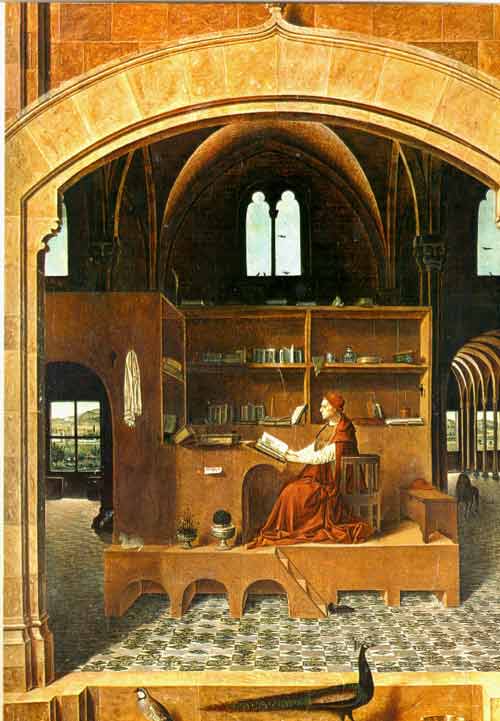
Perhaps I can pull myself together for St. Jerome’s day on September 30th (if I remember it).