Einwohnermeldeämter online/ German local authorities on the Internet

Vertretbar.de (Sascha Kremer) reports that there has been a test of services offered by German local authorities online. I didn’t even realize you could register a change of address online. That would be very welcome. However, Fürth is described as ‘could do better’ (verbesserungswürdig), while Nurember gets top marks (vorbildlich).

Virtuelle Rathäuser online werden verglichen. Weitere Links bei Vertretbar.de.

Spanish law portal

The Juristisches Internetprojekt Saarbrücken (the best portal to start looking for German law, and it contains international links too) always has a link of the week. This week the link is porticolegal, described in German here (with past links of the week below).

Porticolegal offers news, statutes, case reports, literature, a search for lawyers, links to professional associations and universities, online journals and discussions forums, and much more.

German conference on computing and the courts being blogged

The Deutscher EDV-Gerichtstag e.V. (German Association for Computing in the Judiciary) 12th conference is being held from 24th-26th September in Saarbrücken. The association’s website has German, English, French and Russian versions (very good English, translated by Jennifer Heuer).

The German weblog LAWgical is reporting in German. Several short reports on presentations are available there.

Rameses II cuneiform writing found

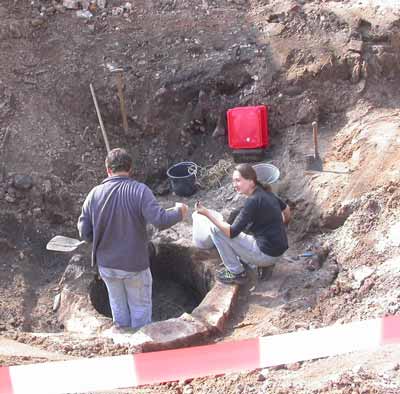
The German Edgar Pusch has been excavating in the Nile Delta for 25 years, on the site of the capital city of Rameses II (1290 to 1224 B.C.).

Among other things he has found a coloured gold floor, remains of a pharaonic palace and the oldest known raw glass production site.

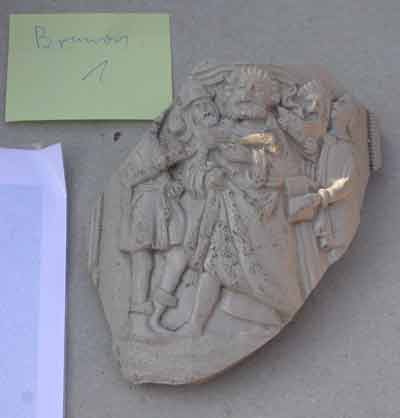
His team has now found what they describe as a fragment from Rameses’ legendary cuneiform archives.

Photograph and more details in the Stuttgarter Nachrichten.

The German spelling is Ramses, but the Oxford Dictionary for Writers & Editors, which I usually follow, has Rameses.

The document is the first cuneiform text to be found in Egypt since 1888/1889. It is from archives of diplomatic documents and refers to the peace treaty between Rameses II and Hattusili III, king of the Hittites. This is the oldest known peace treaty.

It is not known if a road map was recovered.

Training legal translators

In the new edition of Gabe Bokor’s online Translation Journal, there is an article on using a corpus of both original legal texts and also originals with translations in teaching students. Dr. Esther Monzó Nebot teaches at the Jaume I university in Castellón, Spain.

Dr. Monzó describes legal translations as needing to be overt translations, a term taken from Mary Snell-Hornby.

bq. Sometimes we must tell the reader ‘this is a translation’ so as to avoid making them think the Spanish rules are to be applied to an agreement signed in Great Britain. And this may happen if the agreement looks, sounds and feels like an original Spanish agreement. Such a reading may alter the interpretation of both the document and the intention pursued by the parties to it. In these cases, however, translators have their own strategies in order to mark (Hickey, 1998) the text, i.e. to give clues to the reader so that the reader may understand that the text being read, although written in Spanish, belongs to a different legal system. In this particular case of translation, there are also specific conventions the translator is bound by.

This is a problem often overlooked by legal translators; some of them concentrate on making the text sound natural in the target language and then the reader may have the impression that all the concepts mentioned are identical to those of the target language legal system.

She writes of the need for young translators to see examples of translations. They need not slavishly imitate these, but can compare and decide on their own strategy. This would be useful for practising translators too.

bq. …young and inexperienced translators have to work out on their own how to convey that necessary message to their readers, “How should I translate ‘High Court of Justice’ into Spanish so that my reader knows I am not talking about any Spanish court?” To think about such matters over and over again becomes nonsensical when we think of the number of people the world over who have at some time posed exactly the same questions, but this will be necessary as long as we refuse to show our work to trainees and peers.

It is true that legal translation often seems like reinventing the wheel.

The Spanish, Catalan and English corpus created by Dr. Monzó and Anabel Borjá will eventually be available on the Internet at http://www.cdj.uji.es. A couple of screenshots are given in the Translation Journal article.

LATER NOTE: Dr. Monzó would be happy to receive originals and/or translated text, if anyone wants to contribute to the project – texts in Spanish, Catalan, and English. Her email address can be found in the Translation Journal article.

New weblogs

Bag & Baggage on 21st September described a new blog:

bq. Paul attends the University of Edinburgh and will be studying law and politics there for the foreseeable future. He writes An Oasis—”Just trying to get a little pizza in an uncivilized world”—, an ecclectic mix of politics, business, culture, you name it.

Paul has an entry that fits in with my current archaeology kick, about the world’s oldest genitals being discovered near Aberdeen.

In Germany, there’s a new German-language law blog from Saarbrücken University, LAWgical. (German blawgers seem to feel the need to put ‘law’ in capital letters). This was announced by Handakte WebLAWg and by Simon’s Blawg.
The bloggers are Dominik Bachmann, Sonja Hampel, Rainer Langenhan, Iris Speiser and Ralf Zosel. The emphasis is on the law of IT and the new media.