Delia Venables on legal resources/Delia Venables: UK-Recht im Internet

Delia Venables, who I’ve recommended before, was one of the earliest sources of internet information on law in the UK. Her website on legal resources for the UK and Ireland would take a long time to click around. I usually look at the information for lawyers, in particular newspapers and journals and the best new sites on the legal web.

She has recently made her newsletter for lawyers free to access online, although for the printed or pdf version there is still a subscription. The November/December 2012 issue includes the following topics:

* Nick Holmes provides an essential guide to eBooks – options, formats, devices, readers and digital rights management.
* Peter Garsden of Abney Garsden McDonald reviews the success of going paperless. It took over 7 years but it’s worth it in the end.
* Nigel Miller of Fox Williams provides 10 top tips for securing and managing domain names. Domain names are the basis of ecommerce.
* Barrister Amanda Millmore reviews the use of social media in the legal system – by police, as evidence, and in the community.
* Tom Hiskey describes his move from practice as a solicitor to running a legal technology startup company called “The Law Wizard”
* Sue Bramall of Berners Marketing compares the relative effectiveness of blogs and news sections. Which are best?
* Patti Havers describes the history of the Havers Directory and the new look, and new facilities of “Havers – Defining the Bar”.

There is a great deal of information on the site of interest not only to lawyers.

Schweitzer International Bookstore

Have I recommended the Schweitzer legal bookshop in Munich before? I’ve only been once and they had an eclectic selection of law books in English in the basement. Don’t know if that’s still the case. More interesting was a list of books, for example German law in English, which I got hold of years ago. What I didn’t realize is that its successor and various materials are now available online.

Schweitzer Fachinformationen

If you click on International Bookstore, you will find a number of links to newsletters, including special editions of newsletters, in the form of PDFs with details on relevant literature:

Spezial-Ausgaben des ILFB-Newsletters /
Newsletter – special edition
ILFB Spezial: Arbitration
ILFB Spezial: Germany
ILFB-Spezial: Contracts – Forms – Drafting
ILFB-Spezial: Insolvency
Sonderheft: International Corporate Reporting
ILFB-Spezial: Intellectual Property
ILFB-Spezial: Securities Law & Regulations
ILFB-Spezial: Joint Ventures & Strategic Alliances
ILFB-Spezial: Estate Planning – Trusts
ILFB-Spezial: Private Equity
ILFB-Spezial: Islamic Business & Finance
ILFB-Spezial: Business Crime
ILFB-Spezial: Company Law Reform Act

The newsletters relate to books on law, economics and tax, and you can subscribe to them.

From the special newsletter on Germany (August 2011), here is a typical book description from page 37 (I have this book by Singh and it looks very good – English texts on administrative law are not so easy to get – but I haven’t got round to mentioning it yet).

German Administrative Law in Common
Law Perspective
Singh, Mahendra P., 2nd edition 2001
ISBN 3540423656, 377 p.
(Springer Verlag)
Hardback,€ 85,55
A thoroughly revised edition of the author’s book on German Administrative Law, first published in 1985. From the perspective of a common law jurisdiction the author presents the basic framework of German administrative law, along the lines administrative law is understood in the English speaking world. It covers all the essential elements of German administrative law. It is updated to include the latest developments and the impact of EC law in different spheres.
Contents:
Nature, Scope, Growth of German Administrative Law. Legislative Powers of the Administration: Delegated Legislation. Administrative Powers: Administrative Act. Administrative Powers: Contracts, Private-Law Acts, Real Acts, and Planning. General Principles of Judicial Review. Judicial Review of Discretionary Powers. Administrative Courts. Judicial Remedies & Procedure. Liability of the Public Authorities. The Basic Law Grundgesetz). Law on Administrative Proceedings of 25 May 1976 (VwVfG). Code of Administrative Court Procedure (VwGO). An Illustrative Judgment.

Great work by Bettina Kube.

There’s a bookshop from the same chain in Nuremberg, but it doesn’t have a brilliant selection on international law. Maybe others do.

Disparaging the German Federal President/Verunglimpfung des Bundespräsidenten

There’s a kind of defamation you can commit in Germany called Verunglimpfung des Bundespräsidenten. The old StGB translation called it Disparagement of the Federal President, the new one (by Bohlander) calls it Defamation of the Federal President. It’s like defamation in that, in Germany, it’s a criminal offence that can only be prosecuted on the application of the person who claims to have been defamed. There’s a discussion with Udo Vetter here on the risks of going to prison for making a joke about Wulff.

There was in fact a case coming up in Dresden in which someone was on trial for making a joke about Wulff and his wife, but I don’t need to go into that now because this evening it seems the President has had the proceedings dropped (Wulff will keinen Prozess mehr).

See section 90 here:

It comes under the category of offences endangering the democratic state under the rule of law.

Section 90

Defamation of the President of the Federation

(1) Whosoever publicly defames the President of the Federation, in a meeting or through the dissemination of written material (section 11 (3)) shall be liable to imprisonment from three months to five years.

(2) In less serious cases the court in its discretion may mitigate the sentence (section 49 (2)) unless the conditions of section 188 are met.

(3) The penalty shall be imprisonment from six months to five years if the act constitutes an intentional defamation (section 187) or if the offender by the act intentionally supports efforts against the continued existence of the Federal

Republic of Germany or against its constitutional principles.

(4) The offence may only be prosecuted upon the authorisation of the President of the Federation.

Verunglimpfen is a nice word. Unglimpf means insult or defamation. Glimpflich is a better-known word. There was a MHG verb gilimpfan: to behoove. As in: it behooved him to drop the proceedings before he risked further ridicule.

IEL 9: The term “Common law”/Der Begriff “Common Law”

The meaning of the term “common law”

This term has at least four different meanings.

1. (in contrast to local law) The law common to the whole of England after 1066, as opposed to local law (which had existed before 1066 and continued to exist to some extent after 1066). This was the original meaning of the term. This common law was the law made in the King’s (or Queen’s) courts. E.g.

The common law was developed gradually over a period of time, beginning in 1066. Eventually it became a rigid system and ceased to develop to any great extent.

The term is only used in connection with legal history.

2. (in contrast to legislation) Law made by the decisions of judges, as opposed to legislation (statutes), which is law made by Parliament. This meaning arose because the law of England was often made by judges. Another expression with a similar meaning is “case law”: much of English law is case law. E.g.

Murder is a common-law offence ( = its definition is contained in an old report of a legal case where the judge defined the offence of murder in the course of giving his opinion). Theft, on the other hand, is a statutory offence (its definition is laid down in a statute, the Theft Act 1978).

3. (in contrast to equity) The law developed by the old common law courts, mainly between the 12th and 14th centuries, as opposed to equity, a separate legal system which grew up later, and was developed first by the Chancellor and later by the Court of Chancery). E.g.

The common law became so rigid that people used to apply to the Chancellor for a remedy. As a result, equity was developed. However, equity eventually became just as rigid as the common law (or: just as rigid as the law).

At law trusts were not recognized, but in equity they were.

Legal remedies, equitable remedies

4. (in contrast to other legal systems) The law of England and Wales and all other legal systems based on it. E.g.

The USA, England and Australia are all common-law countries

Note also the expression “a common-law wife” ( = the woman a man is living with, without being married). This term is used in England without any legal significance, but in some US states and in Scotland there is a form of legally recognized common law marriage (cohabitation with habit and repute).

Continental law/Kontinentaleuropäisches Recht

Like common law (of which more shortly), civil law is a term with more than one meaning.

1. civil law in contrast to criminal law: private law (Zivilrecht)

2. civil law in contrast to common law: a legal system based on Roman law (ius civilis – römisches Recht, kontinentaleuropäisches Recht)

The second meaning can confuse people who’ve never heard of it. One can call it Roman law, but that’s confusing too, because it might mean the law of ancient Rome rather than that of systems based on it.

Hence we have the relatively rare term continental law. It has the advantage of being comprehensible.

Now, Germany and France recently joined together in the ongoing campaign to show the world that civil law is best, and everyone ought to come to the German and French courts and draft German and French contracts and everything will be better.

There was an article to this effect in the FAZ on February 1.

Verglichen mit dem angelsächsischen Recht leidet das kontinentaleuropäische Recht unter einem Wahrnehmungsproblem: In den letzten 20 Jahren wurde es immer wieder als unflexibel, bürokratisch, wirtschaftsfeindlich und teuer dargestellt. Zu Unrecht, wie sich bei näherer Betrachtung zeigt. Die juristischen Berufsorganisationen Deutschlands und Frankreichs haben daher eine „Initiative für kontinentaleuropäisches Recht“ gegründet.

(Compared with common law, continental law suffers from a problem of perception: in the past twenty years it has repeatedly been described as inflexible, bureaucratic, inimical to business and expensive. Wrongly, as a closer look shows. The professional lawyers’ organizations of Germany and France have therefore initiated an ‘Initiative for Continental Law’.)

Note the use of angelsächsisches Recht for common law. I recall an employer wanting to describe me as an expert in Anglo-Saxon law, but I felt too young for it.

The arguments for continental law as opposed to common law appear compelling (in view of the authors –

Henri Lachmann (Präsident der Fondation pour le droit continental), Rechtsanwalt Axel C. Filges (Präsident der Bundesrechtsanwaltskammer), Notar Dr. Tilman Götte (Präsident der Bundesnotarkammer), Rechtsanwalt Prof. Dr. Wolfgang Ewer (Präsident des Deutschen Anwaltvereins), Notar Dr. Oliver Vossius (Präsident des Deutschen Notarvereins), Oberstaatsanwalt Christoph Frank (Vorsitzender des Deutschen Richterbundes)

they would say that, wouldn’t they?):

codified, so law is easy to find
application is predictable
procedural law is efficient and proceedings are cheap
good at protecting property
hmm – number 5 is ‘Nicht zuletzt ist kontinentales Recht ein Recht der Freiheit. Effizient, kostengünstig, sicher’ – a law of freedom? I think we’re getting into advertising language here.

The article expands on this. Thus if you use the common law, you have to burrow your way through the decisions of many centuries, whereas continental law, with its codes, gives you a ‘checklist’ (a new way of looking at the BGB, or do they mean the French, Austrian or Swiss civil codes?). I take the point about contracts backed up by codified law being simpler and shorter. And about a reliable system of registration.

What’s more, the article continues, continental law cannot be reduced to economics. It has a political mission.

Unser bürgerliches Recht haben sich Bürger gegen absolutistische Fürsten und Feudalherren in Jahrhunderten erkämpft.

I think the French got the upper hand here!

This initiative has a brochure, and I downloaded it in German and English at www.kontinentalesrecht.de. I expect there’s a French version too. This is the related site.

One exciting bit of the brochure is the map of the world. It shows, in mustard yellow, ‘Continental law and mixed legal systems strongly influenced by continental law’ and in blue ‘Other legal systems’. That blue almost fades into the sea. We can see how huge the continental law countries are – they include Louisiana and Quebec. Greenland is pretty big. Then there’s the whole of Russia, China, and nearly all of South America – all great places to get your simple legal contracts backed up by a reliable code, of course. It says ‘Continental law is the prevailing law for two-thirds of the world’s population.’

There is more to be said on this, of course. Probably a big reason for the ‘Dornröschenschlaf’ (it’s a Sleeping Beauty) of continental law is the lack of a common language that isn’t English.

Minor criminal offences/Bagatelldelikte

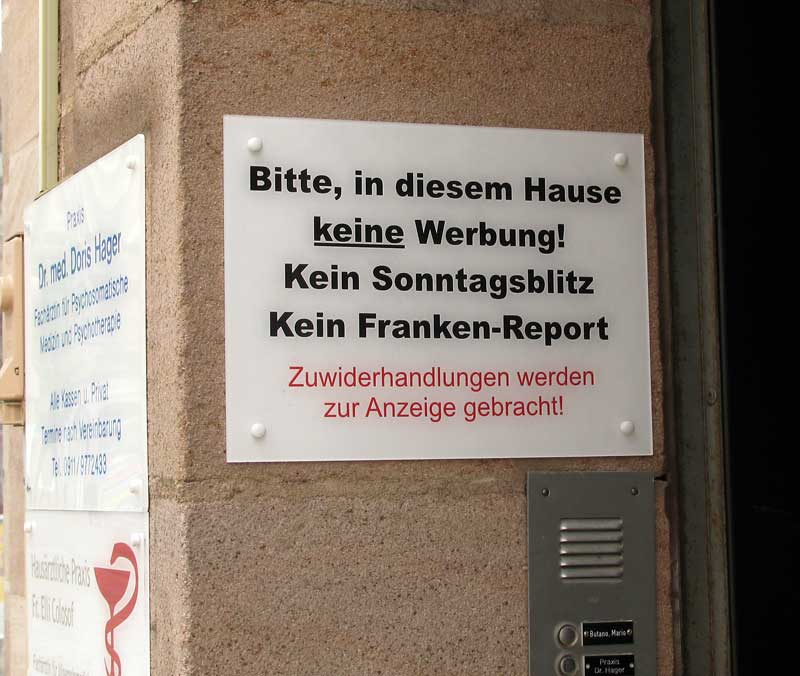
Can anyone tell me what criminal offence is to be reported to the police here?

These people must have been very angry for a long time. One is almost tempted to give them the Sonntagsblitz (an advertising paper with some local news, produced I think by the Nürnberger/Fürther Nachrichten).

Here are some less angry people:

See earlier entry on Communicating with the postman.