
Language issues in US Supreme Court/”Person” und “persönlich” vor Gericht

The US Supreme Court recently decided a case in which language was discussed on the basis of corpora. The question was about the words person and personal.

The decision was FCC v. AT&T Inc.
(PDF file), decided on March 1. This is a slip opinion, which means it has not yet been officially published. It has a headnote, which they call a syllabus.

The situation was that AT&T Inc. claimed that as it was a person (all corporations are persons), it could rely on the right of personal privacy.

Language evidence was presented to show that it does not follow from the noun that the related adjective has the same meaning, particularly in compounds.

In fact, “personal” is often used to mean precisely the opposite of business-related: We speak of personal expenses and business expenses, personal life and work life, personal opinion and a company’s view. Dictionary definitions also suggest that “personal” does not ordinarily relate to artificial “persons” like corporations.

I can’t help feeling that the Supreme Court would have come to this conclusion even without the language evidence. It seems pretty obvious to me. But the definition of person has been expanded in recent years, and at all events the Court of Appeals for the Third Circuit found in favour of AT&T.

We disagree. Adjectives typically reflect the meaning of corresponding nouns, but not always. Sometimes they acquire distinct meanings of their own. The noun “crab” refers variously to a crustacean and a type of apple, while the related adjective “crabbed” can refer to handwriting that is “difficult to read,” Webster’s Third New Interna-tional Dictionary 527 (2002); “corny” can mean “using familiar and stereotyped formulas believed to appeal to the unsophisticated,” id., at 509, which has little to do with “corn,” id., at 507 (“the seeds of any of the cereal grasses used for food”); and while “crank” is “a part of anaxis bent at right angles,” “cranky” can mean “given tofretful fussiness,” id., at 530.

To see what linguistic evidence was presented, you can look at Neal Goldfarb’s amicus curiae brief, which ca also be found via his blog.

This amicus brief was filed on behalf of Project On Government Oversight, the Brechner Center for Freedom of Information, and Tax Analysts. The parties have to agree to a filing. The brief lists the dictionaries and other works cited. A partial quote:

The following are the pairings in each corpus that occurred at least ten times, listed in order of
their frequency:
COHA: personal life, personal income, personal property, personal interest, personal experience,
personal relationship, personal problem, personal reason, personal injury, personal thing,
personal appearance, personal contact, personal matter, personal friend, personal power, personal
opinion, personal fortune, personal gain, personal history, personal letter, personal use, personal
view, personal question, personal tragedy, personal physician, personal attack, personal affair…

The brief relied on three corpora: the Corpus of Historical American English (COHA), the Corpus of Contemporary American English (COCA), and the TIME Magazine Corpus, all of which are the handiwork of Prof. Mark Davies at Brigham Young University. What we did was to search for the string personal [NOUN], in order to find out what words most frequently filled the NOUN slot.

This decision seems correct and well-founded, but I can’t help wondering whether all judges can be relied on to interpret corpus evidence properly.

Via Mark Liberman on Language Log, who links to other weblogs on the topic.
Numbers/Randnummern

Paul McMahon has a post at Ex Tempore on paragraph numbers in Irish Supreme Court decisions.

I know these paragraph numbers from decisions of the European Court of Justice. They are called Randnummern in German.

German law books tend to have paragraphs numbered this way, but these are usually translated as marginal numbers. That means we have two separate translations of the word.

Recently I had to translate Randnummer in connection with a report from the Commission to the Council and to the European Parliament. The following several paragraphs were referred to as a Randnummer in German:

3.3.3. Cases of withdrawal of reception conditions
Articles 16(1)-(3) specify the situations in which reception conditions granted to asylum
seekers may be reduced or withdrawn (e.g. non-compliance with reporting duties, undue
benefits from material reception conditions).
Some Member States withdraw reception conditions in situations not authorised by the
Directive (FI, DE, NL and some regions of AT).
Only a few Member States choose, under Article 16(2), to refuse the reception conditions for
asylum seekers not submitting their applications as soon as possible (EL, MT, CY, UK). In
the latter case, however, use of the provision was seriously limited by the judgment of the
House of Lords concerning compliance with Article 3 of the European Convention on Human
Rights.

My feeling was to simply omit the word Randnummer and quote the 3.3.3. But I was told that the practice appears to be to refer to paragraph 3.3.3, (‘rather than section’ – but section was not the word I suspected, since this isn’t a statute).

Anyway, back to Ireland. Paul McMahon says that five of the eight judges don’t number their paragraphs, and the other three do. He is in two minds about these paragraph numbers, which seems appropriate. And he refers to the unobtrustive right-hand marginal numbers of the German Federal Constitutional Court as an elegant solution.

I’m in two minds about paragraph numbers in judicial decisions. They are rather unattractive, and I think they contribute to the exaggerated belief that explaining a judicial decision requires a technical form of writing, divorced from ordinary discourse. But my views are probably coloured by my experiences working in the American federal courts, where it’s unusual to see numbered paragraphs. (For more on the subject of judicial written style, I recommend Judge Richard Posner’s fascinating article on the subject (JSTOR access required)).

The post is taken up by Eoin in cearta.ie. He thinks the rise of paragraph numbers outside the US is for purposes of orientation.

It’s been a long time since I thought of the numbering system in published English reports. There you would have a report, and in the left-hand margin, every 5 lines or so, was a letter A, B C etc. and you would quote it by referring to the nearest letter: ‘p. 25, at B’.

But I use the internet now, and citation procedures are different.

(Via UKSC Blog)

Legal English blogs/Blogs zur englischen Rechtssprache

I’ve mentioned weblogs on legal English before, I think, and I’ve certainly mentioned Jeremy Day’s blog on English for Specific Purposes, Specific English. But I haven’t yet put them on my blogroll, although I think they must be highly relevant here.

Here is a link to the legal English entries on Jeremy’s blog. The latest one, My first and worst legal English lesson, is a great description of what can go wrong when you present yourself as more expert than you are – certainly a risk not only for non-lawyers teaching legal English, but for lawyers too. If you’re helping lawyers to improve their English, you don’t have to be the source of legal knowledge, but the facilitator.

The entry earlier than that, Legal English blogs, is a whole year old and gives links to other blogs on legal English (including Transblawg!).

And here’s another one: English for Law, by CKL, with many suggestions for teaching materials sources.

Cat woman fined/Geldstrafe für Katzenmisshandlung

No doubt all readers saw the video of Mary Bale stroking a cat and then dumping it in a wheelie bin, whence it was reclaimed 15 hours later. Just in case not, here’s a short video with English soundtrack and German subtitles (from the Swiss 20 Minuten news programme).

Yesterday Mary Bale was fined (Independent report).

A woman who was caught on CCTV dumping a cat in a wheelie bin was fined £250 today after pleading guilty to causing unnecessary suffering to the animal. …

Bale, who appeared close to tears, was fined £250 plus £15 victim surcharge and costs of £1,171.4p.

She was also banned from keeping or owning animals for the next five years.

District judge Caroline Goulborn told Bale the potential of the offence to have caused harm to the cat was substantial, but in reality it had not been hurt.

Just a bit on the legal details: A district judge is what used to be called a stipendiary magistrate. Most magistrates’ courts, which deal among other things with petty crime, have a bench of three lay magistrates, but in big towns there are court with just one stipendiary magistrate – now called a district judge – who is legally qualified and so doesn’t need legal advice from a clerk nor to withdraw and deliberate as a bench of magistrates do.

In England and Wales, prosecutions are made not only by the Crown Prosecution Service, but by other bodies and even individuals. If the CPS had prosecuted, the costs would have been about £1,100 less. This prosecution was by the RSPCA, and according to the Magistrate’s blog, Cash in the Kitty, the RSPCA just claimed all the costs it could think of.

Beerbikes banned/BierBikes in Düsseldorf verboten

Bierbikes hadn’t really registered with me until the city of Düsseldorf banned them recently and the order was confirmed by the Düsseldorf administrative court on October 6.

Meter für Meter schiebt sich das eigentümliche Gefährt über die Straße. An der Theke des “Bierbikes” ist die Stimmung prächtig, bei den genervten Autofahrern dahinter ist sie auf dem Tiefpunkt. Ob feuchtfröhlicher Junggesellenabschied oder umweltfreundliche Stadtrundfahrt: In immer mehr deutschen Städten rollen sogenannte Bier- oder Partybikes. Nun hat Düsseldorf die 16-Sitzer verboten: Kein Betrieb ohne Sondergenehmigung – und die werde nicht erteilt, so sieht es die Stadtverwaltung. Das Düsseldorfer Verwaltungsgericht gab ihr Recht (Az: 16 K 6710/09).

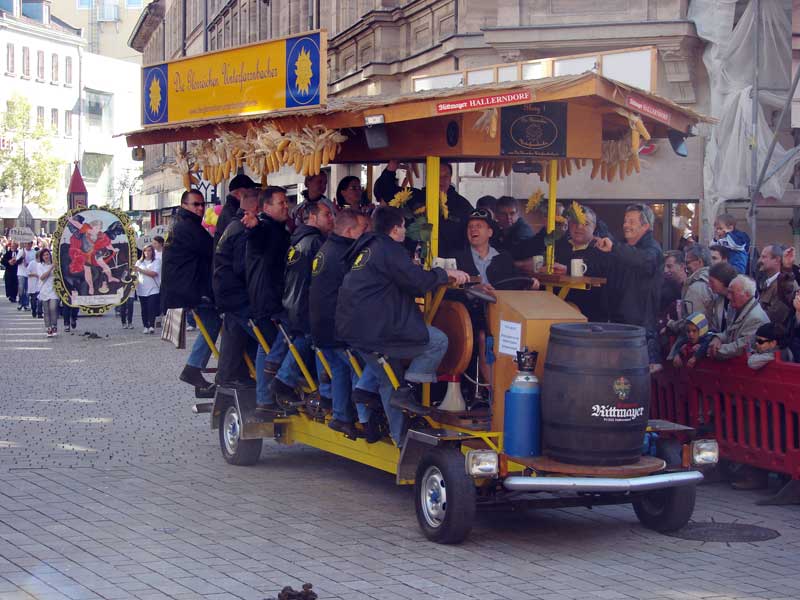
The judgment only affects Düsseldorf, and it is not yet final and non-appealable (rechtskräftig) there, so they can still be used. The idea is that one allegedly sober man steers the vehicle while up to sixteen sit along the sides, peddling – make that pedalling – and imbibing.

Here is a picture of one I took at the harvest festival procession yesterday (the following group represent the church of St. Michael):

The Guardian reported on the matter very promptly:

The bizarre contraptions hail from the Netherlands but are a particular hit in Germany, where they are offered to tourists in 34 different cities. Beer bikes, also known as “pedal pubs” or “mobile conference tables”, allow up to 16 drinkers to sit around a beer-barrel table, help themselves to on-tap beer, and listen to music while pedalling around the city. They are steered by a non-drinker employed by the operator. More than half of those who rent them are on stag parties.

The court in Düsseldorf issued the ban this morningafter complaints from other drivers about rowdiness. Complainants maintain that the bikes caused traffic jams, which intensified the longer a beer bike journey lasted – in effect, the more the revellers drank – and the more their pedal power tended to be reduced.

Changes at register office/Änderungen beim Standesamt

I wrote about the types of German birth certificate in 2005.

The practice of German register offices changed on January 1 2009.

Here is my earlier summary with the changes:

Geburtsschein (minimum details) – now gekürzte Geburtsurkunde
Geburtsurkunde (most details) – now Geburtsurkunde
Abstammungsurkunde (most details – including natural parents) – now beglaubigter Geburtsregisterausdruck

This shows that you can usually translate both Geburtsurkunde and Abstammungsurkunde as birth certificate, but there will be circumstances in which you need to distinguish them and can add ‘showing natural parents’.

Another problem I mentioned then was that some Geburtsurkunden say ‘mit der Abstammungsurkunde identisch’. This means that if you want to get married, you can use the certificate as evidence of your biological parents.

At least the translation is straightforward: we now have a short birth certificate, a (full) birth certificate (to use the UK terms) and a certified extract from the register of births.

There are more changes to the system. There is no longer a Familienbuch, but an Eheregister. I haven’t read these up in detail, but here is some information from Braunschweig.