We should have went to Denmark

One of Denmark’s income earners is a weekend package to get married. It’s directed particularly at US soldiers marrying Germans.
Marriage in Denmark/Heiraten in Dänemark (a site in English, German, Spanish and Portuguese)

Heiraten-leicht-gemacht.de wants to help all bi-national couples who have difficulties to get married in Germany or in other European countries. We will show you the way to a fast, legal and unbureaucratic marriage.

Bi-national couples in Germany or in other European countries need to master endless bureaucratic hurdles to get married. The main problem here in Germany seems to be the ‘Ehefähigkeitszeugnis’ (a certificate which formally enables you to marry) from the home country of the non-German partner.

The latter is rather easy and legally possible to avoid when getting married in DENMARK. This is where our concept starts. We would like to show you an easy, unbureaucratic and cheap way to get married in Denmark.

Our special offer is the EXPRESS-WEDDING – you will get married in Denmark within 24 hours.

(Ehefähigkeitszeugnis: certificate of no impediment)

Nelly at Head over Heels is a German about to get married to an American in Germany (We should have went to Denmark and see also Die standesamtliche Hochzeit). She has collected tips and links for other Germans wanting to marry Americans:

This is getting ridiculous. I’ve been looking for a translator and interpreter for hours. You see, we can’t just get the papers translated by any translator and we can’t just hire any interpreter to come with us to the courthouse. I searched on the official associations website for interpreters and translators but ya know what? Most of them don’t translate birth certificates anymore, most of them don’t do the weddings anymore. It’s not good enough for them. They could lose a better job over it and we can’t afford them anyway. That is what I was told a dozens of times.

She’s unhappy at having to pay 100 euros for an interpreter for the registration and another 100 euros for the ceremony. The registration is said to take 30 minutes, but I don’t know what the interpreter’s travel time would be.

These are German translators translating long US birth certificates into German, which is more expensive than German into English (and with luck, the German can buy a multilingual birth certificate from the register office). I am not sure how they say no on the phone, but ‘I might lose a better job’ or ‘You can’t afford me’ don’t seem to be the way to go.

I think it’s true that if I charged the right price for a certified translation of a private document (the price that gives me an hourly rate I can live on), only one in ten potential private clients would not be outraged. I used to charge a lower price and half the clients were also outraged. On top of that, a lot of time can be spent when the customer brings the original documents and collects the translation, and of course one doesn’t charge for that time. It seems to compound the problem common with other customers too that they may think translation is typing in another language.

Blaise/Blasius

Blessing of the throats on St. Blaise’s day, February 3, at St. Etheldreda’s in London (probably the only pre-Reformation church in England restored to Catholicism). St. Etheldreda is the patron saint of throat complaints. I haven’t actually got a sore throat, but perhaps this is why:

Blessing of the Throats, London
Though not strictly a folk custom, the annual Blessing of the Throats service at London’s St Etheldreda’s church in Ely Place is quirky enough to figure in any list of strange British customs.
St Etheldreda’s is the second oldest Catholic church in England, returned to Catholic use in the 19th century. It is here that on February 3, St Blaise’s day, a ceremony is held to ask for that saint’s help in treating those with throat problems. Blaise, a 4th century doctor in Armenia who became bishop of his home city Sebaste, saved the life of a small child with a fish bone stuck in his throat as the saint was being led off to be tortured for his faith.

Meanwhile, in Wolfsburg:

Blasius-Segen gegen Halserkrankung, wird erteilt am Dienstag, 3. Februar, um 18 Uhr. (St. Christophorus)

Wikipedia says Etheldreda’s real name was Æthelthryth.

(Via Baroque in Hackney)

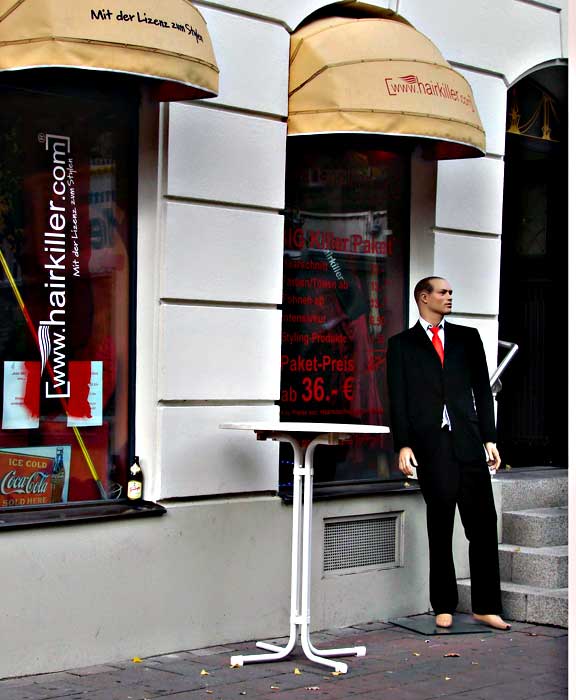
Hairdressers’ names in Germany/Friseurnamen

Under Huns, Hair Salons and Puns, Strange Maps reprints a map from Die Zeit, showing the incidence in Germany of salons named Haareszeiten, Haarmonie and Haargenau. Plus link to a flickr pool on hairdressers with funny names.

The map shows little except that the names are widespread. According to the article in Die Zeit, there are fewer such ridiculous names in Berlin and Munich, where they have had their day, than in Stuttgart or North-Rhine-Westphalia.

Was in Stuttgart noch als originell gilt, ist in Berlin längst verpönt. Dort nämlich ist der Originalitätsdruck so groß, dass die Friseure sich kaum noch trauen, sich wie alle zu nennen. Friseure heißen in den Berliner Bezirken, in denen die jungen, ironischen Menschen wohnen, schon wieder “Friseursalon”.

It looks as if this topic has been covered in more depth elsewhere. Even Bastian Sick has done it. Maybe Die Zeit just took the first three names mentioned in this thread at www.haarforum.de and pinned them down in the Yellow Pages. www.wissen-friseur.de has many more listed. So does ronsens. All have more links, and Google is full of them. In fact, little else is written about on the Internet than hairdressers’ names.

I’ve already shown a photo of the local Happy Hairy People.

This reminds me of opticians’ window displays.

ADDED LATER:

Washing your hands without mixer taps/Wie machen es die Engländer?

an old discussion on wer-weiss-was about the British and mixer taps (actually in this case a former Commonwealth country).

War jetzt zum wiederholten mal in einem ehemaligen Commonwealth-Land und hab mich wie immer gewundert:
Wie waschen die sich die Hände?
In der einen Ecke des Waschbeckens gibt es einen Brüh-Heißen Wasserhahn in der anderen Ecke einen Eis-kalten.
Gibt es irgendeinen Trick?
Und nur mal theoretisch ist EIN Wasserhahn (mit Mischregler) nicht billiger und einfachere/schneller einzubauen als ZWEI?

An Englishman replies:

but if having a good wash, then you put the stop in the sink and put hot and cold into the basin until temperature is ok for you

The Germans may not have thought of that one.

It’s one of those topics that heats national prejudices.

I ask myself: how long have the Germans had mixer taps? Were they introduced together with the autobahn?
I remember how impressed my brothers were when I was living in a ramshackle building in Germany with other students, and the fuse went. The fuse was a large round plug half the size of a rolling pin, and all you had to do was unplug some electrical device and push the fuse back in. They had been expecting work with a screwdriver. But I think that fuse system had existed since the early 1900s at least.

This follows a mailing-list discussion on u-forum about a use of the word spigot in British English and how to translate it into German.