Miscarriages of justice/Fehlurteile

Blair entschuldigt sich bei zwei Familien.

The Guildford Four and the Maguire Seven, wrongly imprisoned in the 1970s, received an apology from Tony Blair completely exonerating them yesterday, because it’s one thing being not guilty and another being innocent.

The Independent reports, and gives a summary of events and also a comparison of the situation when the arrests were made and anti-terrorism legislation was in place and the situation now, in view of the moves for new anti-terrorism law and the discussion about the British inmates of Guantanamo Bay.

Eleven people spent up to 15 years behind bars before being cleared while one man, Guiseppe Conlon, died in prison. They were jailed in relation to the 1974 Guildford and Woolwich pub bombings in which the IRA killed seven people.

Mr Blair’s apology was delivered in a TV statement in his office in the House of Commons and then in private to those wronged by the British legal system. He said: “I’m very sorry that they were subject to such an ordeal and such an injustice. That’s why I’m making this apology today – they deserve to be completely and publicly exonerated.” He then shook them by the hands.

The two cases were particularly well-known. Gerry Conlon and Annie Maguire both wrote books, and there was the film In the Name of the Father, which unfortunately did not aim to be factual (the scene where all the defendants in both cases were crammed into the dock was also unintentionally funny). But Daniel Day-Lewis was good. Roger Ebert did justice to this one:

Convinced by the film’s documentary detail, we assume all these facts are based on truth, and it is a little surprising to discover that the sadistic British policeman is a composite of several officers, that Conlon and his father were never in the same cell – and that the crucial character of Joe McAndrew (Don Baker), an IRA man who confesses to the Guildford bombings, is a fictional invention. All the same, the main thrust of the story is truthful: British courts found that Conlon and the others were jailed unjustly.
Alaaf – Helau – carnival language

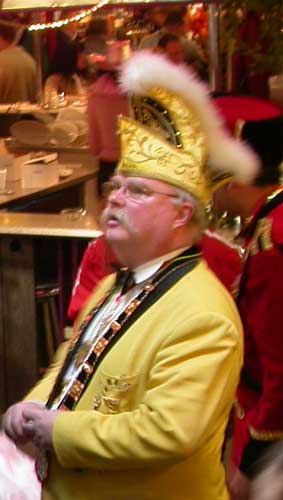
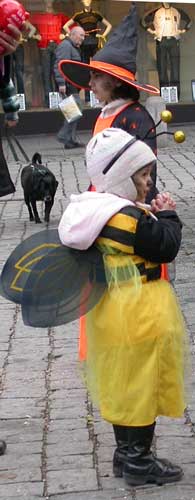
Philip Lenssen, a German contributor to the group blog Google Blogoscoped, has used Google to collect a list of 200 German towns and what words are used as a carnival salute (Alaaf or Helau) and for carnival (Fasching or Karneval – the word Fastnacht, Fasnet etc. isn’t even considered).

bq. I can’t say this strikes me as very authoritative. Incidentally, I heard a Fasching event about ten days ago where the cry was ‘Fürth Alaaf – Franken Helau’.
The Googleshare algorithm here is simple enough. Let’s take Hamburg as example. If the page-count for the Google result for Hamburg Helau is higher than for Hamburg Alaaf, it will assume “Helau” is indeed the way to salute during carnival in Hamburg. As most automated data mining with Google, this algorithm isn’t failsafe; in particular, it disregards the fact some of the cities do not have carnival in he first place.

Duden says Alaaf is from Cologne and from ‘alles ab’ meaning ‘alles (andere) weg’ (Kluge’s etymological dictionary agrees, saying it is a call for more space), and Helau means Hurrah.

(Via Handakte WebLAWg)

Portuguese legal weblogs

From my referrers: Cum grano salis (US with a grain of salt, UK with a pinch of salt, DE cum grano salis!), since July 2004:

bq. Efeméride
Este despretensioso blawg, de informação e reflexão na área judiciária, foi criado às 14:00 horas do dia 15 de Julho de 2004, em Portugal.

Postings mainly by L.C.

This refers to the blog of a young lawyer in Oporto, Suo Tempore.

And to Ciberjus, a blawg for Portuguese and Portuguese-speaking lawyers. Ciberjus is not anonymous: Francisco Bruto da Costa writes that it is a blog associated with the Ciberjus list, which has over 300 members.

Further links on those sites will be especially interesting to those whose Portuguese is better than mine.

German Wikipedia fake entries/Falsche Einträge in Wikipedia

Wikipedia: Denkste: ine Sammlung von erfundenen Wikipedia-Einträgen (dank an Peter Müller).

bq. Haakon Schorn (*1763, † 1826) war ein norwegischer Geschäftsmann. Er ließ sich 1790 im Südwesten Englands (bei Bristol) nieder und ließ dort während der immer stärker werdenen Industrialisierung eine Vielzahl an Fabriken erbauen. Da diese noch nicht, wie heute, über Filteranlagen verfügten und die Abgase ungehindert über die aus Stein erbauten senkrechten Abzugsrohre an die Luft abgaben, setzte sich in der Bevölkerung bald der Begriff des “Schorn”-Steins durch. Heutzutage hat sich der Begriff Schornstein schon längst etabliert und kaum jemandem ist noch klar, woher er eigentlich stammt.

Manche der besten landen in einem Humorarchiv.

The English Wikipedia does have a page of votes for deletion.

bq. Derwent Center of Universe
Cannot find in Google. Possible joke page. Delete.-gadfium 02:06, 3 Feb 2005 (UTC)
* Delete. I can’t find evidence of this. JoaoRicardo 02:32, 3 Feb 2005 (UTC)
* Delete non-notable, possible original research. –Deathphoenix 05:37, 3 Feb 2005 (UTC)