
Did George Bush steal a German word? The Nürnberger Nachrichten has an article by Evelyn Scherfenberg on German words that have been exported.
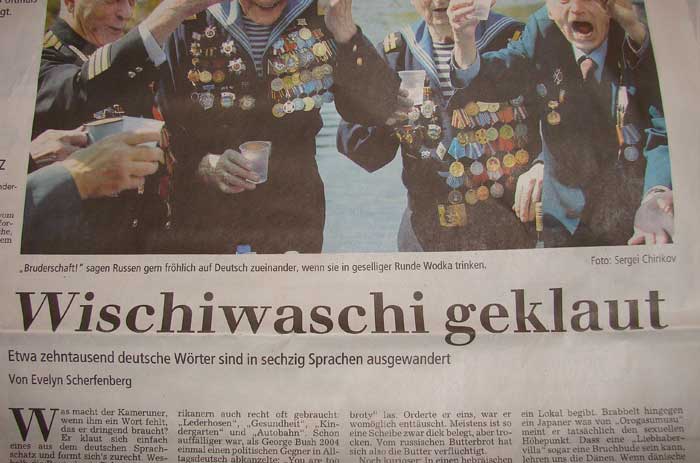
Schon auffälliger war, als George Bush 2004 einmal einen politischen Gegner in Alltagsdeutsch abkanzelte: “You are too wischiwaschi!”
The legal connection: apparently this idea that wishy-washy was borrowed from wischiwaschi comes from a book by Prof. Dr. Jutta Limbach, Ausgewanderte Wörter

It looks as if the two terms may have grown up independently in the two languages. Kluge’s etymological dictionary of German says the term means ‘verschwommenes Geschwätz’ (waffle), is pre-20th-c. and was formed on the basis of Gewäsch. The OED gives two meanings: 1. sloppy or insipid food (earliest example 1791) 2 1) feeble or poor in constitution (1703) and 2 b) Feeble or poor in quality or character; trifling, unsubstantial, trashy, milk-and-watery. Also rarely as int. = pish! tush!
a1693 Urquhart’s Rabelais iii. xxxvi. 298 Pan. Wishy, washy; Trolly, trolly [orig. Tarabin, tarabas!]. 1797 G. Colman Heir at Law ii. ii, A lord without money be but a foolish, wishy washy kind of a thing a’ter all. 1801 T. Dibdin Il Bondocani iii. ii, None of your wishy washy sparks that mince their steps. 1867 Trollope Chron. Barset I. vii. 55 A weak, wishy-washy man, who had hardly any mind of his own to speak of. 1865 M. E. Braddon Doctor’s Wife iii, Isabel painted wishy-washy looking flowers on Bristol-board from Nature. 1893 Nation (N.Y.) 9 Feb. 106/3 A silly, wishy-washy, inconclusive+style of writing.
The English meaning makes more sense in Bush’s context. Pish! tush! is all I can say.