Email from amazon.de/amazon.de schreibt mir

These are usually amazing, aren’t they? (I thought the exclamation mark after ‘Liebe Kundin…’ went out thirty years ago):

bq. Liebe Kundin, lieber Kunde!
Kunden, die sich für The Roses (Jumbo) von Pierre-Joseph Redoute interessierten, haben Vegetables (Genome Mapping and Molecular Breeding in Plants) von Chittaranjan Kole bestellt. Daher möchten wir Sie darüber informieren, dass Vegetables (Genome Mapping and Molecular Breeding in Plants) von Chittaranjan Kole soeben erschienen ist. Bestellen Sie jetzt Ihr Exemplar!
Vegetables (Genome Mapping and Molecular Breeding in Plants) Vegetables (Genome Mapping and Molecular Breeding in Plants)
Chittaranjan Kole
Preis: EUR 192,55

I’m sorry, amazon, I’d love to, but I haven’t got time (or money, in this case). It’s true I once translated a book on paintings of roses, but that was a different matter.

Maybe the Polyglot Vegetarian‘s mileage may vary. (new blog – thanks to languagehat)

Language and the EU

Geoffrey K. Pullum’s recent entry in Language Log repeated some dubious statistics. Working Languages presents a corrected version. The latter is taken into account in a final note under the Language Log entry, where it is described as ‘No Happy New Year from…’ (although it did start with a compliment to LL).

I suppose the same could apply to my comment at Working Languages. If such comments seem irritated, it is because running down the EU and perpetuating blatant inaccuracies about it is another snowclone. Now I don’t think LL is rude to snowcloners, but it probably doesn’t wish them a happy new year, and of course the functioning of the EU plays a different role in our lives than the Inuit vocabulary on snow. Still, I do hope Geoffrey Pullum has a happy new year, at least from now on.

Like snowclones, inaccuracies about Europe have acquired their own name: Euromyths, and here’s a list of euromyths. Nothing about translation there: it isn’t such a crowd puller in newspaper stories. But the entry on EU workers does suggest that EU translators are wrongly believed to be able to escape prosecution for traffic offences:

UKIP MEP Jeffrey Titford said: “Imagine if some young thug slings a brick through your window and the police arrest him. How would you feel if they had to let him go because daddy works for the EU?”

Mind you, I’m not sure if the author of Working Languages could pass as a ‘young thug’.

Termination of employment/Aufhebungs- und Abwicklungsvertrag

I haven’t previously had to translate Abwicklungsvertrag. This was in the context of an attorney’s practice areas, which included drafting Aufhebungsverträge (a contract terminating employment) and Abwicklungsverträge (a contract dealing with the end of employment, after termination has already taken place).

I decided to go for termination agreements and post-termination agreements (the employment context was clear). I could imagine using the German terms in brackets in some contexts. If Harald Schwamborn’s definitions are correct, I don’t think there is anything in English law quite like an Abwicklungsvertrag:

Beim Aufhebungsvertrag wird das Arbeitsverhältnis durch den Vertrag beendet. Beim Abwicklungsvertrag geht eine Kündigung – in der Regel des Arbeitgebers – voraus. Das Arbeitsverhältnis wird also nicht durch den Abwicklungsvertrag beendet, sondern durch die vorausgehende Kündigung. In dem Abwicklungsvertrag wird lediglich geregelt, “wie man auseinander geht”.

I do find the discussions on proz.com a great resource, although I decided not to follow the results of this one. Kim found an excellent resource at Jones Day (link doesn’t work for me), which suggested settlement agreement. I find that a bit unclear. The original asker’s client obviously had no idea how to deal with the term:

In unserer arbeitsrechtlichen Praxis finden Verwendung:
Aufhebungsvertrag – settlement agreement
Abwicklungsvertrag – contract finalizing agreement
Abwicklung eines Vertrages – winding up a contract

I found a description of German labour law in English at the ILO, but it doesn’t have enough German terminology interspersed.

LATER NOTE (November 2007): the Abwicklungsvertrag struck me as odd again. It means dealing with all the steps of putting an end to an employment relationship. One suggestion was phase-out agreement, more common with greenhouse gases (albeit less effective). I am now tending to settlement agreement. I found this here (excerpt from an article of which non-subscribers could not read the rest, September 2004):

Article Excerpt
If an employer wishes to end an employment relationship, it can do so either by terminating the employee and trying to conclude a so-called settlement agreement or by trying to conclude a mutually acceptable severance agreement with the employee. An employee will generally only come to terms with an employer on a severance agreement or settlement agreement if the employer agrees to pay an acceptable termination payment. Please note the difference between a “severance agreement” (Aufhebungsvertrag) and a “settlement agreement” (Abwicklungsvertrag). A severance agreement is an agreement concluded between the employee and the employer whereby they…

Wacky warnings/Lustige Verbraucherinformationen

The BBC and snopes.com/my way report (with pictures) on a warning notice on a washing machine, ‘Do not put any person in this washer’.

I have to admit I can’t see the harm in giving such warnings, just because some people think they’re obvious. It seems that books with collections of such trivia sell well, though. These finance the work of M-Law, a Michigan organization against frivolous litigation.

My Way News writes:

A spokeswoman for the manufacturer said the washer warning label is far from wacky.
“A front loader is just at the right height – speaking now as a mother and not a corporate spokeswoman – for a 4-year-old,” said Patti Andresen-Shew, marketing director for Alliance Laundry Systems LLC in Ripon, Wis.
She said there have been lawsuits filed against companies – “fortunately not ours” – after small children got into coin-operated laundry equipment and an older child started the machine.
The Center for Justice and Democracy, a group fighting legislation to limit the right to sue, said warning labels play a vital role in protecting the public.
“Often, it is only through lawsuits brought by injured consumers that manufacturers have been forced to place critical warning labels on dangerous products, saving millions of lives and preventing innumerable injuries,” it said in a statement.

Anyway, they can’t stop me if I really want to.

(Thanks to Volkmar Hirantner – also seen in RA-Blog)

Feuerzangenbowle

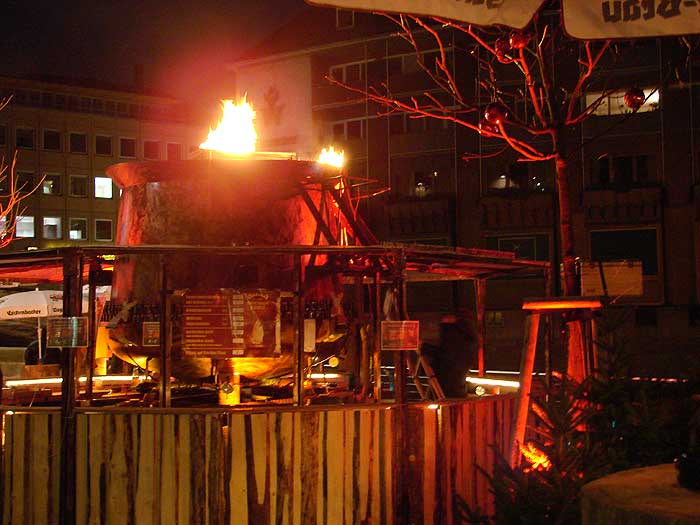
Feuerzangenbowle is a form of punch, where a sugar loaf supported horizontally above a pot of mulled wine is soaked with rum and set light to, so that the burning sugar falls into the wine. h2g2, the BBC’s proto-Wiki, describes how to do it.

This picture, which I took yesterday at about 17.30, shows a cauldron calling itself the biggest Feuerzangenbowle in the world, which has been irritating some persons in Nuremberg who claim it draws people away from the Christkindlsmarkt (that’s over now, but the Feuerzangenbowle continues till Sunday).

DSC0354507w.jpg

It was translated as ‘the world’s biggest burnt punch event’, and I see Muret-Sanders has ‘burnt punch’, a rather disturbing and puzzling term. I also found on the Web ‘mulled wine punch’, which sounds better, although it rather glosses over the role of the rum, ‘flaming red wine punch’, ‘flaming fire tongs punch’ (sounds like the tongs we used to use to put coal on the fire, and as if the tongs were on fire – the Feuerzange is a tong-like device intended to hold the sugar loaf). The Heinz Rühmann film (which was showing on two screens at the site) is even once rendered as ‘The Fire Tongue Bowl’, a masterpiece of false friendliness.

For a picture of a sugar loaf (Zuckerhut), I turn to CAPL.