Flabeg pillar / Flabegsäule

20070830fue070w.jpg

Not much good news today, me hearties, but at least this:

Die von Ingo Klöcker zum Jubiläumsjahr gestaltete Flabeg-Spiegelglasstele in der Adenaueranlage bleibt auch während der Fürther Kirchweih stehen. Das hat OB Thomas Jung angesichts der Kosten von 10 000 Euro für die geplante Versetzung beschlossen. Die Kirchweihbuden müssen nun um das Kunstwerk herum gruppiert werden.

Thank goodness for that, though it’s not for the right reason. I had no idea this nice column commemorating the mirror industry in Fürth was only a temporary amusement.

Forthright and candid feedback / Das ist Unsinn

There’s a translation help section in the forums of Toytown Germany, a site for English-speaking residents. Dafydd wanted to know a German equivalent for ‘I’m sorry but that’s simply bollocks’:

Back in Blighty, amongst colleagues that I know pretty well I would have no qualms about using the above phrase in a light hearted manner but with the clear message that I will not accept what they are saying and they need to go back and think again.

I do think the suggestion ‘Es tut mir leid, aber das ist Unsinn’ is more appropriate than ‘Gequirlte Scheiße’.

Head massager / Kopfkrauler

Deutsche Sprache schwere Sprache:

Falls Sie der- oder diejenige sind, der die Kopfmassage erhalten möchte, ist das Wichtigste, sich jemanden zu suchen, der Dich krault!
Und vielleicht möchte er oder sie ja auch „kopfgekrault“ werden…
Sitzen Sie sich hierzu aufrecht mit dem Kinn nach unten gerichtet hin.
Der „Masseur“ setzt den Kopfkrauler an Ihrem Hinterkopf an und bewegt ihn (unter Drehen) bis zum Nacken und dann wieder zurück. Mit ein bisschen Übung lässt sich die Massage durch Variieren des Drucks, fließendere Bewegung und Einbeziehen des ganzen Kopfs intensivieren. Für jeden, der „kopfgekrault“ wird, ist es wichtig, die Augen zu schließen und sich zu entspannen.

You can get them to use as a freebie, with your business name on a plaque:

werbung.gif

Vorteile des Kopfkraulers:
• gut gegen Migräne etc.
• entspannende Wirkung bei Parkinson-Patienten
• überwiegend positives Feedback bei geistig behinderten Menschen
• gut bei Kindern vor den Schularbeiten oder vor dem Schlafengehen
• begeisterte Frisör- und Kosmetik-Kundinnen
• Ideal zur Entspannung z.B. auf Arbeit bei Streß
• Anwendung als ergänzende Elemente zu herkömmlichen Massagen
• Ideal zum Verschenken, Partygag, Werbegeschenk etc.

Perhaps I should add that I am not thinking of getting one.

Pied piper of Hamelin / Rattenfänger in Spanien

The plague of the common vole (Microtus arvalis, Feldmaus) in Spain this year has led to desperate measures such as burning.

Such drastic measures are only permitted by European Union officials in exceptional circumstances and many observers are questioning why the EU has wasted so much time and money in dragging voles through the courts on previous occasions when burning them to death is so much quicker, cheaper and effective.

This precept could be applied to many court cases.

It’s a shame they are not the right food for the vultures that have now emigrated to the Netherlands after carcasses were no longer left out on the hills.

I’m not sure that driving the voles with ultrasound to where they can be burned or drowned is quite the same as the Pied Piper of Hamelin luring them away with music. But perhaps the playing of various instruments in Villotilla is?

According to my book on European mammals, the common vole is breeds faster than any other mammal. One vole lives for 4 – 5 months and can produce 500 descendants in that time. If the population is too dense, they attack each other and may even eat weaker ones. The situation improves when there is mass death, usually at the beginning of the cold weather.

Thanks to Trevor, who is taking the vole plague with equanimity.

Stumbling blocks / Stolpersteine

For years, Günter Demnig, a Cologne artist, has been creating bronze stones embedded in the pavement outside the former homes of Jews murdered in the Holocaust.
They are called Stolpersteine – stumbling blocks.

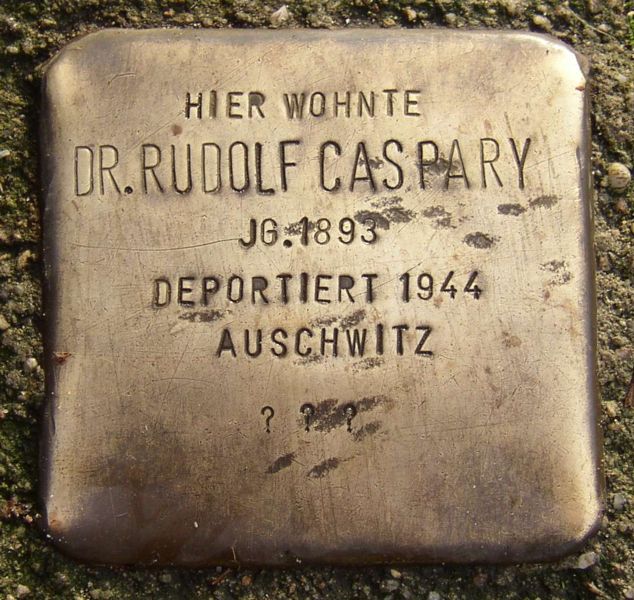
On September 14th the first stone was laid in Berlin for an African, Mahjub bin Adam Mohamed. So the Observer reports today, under the heading first memorial to black victims of Nazi genocide. Here’s a picture of one from Wikipedia (German, English):
634px-Berlin_Stolperstein_Caspary.jpg

It’s a sad story, but there’s more to it than the Observer spotted from Vienna.
Husen, as he was later called (a Germanized form of Hussein), was born in Dar-es-Salaam in German East Africa in 1904 and was an Askari – sort of East African Gurkhas. He fought for Germany in the First World War, although he was a child. He later made a living in Germany, was given a German passport (later taken away), married a German woman, had three children. Before and during the war he worked teaching Swahili at the Seminar für Orientalische Sprachen in Berlin and playing the ‘good African’ in German films.

From about 1936 on, the German Ministry of the Interior secretly had policemen taught Swahili, to be ready to take back the former German colonies. Husen taught these policeman from 1937, in great secrecy.

He was arrested for miscegenation in 1941 and died in Sachsenhausen concentration camp.

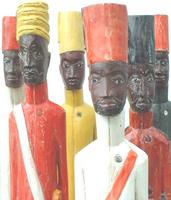
You can order handcarved British East Africa Askari soldiers here.
askari-f.jpg

Here, from a page about foreign language assistants at the Oriental Languages school in Berlin, an earlier Swahili teacher from Africa encounters German bureaucracy for the first time:

An einem anderen Tag standen wir auf und gingen, bis wir an einen Platz kamen, und an diesem Platz waren viele Menschen, und ich fragte: Was sind das für Menschen? Und man sagte mir: Diese Leute sind deshalb hingesetzt, wenn jemand geboren wird oder stirbt, oder wenn ein Fremder kommt, so ist ihr Geschäft (solcher Leute sind siebentausend): wenn ein Fremder kommt, so fragen sie ihn: Wann bist du geboren, an welchem Tage oder Monat, aus welchem Lande kommst du, und was ist dein Geschäft. Und dann musst du alles sagen. Und wenn du sagst: Ich habe keine Beschäftigung, dann wirst du sogleich auf die Reise gebracht werden; und wenn du nicht weißt, an welchem Tag du geboren bist, so wirst du sogleich auf die Reise gebracht werden. Das ist die Nachricht von diesen Leuten, die dort sind. Und wir gingen heraus und gingen nach Hause.“

(Thanks to Trevor)