Nuremberg Zoo:

Karstadt, Nuremberg:

Mariannes Wollstube, Fürth (crochet pattern):

<seufz>, as the Germans write in email.

Nuremberg Zoo:
Karstadt, Nuremberg:
Mariannes Wollstube, Fürth (crochet pattern):
<seufz>, as the Germans write in email.
More here.
It may be easier to become a lawyer than a translator in Brazil, judging from this Guardian article:
Brazil’s lawyers have been shocked to find that a boy aged eight has managed to pass the entrance exam to law school.
The Bar Association said the achievement of Joao Victor Portellinha should be taken as a warning about the low standards of some of Brazil’s law schools.
Since he hasn’t completed high school yet, he can’t actually study.
“My dream is to be a federal judge,” the boy said, according to Globo TV’s Web site. “So I decided to take the test to see how I would do … it was easy. I studied a week before the test.”
I don’t know whether this test is the only criterion used.
Apparently the Guardian had some space left, so the article concludes as follows:
As a former colony, Brazilian civil law is largely based on that of Portugal with statutes derived from the Romano-Germanic legal tradition, but has been amended to include some precedent-based common law.
Exactly what the oddly-express last clause means I have no idea. Presumably, like most civil-law systems, Brazil now takes account of case law.
Trevor asks: Why do we hear so much about the civil/French tradition, and rarely anything about the Romano-German? Readers, this is a question for a future entry. Watch this space.
This week the Federal Constitutional Court announced its decision on the Federal Trojan (Bundestrojaner), the plan of the German Minister of the Interior to secretly inspect computers nationwide. This related specifically to legislation of North-Rhine Westphalia, but made it clear that the same result would apply to federal legislation.
Press release of the court in German
Decision in German
It extends the general right of personality to create a new fundamental right: the ‘fundamental right to the guarantee of the confidentiality and integrity of information-technology systems’.
§ 5 Abs. 2 Nr. 11 Satz 1 Alt. 2 VSG, der den heimlichen Zugriff auf informationstechnische Systeme regelt (“Online-Durchsuchung”), verletzt das allgemeine Persönlichkeitsrecht in seiner besonderen Ausprägung als Grundrecht auf Gewährleistung der Vertraulichkeit und Integrität informationstechnischer Systeme und ist nichtig.
Section 5 (2) no. 11 sentence 1 alternative 2 of the Act on the Protection of the Constitution (Verfassungsschutzgesetz), which governs secret access to information-technology systems (known as the online search), infringes the general right of personality in the specific form of the fundamental right to the guarantee of confidentiality and integrity of information-technology systems and is void.
This doesn’t exactly roll off the tongue, so some German blawgs have been seeking a neater term for the new right. Telemedicus lists some:
Comments on DE:BUG:
Recht auf informationelle Selbstbestimmung
Datenfrieden
Netzpolitik:
Grundrecht auf digitale Intimsphäre / Privatsphäre (someone objects that Intimsphäre is reminiscent of sanitary towels)
Recht auf Vernetzung
Statut über abhörsichere Informationstechnologie (StasI)
Recht auf digitale Unversehrtheit
IT-Grundrecht
virtuelle Menschenwürde
Grundrecht auf informationelle Integrität
and more
Malte Welding:
Recht auf Privatheit der Online- und Rechnernutzung (PORN)
More details on Telemedicus here and here
Here’s the Electronic Frontier Foundation in English, Spiegel Online in English.
It always surprises me how many Scots there are in Bavaria (see earlier entry).

Here are a couple of shots of a ballot paper for the local elections in Fürth.
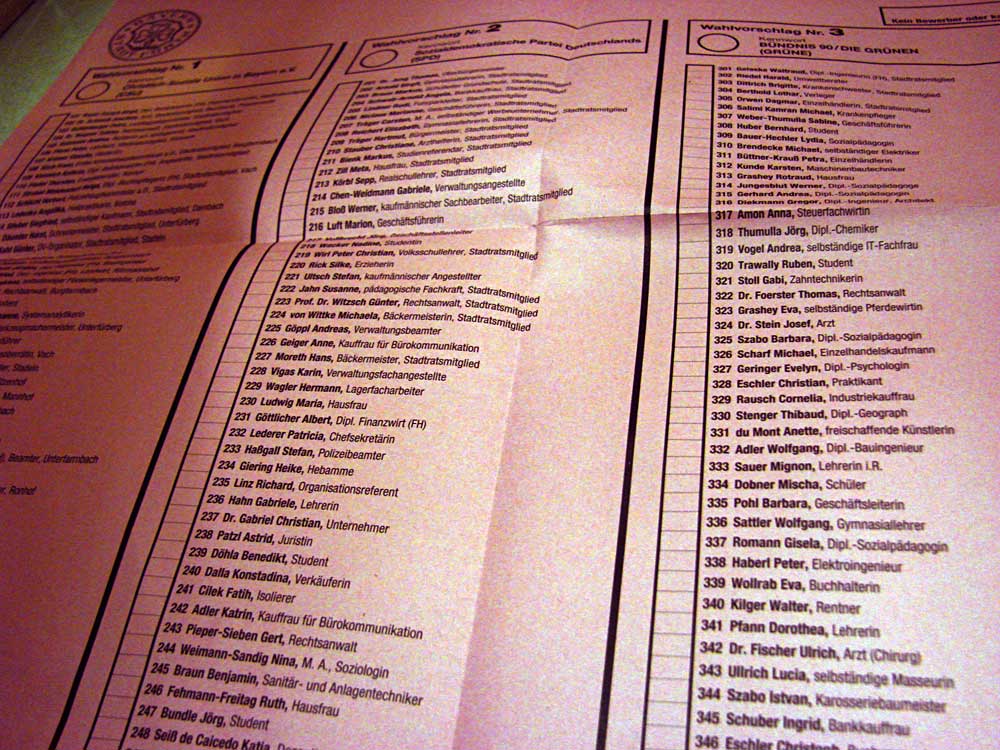

There is a pink one with six fields – sorry about the varying pinks, but it was dark in there – and a yellow one with six potential mayors. You can see a corner of the yellow one in the bottom picture, but it was not very exciting.
As for the pink one, there is no information available in writing on how to fill it in. I had forgotten, so I was sent to a helper, who informed me rather superficially.
I can simply choose one party, putting a cross at the top. That seems to include one vote for each of the 50 (I think) names under that party (Die Linke has fewer candidates). But if I put a the figure 3 by a particular name, my votes go to that name first, even if it’s in another party, and they’re deducted from the main party I chose. (Actually, 3 is not the minimum – presumably 1 is the minimum – but they didn’t tell me that). I asked where I could read about it and I was told in the paper – but I missed that date – or on the Internet, but where on the Internet? No answer forthcoming.
This is not an invitation for an explanation – I’ve had it again and again. Kumulieren means giving one candidate up to three votes, and panaschieren means favouring more than one party, which I can reveal I did.
Only after coming home did I discover this explanation (in German) and this test ballot paper.