Lawsuit, Shmawsuit/Yiddisch

Judge Alex Kozinski and Eugene Volokh on the use of Yiddish in court decisions:

Searching through the LEXIS legal opinions database reveals that “chutzpah” (sometimes also spelled “chutzpa,” “hutzpah,” or “hutzpa”) has appeared in 231 reported court decisions. Curiously, all but eleven of them have been filed since 1980. There are two possible explanations for this. One is that during the last 21 years there has been a dramatic increase in the actual amount of chutzpah in the United States–or at least in the U.S. legal system. This explanation seems possible, but unlikely.

The more likely explanation is that Yiddish is quickly supplanting Latin as the spice in American legal argot. As recently as 1970, a federal court not only felt the need to define “bagels”; it misdefined them, calling them “hard rolls shaped like doughnuts.” All right-thinking people know good bagels are rather soft. (Day-old bagels are rather hard, but right-thinking people do not eat day-olds, even when they are only 10 cents each.) We’ve come a long way since then.

Mind you, there’s no comparison with US language outside lawsuits.

This is a 1993 article, Lawsuit, Shmawsuit, available online.

(Via Ruth Morris, who writes on Interpreting in legal contexts and Interpreting in the Israel legal system – and has published on the same topic in England and Wales)

Ingeborg Bachmann prize/Preis

Yet again I was too busy to digest the Bachmann prize contenders’ texts in advance and come to my own conclusion. Every time I switched on or played back, the texts seemed rather pedestrian and descriptive. The NZZ referred to belangloser Realismus, which seemed right (links in Perlentaucher).

I liked the winning entry by Tilman Rammstedt a lot, but perhaps it won by default. It was notable that only men won prizes, although probably justified in this case. I had the chance of listening to it live, but the reading was dreadfully fast and irritating.

As mentioned before, the texts can be read in English (and other languages) this year. Here’s the winning one.

So what translators did they choose? Only two into English: Martin Chalmers, who has translated Jelinek, Kluge, Enzensberger, Klemperer and more, and Stefan Tobler, who translates from German and Portuguese.

I can’t say I’ve spent long reading the translations, and what I have seened looked OK – in any case, the texts are not of the most demanding kind. But my suspicions were aroused by the translation of Wissenschaft as science at the beginning of the text by Dagrun Hintze (I would have chosen the adjectives academic or scholarly for wissenschaftlich).

Du hast vergessen, wie man das auseinander hält, Definition für Definition, aber wundern kann dich das nicht, mit der Wissenschaft gab es von Anfang an diese Schwierigkeit, dieses Fehlverhalten auf deiner Seite, weißt du noch, der Dozent in Bart und Sandalen, gleich unter die erste Hausarbeit nur ein Satz, dafür in Rot, dein erstes präzis formuliertes, scharlachfarbenes Waterloo: Das ist kein wissenschaftliches Arbeiten. Du hingegen hattest gedacht, der Text würde leuchten, als Beispiel, und so verflucht viel Brillanz bei einer Erstsemesterin, stattdessen dieser scharlachfarbene Satz, du hast zwei Wochen zu Hause gelegen, geheult, den Dozenten dann nicht mehr gegrüßt, das Seminar penibel geschwänzt, als ob das irgendwas nützte.

You have forgotten how to distinguish between things, definition by definition, but that shouldn’t surprise you, you always had this difficulty with science right from the start, this abnormal behaviour, do you remember the bearded, sandal-wearing lecturer, just one sentence at the bottom of your first essay, but in red, your first, precisely formulated, scarlet Waterloo: This is not a scientific approach. You, however, had thought that the text shone, was a beacon, for a first semester student so damned full of brilliance, instead that scarlet sentence, you lay at home for two weeks, you wailed, then didn’t ever say hello to the lecturer again, embarrassingly you skived the seminar, as if that helped.

I’m not sure who’s going to be reading these translations. Perhaps it will start with the Goethe Institutes. Perhaps Klagenfurt has a broader competition in mind in future – an amazing and probably doomed idea.

Don Dahlmann links to a list (German) of tips on how to win and how to lose the competition – I’m not sure of their origin (the ‘open mike’ recommendation didn’t work this time:

Pluspunkte:
Autorenporträt und Textform:
1. Lastenausgleich: Autor hat nicht in der NVA gedient
2. Lastenausgleich: Autor ist kein junges Mädchen
3. Lastenausgleich: Autor hat am Leipziger Literaturinstitut studiert
4. schnörkelloser Lebenslauf ohne Preise, ohne Aufenthalte, ohne Hobbys (“Schreiben”, “Breakdance”, “Leichenwaschen”)
5. Gute Typo
6. Autor ist Träger interessanter Preise (Stipendium der Raketenstation Hombroich, Walter-Fick-Preis)
7. Keine “open mike”-Teilnahme / Teilnahme wird im Lebenslauf verschwiegen

Minuspunkte:
Autorenporträt und Textform:

1. Multiple Wohnorte in der Biografie (jeder Wohnort > 1 bringt einen Minuspunkt)
2. Hand im Gesicht auf dem Autorenfoto
3. Lastenausgleich: Autor sieht außergewöhnlich gut aus
4. Brücken, Flüsse, Seen, Ufer im Autorenporträt
5. Bahnhöfe, Züge, Gleise, Bahnsteige, Flughäfen im Autorenporträt
6. Rolltreppen, Rollbänder, Aufzüge, Großaufnahme gehender Füße im Autorenporträt
7. Bücherregale im Autorenporträt

Austrian and German texts/Österreichisch und Deutsch

Rechtsanwalt Jens Hänsch, Dresden, compared part of an Austrian judgment he received with its German equivalent. I shamelessly reproduce both:

Was in Deutschland hieße

1. Der Beklagte wird verurteilt, an die Klägerin 1.144,50 Euro zuzüglich Zinsen in Höhe von 9,47 % seit dem 10.04.2006 zu zahlen.
2. Der Beklagte hat die Kosten des Rechtsstreits zu tragen.
3. Das Urteil ist vorläufig vollstreckbar.

heißt Im Namen der Republik wie folgt:

Die beklagte Partei ist schuldig, der klagenden Partei den Betrag von € 1.144,50 samt Zinsen in Höhe von 9,47 % seit 10.04.2006 sowie die Prozesskosten gemäß § 19a RAO zu Handen der Klagsvertreter zu bezahlen, all dies binnen 14 Tagen bei sonstiger Exekution.

At least they didn’t write ‘samt Anhang’!

On this topic, I do wish people asking questions on translators’ mailing lists would say if their text is German, Swiss or Austrian and if their audience is specifically British, American or global.

Such toe is all right now/Nachahmung in der Rechtssprache

Some Germans – lawyers or translators – can write really good legal English but tend to be more Catholic than the Pope (päpstlicher als der Papst) when doing so.

I’m reminded of this by the (new) legal writer’s quote in his latest entry:

“Much bad writing today comes not from the conventional sources of verbal dereliction—sloth, original sin, or native absence of mind—but from stylistic imitation. It is learned, an act of stylistic piety which imitates a single style, the bureaucratic style I have called The Official Style. This bureaucratic style dominates written discourse in our time, and beginning or harried or fearful writers adopt it as protective coloration.”

—Richard A. Lanham, Revising Prose vi (3d ed. 1992).

(This is quoted from Garner’s Usage Tip of the Day, which I don’t receive).

That refers to native English speakers writing English, who have less excuse, of course.

Particular features of this hyperlegalese:

use of said and aforesaid where it adds nothing

use of such instead of this/these

Here’s a site that objects to it too (Alabama Legislative Reference Service):

Rule 10. Use of “Such”
Do not use “such” as a substitute for “the,” “that,” “it,” “those,” “them,” or other similar words.
Example: “The (not ‘such’) application shall be in the form the court prescribes.” Use “such” to express “for example” or “of that kind.”

overuse of shall. I quote an example from Butt and Castle on Modern Legal Drafting:

If the Vendor shall within one month of the receipt of such notice give written notice (If the Vendor … gives would suffice)

Here is Todd Bruno of Louisiana State University, quoting Gerald Lebovits:

About said, as in aforesaid, Justice Smith asked whether one would say, “I can do with another piece of that pie, dear. Said pie is the best you’ve ever made.” About same, he asked whether one would say, “I’ve mislaid my car keys. Have you seen same?” About the illiterate such, he asked whether one would say, “Sharon Kay stubbed her toe this afternoon, but such toe is all right now.” About hereinafter called, he asked whether one would say, “You’ll get a kick out of what happened today to my secretary, hereinafter called Cuddles.” About inter alia, he asked, “Why not say, ‘Among other things?’ But, more important, in most instances inter alia is wholly unnecessary in that it supplies information needed only by fools …. So you not only insult your reader’s intelligence but go out of your way to do it in Latin yet!”

See also the Legalese Hall of Shame.

War of flags/Fahnenkrieg

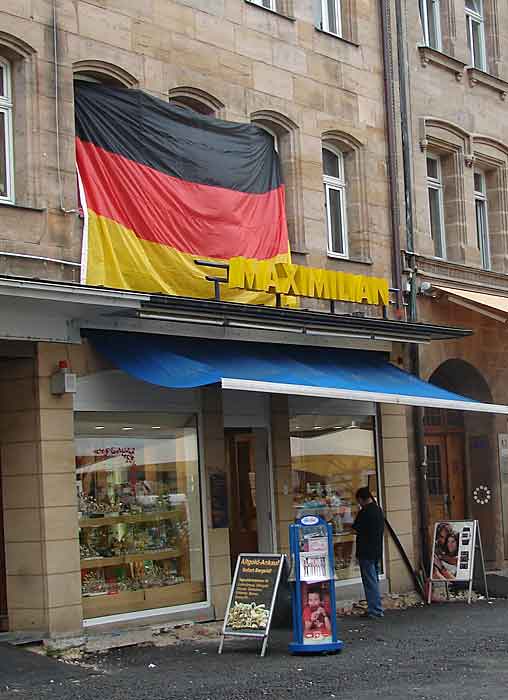
I know I turn on the TV too often and expect too much of TV newscasts. But at present the programme consists almost exclusively of observing our boys in Switzerland or Austria. On Monday there was a discussion of what the weather might be like on Wednesday. More than once I’ve heard ‘Einmal (zweimal) werden wir noch wach …’, which usually refers to how many days before you can open your Christmas presents.

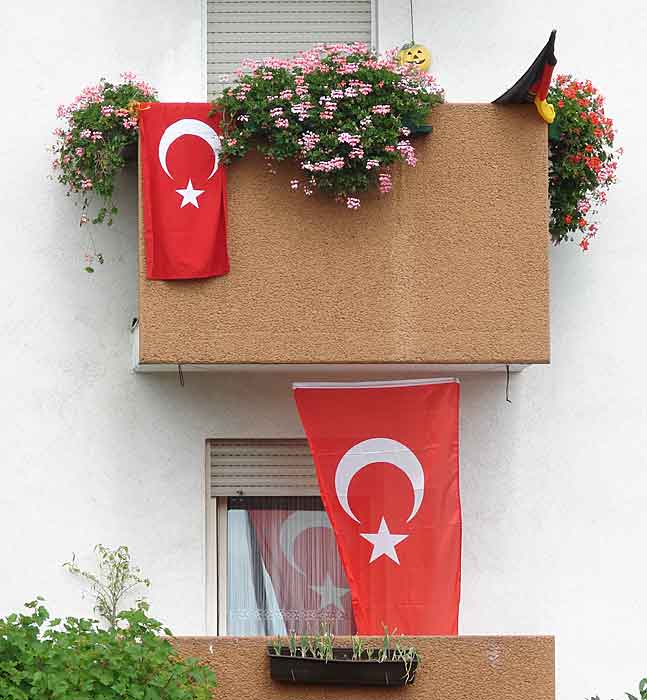
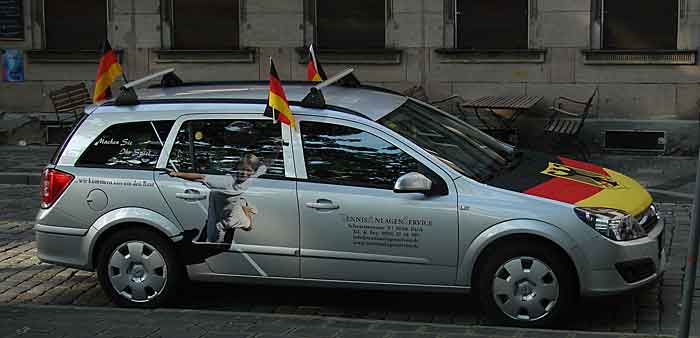
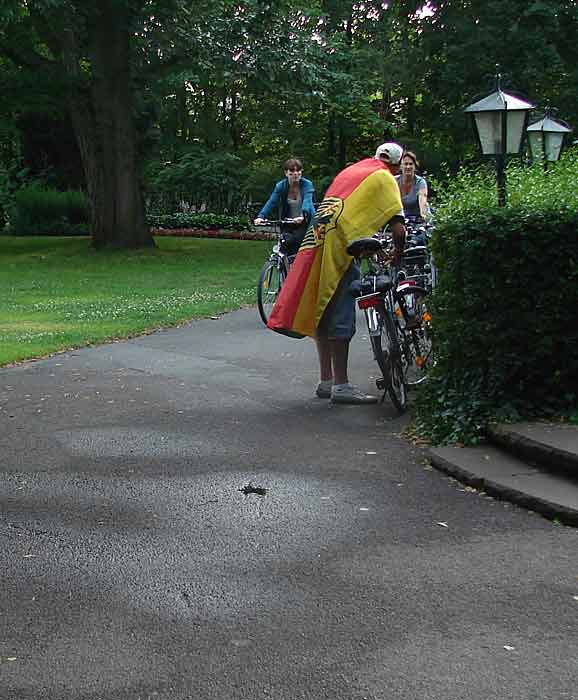
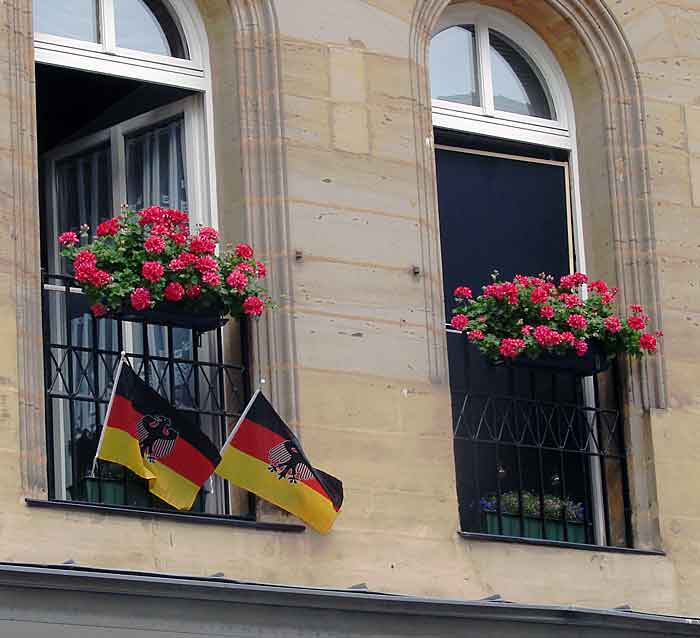
The war of the flags is heating up. Cars with German and Turkish flags are those of Turks.

According to Wikipedia, those two flags are tolerated, for example in support of Germany at sports events:

Ihnen ist die Verwendung des Bundeswappens sowie des Bundesschildes und der Bundesdienstflagge untersagt. Trotzdem trifft man häufig auf Flaggen, die der Bundesdienstflagge ähneln, aber statt des Bundesschildes das Staatswappen Deutschlands in der Mitte führen. Die Benutzung dieser inoffiziellen Flaggenvariante – sie hat in ihrer Form zwar keinen hoheitlichen Charakter, könnte jedoch irrtümlich für die selbige gehalten werden – wird geduldet, sofern sie ein Ausdruck nationaler Verbundenheit mit der Bundesrepublik Deutschland darstellt (z. B. bei sportlichen Großveranstaltungen).