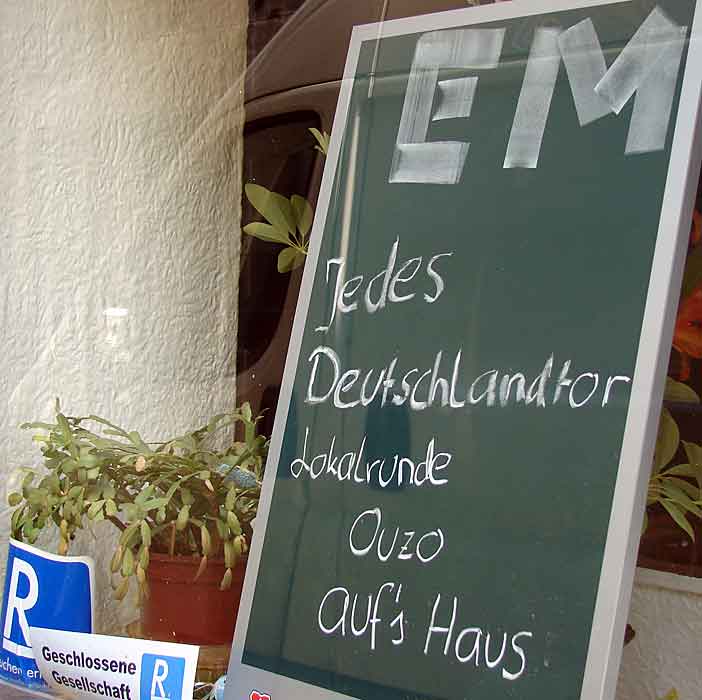
Britain and war/Krieg und Militarismus in Großbritannien

H. Gustav Klaus and Christian Schmitt-Kilb find Britain is obsessed with war. It’s always the British war cemeteries on the Continent that are best looked after (mind you, every year or two a tin is rattled at me to contribute to German war graves, the equivalent of which I have never encountered in Britain:

Just how present war is in British intellectual debate can be gauged by browsing
through the Times Literary Supplement. One hesitates to speak of an obsession, but
not a week passes without a book on the subject of war being reviewed. No non-
specialist German weekly or monthly comes to mind that would cover the subject
so continually. The plethora of books published year in year out ranges from
military to counterfactual history, from biographies to diaries and letters of military
leaders, from reportage to photojournalism. It includes historical fiction and (anti-)
war poetry. But the fascination with war also manifests itself in museums and
historical pageants, the performing arts, photography, film and television, memori-
als and Remembrance Day(s).

Volume 14, No. 1, Journal for the Study of British Cultures html, PDF.

The TLS took them up on this on the back page, on October 5 2007 (probably not online):

Using the past twenty issues of the TLS as a representative sample, we checked and were initially surprised to find that Klaus and Schmitt-Kilb are largely correct. They will doubtless be sighing into their schnapps over the cover picture of Adolf Hitler (September 21), which appeared long after the Journal went to press. “No non-specialist German weekly or monthly comes to mind that would cover the subject so continually.” War, inseparable from Britain’s rise as “Great”, is just as closely linked to its decline.

Far be it from us to suggest other reasons why German weeklies do not dwell on the subject, but as to the TLS’s role, we are bound to point out that “the subject of war”, in its widest application, is tantamount to the subject of history. Does a review of The Disinherited: The exiles who created Spanish culture (August 3) count as a piece about “the subject of war”? Since the reviewer mentions the “socialists, republicans” and other who were “checked by Franco’s ‘crusade’ during the Civil War”, it must do. The lead article in the TLS of May 18 was a review of Cultural Responses to the Persian Wars; in the May 25 issue, there was a piece of several books about the American West, including one on the Sioux warrior Crazy Horse, “the decisive tactician in Custer’s deafeat”. It’s not an obsession; just us doing our duty.

Ballack clause/Ballack-Klausel

At the end of May, Michael W. Felser blogged about the ‘Ballack clause’ in the prospective Arbeitsvertragsgesetz (Employment Contract Act). He quoted the FTD of that date.

At present, he writes, German employment law comprises 30 to 60 statutes, and this bill is to consolidate those into one 32-page statute. Now a clause relating to high earners is being criticized and may result in the whole being rejected.

Das Arbeitsvertragsgesetz, dass das gesamte deutsche (Individual-)Arbeitsrecht auf 32 Seiten zusammenfassen und dabei die bisher geltenden 30 bis 60 Arbeitsgesetze ersetzen soll, steht erneut in der Kritik, diesmal von Führungskräften. Schuld ist die Ballack-Klausel, die Unternehmen Abweichungen von dem im Arbeitsvertragesetz geregelten Rechten bei Leitenden Angestellten und anderen Topverdienern erlauben soll, berichtet die Financial Times heute.

The clause, so referred to by its creators, provides that high earners may be exempted – to their disadvantage – from some provisions of employment law. The definition is earning between 125,000 and 150,000 euros per year, which is criticized as too low for an employee really to be on equal terms with the employer. The term Ballack clause is a bit iinappropriate, as Ballack earns that amount per week rather than per year. FTD:

Kritiker, an vorderster Front der Deutsche Führungskräfteverband, poltern heftig gegen das Vorhaben. In Mitgliedzeitschriften und auf Anfrage stellt sich der Verband klar gegen eine Umsetzung der Ballack-Klausel. Zumindest gehaltstechnisch spiele der Namensgeber Michael Ballack in einer ganz anderen Liga als die ins Visier genommenen Topverdiener.

Nach Schätzungen der englischen Presse verdient der Kapitän der deutschen Nationalmannschaft bei Chelsea umgerechnet etwa 153.000 Euro. Pro Woche wohlgemerkt. Damit sei der Fußballspieler ohne Frage wirtschaftlich unabhängig, heißt es im Führungskräfteverband. Für einen Angestellten, der 150.000 Euro im Jahr verdiene, gelte das aber gerade nicht.

The clause is § 148 Abs. 2 ArbVG-E.

§ 148 ArbVG Abweichungen vom Gesetz

Absatz 2: “Arbeitnehmer, deren Entgelt das Fünffache der Bezugsgröße nach § 18 des Vierten Buches Sozialgesetzbuch übersteigt, können mit ihrem Arbeitgeber von den §§ 31, 41, 42 Absatz Satz 2, 49, 51, 59, 64, 130 abweichende Vereinbarungen treffen. Sie können mit ihrem Arbeitgeber außerdem vereinbaren, dass der Antrag nach § 119 Absatz 1 keiner Begründung bedarf.”

The project is being supported by the Bertelsmann Stiftung.

Online translation/After Party

Online translation can be very helpful to give a gist, but I am told that a non-German speaker recently wanted to understand these details about a concert in Zurich:

Eröffnungsfeier mit Noëmi Nadelmann, Melanie C und einer After Party
Im Anschluss spielt das Zürcher Kammerorchester mit der Sopranistin Noëmi Nadelmann unter der Leitung von Muhai Tang. Nach einem kurzen Showprogramm folgt um 22.00 Uhr das Konzert der Sängerin Melanie C. Dazwischen verlost das Schweizer Fernsehen Tickets. Nach dem Konzert sorgt ein DJ bis zum Festende um 02.00 Uhr für Stimmung.

Thus the results:

Opening ceremony with Noëmi needlemaker, Melanie C and an anus party
In the connection the Zurich chamber orchestra with the soprano Noëmi needlemaker plays under the direction of Muhai seaweed. After a short show program follows at 22.00 o’clock the concert of the singer Melanie C. Dazwischen the Swiss television draws lots for tickets. After the concert a DJ provides up to the festival end at 02.00 o’clock for mood

I think Ms. Needlemaker and Mr. Seaweed got off lightly here.