Transblawg is seven years and three days old today. Sorry about the slow posting. None of my three readers reminded me. However, a description of a different birthday celebration, at the restaurant Essigbrätlein in Nuremberg, will follow (with pictures).
Monthly Archives: April 2010
Collocation dictionaries/Kollokationswörterbücher
There is a new edition of the BBI Combinatory Dictionary of English available, 24 euros for the paperback. Here is a PDF workbook which gives a good impression of the contents.
According to the John Benjamins Book Gazette, the new edition has 20% more material. It looks to me as if it has much more information on BE/AmE differences.
I had meanwhile gone over to the Oxford Collocations Dictionary. (amazon lets you look inside). That seems larger, and it has some pages summarizing differences which might be useful for foreign learners. In the middle, it also has some workbook pages it describes as ‘photocopiable’, which I suppose means free to use in class without copyright considerations.
Since I only use these books occasionally to get an idea for a verb combination, I appreciate the fact that I have found them both reliable and full.
The first edition used to be available online, but if anyone is looking for an online collocations dictionary (the search words that most frequently bring people to this site), Mark Davies’ page at Brigham Young University is the way to go.
As for German collocations, if you search for a word in DWDS, it will show you some collocations too.
Thermal baths/Therme-Schwimmbad

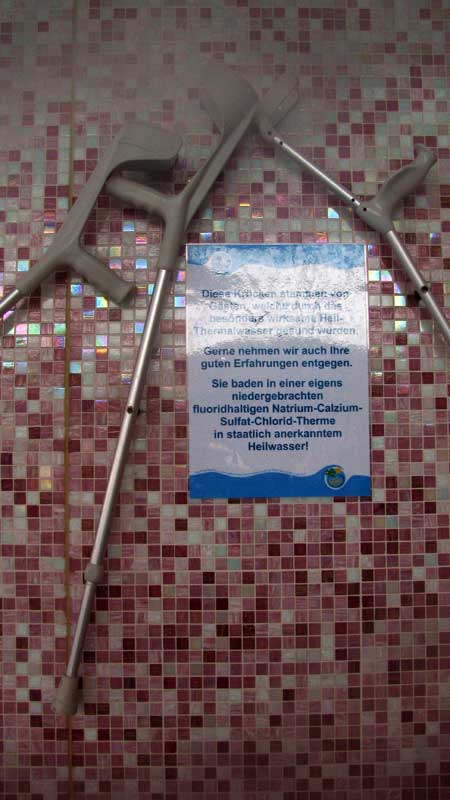
Diese Krücken stammen von Gästen, welche durch das besonders wirksame Heil-Thermalwasser gesund wurden.
Gerne nehmen wir auch Ihre guten Erfahrungen entgegen.
Sie baden in einer eigens niedergebrachten fluoridhaltigen Natrium-Calzium-Sulfat-Chlorid-Therme in staatlich anerkanntem Heilwasser!
Apologies for infrequent posting. Sometimes my time is taken up with considerations of my health. Mind you, I have not got any crutches to give them. I could offer my Nordic walking poles, but I’m not sure what kind of message that would send.
(Btw, this is not Fürthermare)
Street cleaning week/Kehrwoche
You can do a course on how to do your bit in street cleaning week in the Ostfildern Volkshochschule (I associate this with Baden-Württemberg):
Samstag, 17. April
10:00 Uhr, VHS an der Halle, Nellingen, Esslingerstr. 26
Kehrwoche for beginners A1
Veranstalter: Volkshochschule OstfildernThis course is designed for people from abroad who have recently arrived in Suabia or have been here for a while, but are not yet familiar with the Swabian tradition of the cleaning week (“Kehrwoche”). This could lead to cultural misunderstandings. Your landlord/-lady might have give you negative feedback on the way you do your Kehrwoche, for example, and you just don’t understand why, and because he speaks in dialect you don’t understand him, either. We will deal with the following aspects: – historical aspects: the origin of the Kehrwoche – tools and equipment (“Kutterschaufel und Kehrwisch”) – rules and standards (what to clean, best time to do the cleaning week, “big” and “small” cleaning week) – vocab and definitions (Kandel etc.) – how to become a Kehrwoche specialist/insider’s knowledge (e.g. how to make as much noise as possible so everybody notices you’re doing it) If you want to, you can bring your own equipment. The trainer will then tell you if it’s adequate. The course will be held in English and German.
(Via vowe.net)
Football hooligans/Ein Hool
One of Werner Siebers’ clients is a football fan:
Der Mandant ist Fußballfan; nicht Hardcore, nicht Ultra, kein Hool, aber mit Überzeugung.
On Google, there are about 1480 ghits for “ein hool site:de”. It seems to be an abbreviation of hooligan.
I don’t know how long this has been around. There is a 2009 song ‘Meine Mutti ist ein Hool‘, but whether that invented the term, I don’t know.
Easter customs in the UK/Osterbräuche in England
From Süddeutsche Zeitung:
Kätzchen-Tätschler in Großbritannien
In Großbritannien berühren sich die Menschen gegenseitig mit gesammelten Weidenkätzchen, das soll Glück für das nächste Jahr bringen.
‘(At Easter) In Great Britain, people touch each other with pussy willow branches to bring luck for the coming year.’ (Kätzchen: catkins)
Highly mysterious.
It also says, apparently correctly, that in Australia, chocolate bunnies are sometimes replaced by chocolate bilbies – the bilby is a rabbit-sized marsupial which was a victim of the plague of rabbits. See the At the Elephant blog. Mind you, the chocolate rabbit is more of a German thing. I have heard of people in Upminster buying chocolate rabbits at Aldi, though.
Here’s another curiosity from a site in global English:
As a part of Easter tradition, there is a trend among British people to eat yummy hams, in order to commemorate the Easter Sunday.
Surely it takes more than three days to make a ham?
The same site refers to unisex Easter bonnets:
For offering prayers in the church, men and women dress up in their special outfits and as a part of their wardrobe, colorful Easter bonnets embellished with flowers is like a must.