Continental law/Kontinentaleuropäisches Recht

Like common law (of which more shortly), civil law is a term with more than one meaning.

1. civil law in contrast to criminal law: private law (Zivilrecht)

2. civil law in contrast to common law: a legal system based on Roman law (ius civilis – römisches Recht, kontinentaleuropäisches Recht)

The second meaning can confuse people who’ve never heard of it. One can call it Roman law, but that’s confusing too, because it might mean the law of ancient Rome rather than that of systems based on it.

Hence we have the relatively rare term continental law. It has the advantage of being comprehensible.

Now, Germany and France recently joined together in the ongoing campaign to show the world that civil law is best, and everyone ought to come to the German and French courts and draft German and French contracts and everything will be better.

There was an article to this effect in the FAZ on February 1.

Verglichen mit dem angelsächsischen Recht leidet das kontinentaleuropäische Recht unter einem Wahrnehmungsproblem: In den letzten 20 Jahren wurde es immer wieder als unflexibel, bürokratisch, wirtschaftsfeindlich und teuer dargestellt. Zu Unrecht, wie sich bei näherer Betrachtung zeigt. Die juristischen Berufsorganisationen Deutschlands und Frankreichs haben daher eine „Initiative für kontinentaleuropäisches Recht“ gegründet.

(Compared with common law, continental law suffers from a problem of perception: in the past twenty years it has repeatedly been described as inflexible, bureaucratic, inimical to business and expensive. Wrongly, as a closer look shows. The professional lawyers’ organizations of Germany and France have therefore initiated an ‘Initiative for Continental Law’.)

Note the use of angelsächsisches Recht for common law. I recall an employer wanting to describe me as an expert in Anglo-Saxon law, but I felt too young for it.

The arguments for continental law as opposed to common law appear compelling (in view of the authors –

Henri Lachmann (Präsident der Fondation pour le droit continental), Rechtsanwalt Axel C. Filges (Präsident der Bundesrechtsanwaltskammer), Notar Dr. Tilman Götte (Präsident der Bundesnotarkammer), Rechtsanwalt Prof. Dr. Wolfgang Ewer (Präsident des Deutschen Anwaltvereins), Notar Dr. Oliver Vossius (Präsident des Deutschen Notarvereins), Oberstaatsanwalt Christoph Frank (Vorsitzender des Deutschen Richterbundes)

they would say that, wouldn’t they?):

codified, so law is easy to find
application is predictable
procedural law is efficient and proceedings are cheap
good at protecting property
hmm – number 5 is ‘Nicht zuletzt ist kontinentales Recht ein Recht der Freiheit. Effizient, kostengünstig, sicher’ – a law of freedom? I think we’re getting into advertising language here.

The article expands on this. Thus if you use the common law, you have to burrow your way through the decisions of many centuries, whereas continental law, with its codes, gives you a ‘checklist’ (a new way of looking at the BGB, or do they mean the French, Austrian or Swiss civil codes?). I take the point about contracts backed up by codified law being simpler and shorter. And about a reliable system of registration.

What’s more, the article continues, continental law cannot be reduced to economics. It has a political mission.

Unser bürgerliches Recht haben sich Bürger gegen absolutistische Fürsten und Feudalherren in Jahrhunderten erkämpft.

I think the French got the upper hand here!

This initiative has a brochure, and I downloaded it in German and English at www.kontinentalesrecht.de. I expect there’s a French version too. This is the related site.

One exciting bit of the brochure is the map of the world. It shows, in mustard yellow, ‘Continental law and mixed legal systems strongly influenced by continental law’ and in blue ‘Other legal systems’. That blue almost fades into the sea. We can see how huge the continental law countries are – they include Louisiana and Quebec. Greenland is pretty big. Then there’s the whole of Russia, China, and nearly all of South America – all great places to get your simple legal contracts backed up by a reliable code, of course. It says ‘Continental law is the prevailing law for two-thirds of the world’s population.’

There is more to be said on this, of course. Probably a big reason for the ‘Dornröschenschlaf’ (it’s a Sleeping Beauty) of continental law is the lack of a common language that isn’t English.

The Lost German Slave Girl/Eine Deutsche als Sklavin in Louisiana?

Here is yet another gratuitous book report.

The Lost German Slave Girl. The Extraordinary True Story of Sally Miller and Her Fight for Freedom in Old New Orleans, by John Bailey, Atlantic Monthly Press 2003

This book was a present from my friend and fellow-translator Karen in Denver (thanks, Karen!). I read it quite a few weeks ago, so my report is rather vague now.

John Bailey is an Australian lawyer who has now turned to writing, and he discovered this story when he was researching the details of law relating to slavery in Louisiana. Sally Miller was the ‘lost German slave girl’, who won a case freeing her from slavery because a person who was Caucasian could not be a slave. It’s a fascinating story and it throws some light on the situation of slaves who could not be freed from slavery. There’s also a fair amount about the circumstances in which the Müller family from the Alsace emigrated to the USA, following years of pillaging by French troops, bad harvests and ice in summer (apparently resulting from volcanic eruptions in the West Indies, the Philippines and Indonesia from 1813-1816 – so tonight I will be watching the arte documentary on ‘The year without a summer’).

From an interview with John Bailey:

My plans unraveled, when one day, in the quiet corner of a law library on a university campus in Louisiana, as I struggled to bring some semblance of order to my unruly and ever expanding manuscript, I opened a volume of the Louisiana law reports for 1845. There I met Sally Miller, the Lost German Slave Girl. I was immediately enthralled by her story. By the end of the day, I had shoved my notes on lawyers, judges and politicians into my bag, and opening a fresh page in my diary, had began to jot down ideas for an entirely different project – this one, on the saga of Sally Miller’s bid for freedom.

One feature of the book is that while it cloaks the story in mystery – the witnesses in the trial are obviously long dead – at the same time it often knows exactly what the weather was like or what the main characters were thinking. This is part of the genre ‘bringing history to life’, I think. For a long time I was convinced that I was never going to know anything more about the truth or falsity of the story, but in fact more information was revealed at the end, which made the end of the book more satisfying than I had expected.

A bit of research on the Internet revealed that the story has been told before. Curiously, there is a 2007 American book on the subject, which looks similar to Bailey’s: The two lives of Sally Miller: a Case of Mistaken Racial Identity in Antebellum New Orleans, by Carol Wilson. You can read quite a bit of this on Google Books.

Minor criminal offences/Bagatelldelikte

Can anyone tell me what criminal offence is to be reported to the police here?

These people must have been very angry for a long time. One is almost tempted to give them the Sonntagsblitz (an advertising paper with some local news, produced I think by the Nürnberger/Fürther Nachrichten).

Here are some less angry people:

See earlier entry on Communicating with the postman.

The other most stupid book you read as school reading/Das andere blödeste Buch, das du während der Schulzeit als Lektüre gelesen hast

I know this meme is getting really boring, and I should not go back and repeat an earlier entry, but I forgot I wanted to rant about a long poem, rather than a book, that I think we did for O Level. It was a poem by Gerard Manley Hopkins called The Wreck of the Deutschland.

I never really ‘got’ Gerard Manley Hopkins, but I understood we are suppose to venerate him and recognize his brilliant originality in devising stuff like sprung rhythm. I couldn’t even appreciate this much in short poems.

You can get an impression of this work on youtube nowadays. I must say this brings back all the negative feelings I felt then. Here is the text (beginning – it gets quite long):

To the happy memory of five Franciscan Nuns exiles by the Falk Laws drowned between midnight and morning of Dec. 7th. 1875

PART THE FIRST

1

THOU mastering me
God! giver of breath and bread;
World’s strand, sway of the sea;
Lord of living and dead;
Thou hast bound bones and veins in me, fastened me flesh, 5
And after it almost unmade, what with dread,
Thy doing: and dost thou touch me afresh?
Over again I feel thy finger and find thee.

I didn’t know about the Leytonstone connection, though.

A book from which you would read to your children/Ein Buch, aus dem du deinen Kindern vorlesen würdest

Possibly something I liked myself, such as The Heroes of Asgard, by Annie Keary. You can get it as a book or see bits here.

[41] IN the beginning of ages there lived a cow, whose breath was sweet, and whose milk was bitter. This cow was called Audhumla, and she lived all by herself on a frosty, misty plain, where there was nothing to be seen but heaps of snow and ice piled strangely over one another. Far away to the north it was night, far away to the south it was day; but all around where Audhumla lay a cold, grey twilight reigned. By-and-by a giant came out of the dark north, and lay down upon the ice near [42] Audhumla. “You must let me drink of your milk,” said the giant to the cow; and though her milk was bitter, he liked it well, and for him it was certainly good enough.

Photos/Fotos

I have been slow to post recently, but I did spend two days attempting to update my weblog software, until fortunately the problem was solved and the work done by Garvin Hicking, who is the Serendipity developer, with the help of the user Timbalu, who first realized that the MySQL database on my provider’s site was extremely ancient and the mysterious feedback I was getting, e.g. suggesting I increase permissions on subdirectories I could not even see, resulted from MySQL being unable to cope with the data. My fault, no doubt, as I had not updated since 2007.

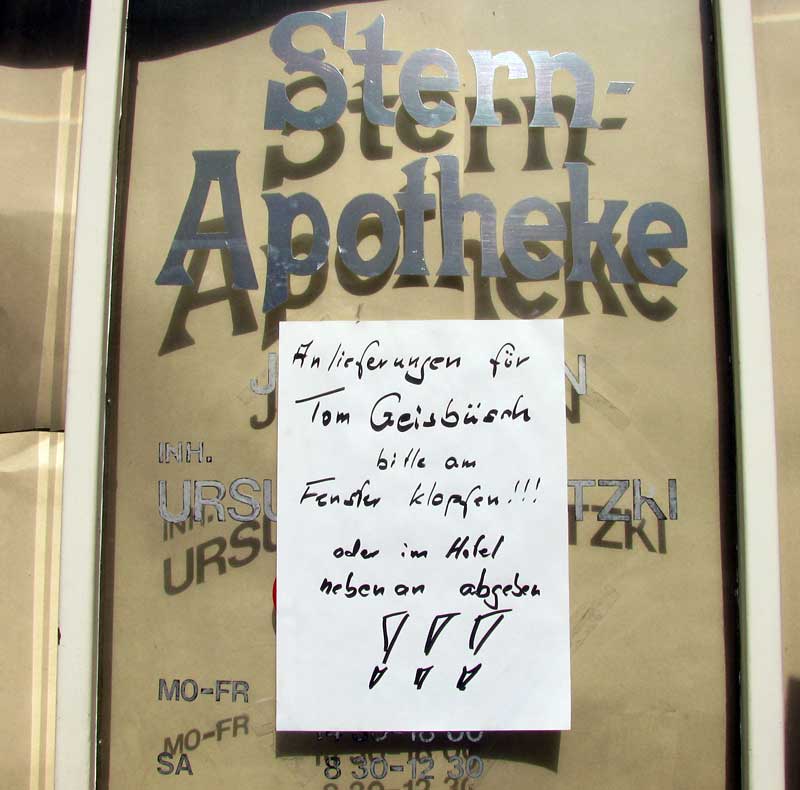
To make up for the silence, here is a photo taken in Fürth last week.

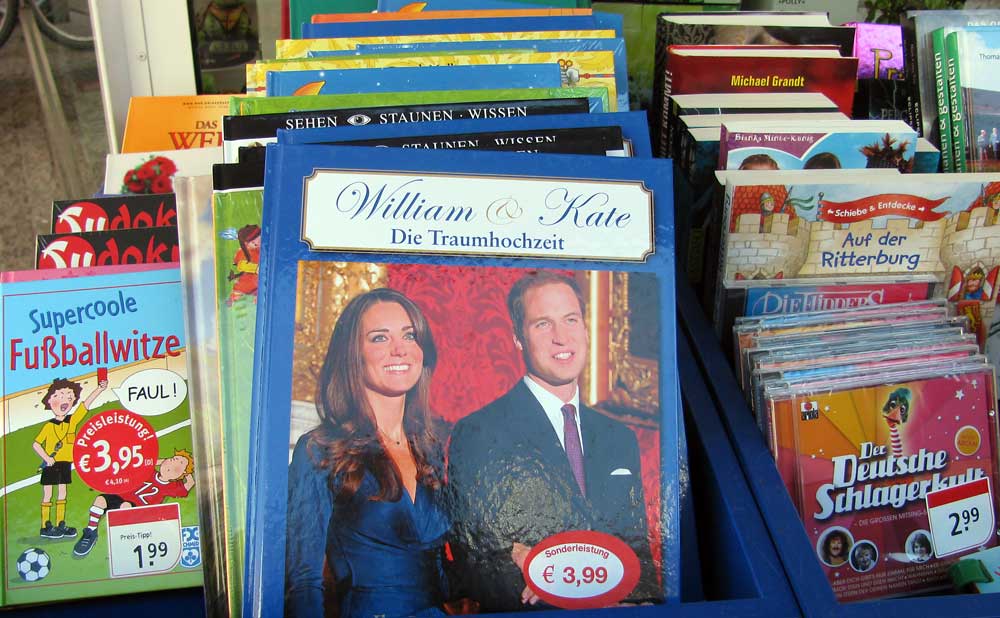
Although I haven’t heard mention of the royal wedding in my many phone calls with the UK, I gather from the German press that everyone in the UK is really excited about it. If so, you might consider the book Knit Your Own Royal Wedding (amazon.de, Daily Telegraph).

Here is a picture of a bookstand at Erlangen station. Things were not like this twenty years ago:

Now an example of new German, in case you are out of touch:

And finally, taken this morning, part of a flea market outside the TV shop run by Ingomar Schnatzky: